
Where to actually play pokies in Tasmania this year
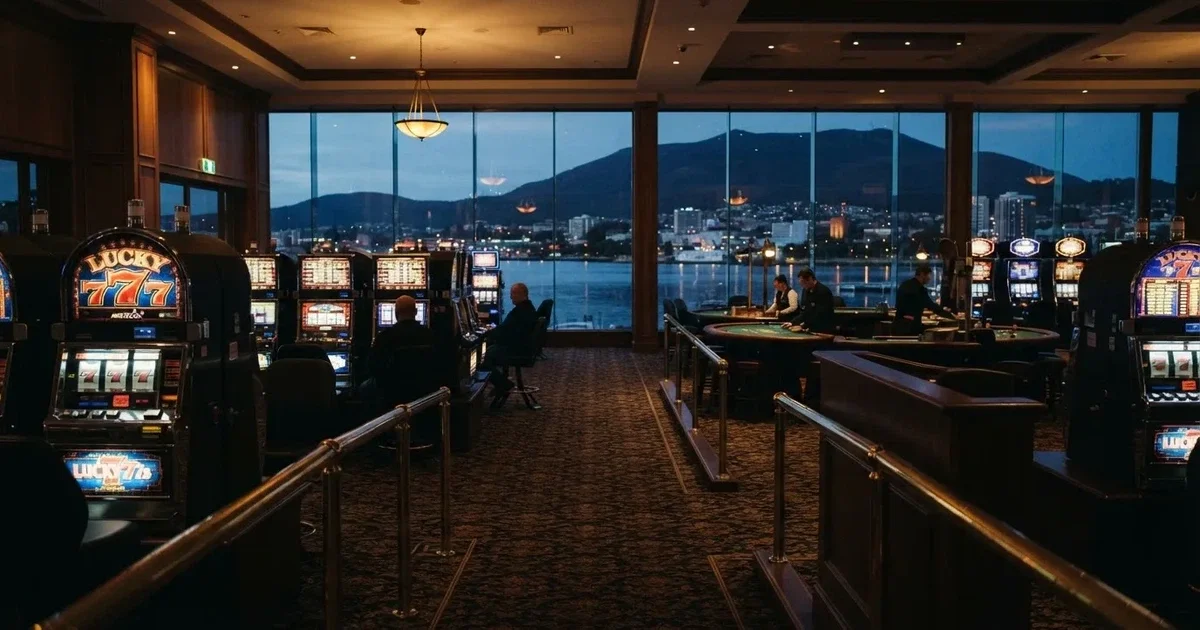
The straightforward reality of playing pokies in Tasmania sits on the ground, not on a screen. Tasmania has two licensed casinos — Wrest Point in Hobart and the Country Club Casino and Resort in Launceston — and a network of pubs and clubs that hold their own machine entitlements under the Gaming Control Act 1993. Every electronic gaming machine on the island runs through that framework. Online casino games, online pokies and in-play betting cannot be licensed for anyone in Australia under the Interactive Gambling Act 2001, whatever the offshore site says about Curaçao or Kahnawake on its footer. The page below walks through what is licensed in Tasmania, what changes the cashless gaming card brought in from December 2025, and the eleven offshore brands the ACMA has named in formal warnings since 2022 — the reader who searched for Tasmanian pokies and the reader who ends up at one of those sites are the same reader, and the two answers are not interchangeable.
Data current as of 28 October 2026, cross-checked against the Australian Communications and Media Authority’s formal warning register and the Tasmanian Liquor and Gaming Commission’s public material.
Table of Contents
- Tasmania’s pokie floor and the rules that shape it
- The cashless gaming card: what it sets, what it doesn’t
- Responsible gambling: where a Tasmanian player actually picks up the phone
- How a session at a Tasmanian pokie venue actually runs
- Payments at licensed Tasmanian venues versus an offshore site
- How a shortlist of Tasmanian pokie venues actually gets put together
- What the rest of Australia looks like by comparison
- The eleven offshore brands the ACMA has named
- How the ACMA’s blocking rate has run
- Frequently asked questions about pokies in Tasmania
Tasmania’s pokie floor and the rules that shape it
The licensed pokie market in Tasmania is a closed one in a specific sense: only two casinos may run EGMs at casino scale, and outside them a finite pool of pub and club entitlements has been issued. Federal Group, which began life as the Federal Coffee Palace Company Limited in Melbourne in 1885, ran the exclusive machine licence for venues outside its casinos under the Gaming Control Act 1993 until August 2017, when it gave up the monopoly and individual pubs and clubs were allowed to hold their own entitlements. The Farrell family took majority ownership of the holding company by 1989 and privatised the group in 1990; it remains Tasmanian family-owned.

Wrest Point opened on 10 February 1973 as Australia’s first legal casino. The Country Club followed in 1982, its design modelled on the stately homes of the American South in a Georgian style chosen for the rural landscape around Launceston. Both properties sit inside Federal Group’s licence structure. In the year to 30 June 2018, Mulawa Holdings — the part of the group that carries the Tasmanian gambling licence — reported profit nearly doubling from A$13.9 million to A$24.4 million on revenue of A$543 million, while paying about A$75 million in gaming taxes and licence fees to the Tasmanian government.
The pub and club network outside the two casinos operates under its own licence regime. The Tasmanian Liquor and Gaming Commission is the regulator, the same body that oversees the new cashless card system that came in for hotel and club pokies from December 2025.
The cashless gaming card: what it sets, what it doesn’t
From December 2025, every hotel and club poker machine in Tasmania operates on mandatory carded play. The reform is the most consequential change to the state’s pokie floor in a generation, and it sits next to the player in three specific numbers. The default loss limits are A$100 per day, A$500 per month and A$5,000 per year. A punter can raise any of those limits, but only after a minimum 24-hour wait — the cool-off is statutory, not optional, and it applies to every increase.
The card also pre-empts the part of the night that used to go on cash. Pre-December-2025 behaviour at a pub or club was, in practice, a person feeding notes into a machine; from the rollout, every machine takes the player’s card and reads the limits off it. The Tasmanian Liquor and Gaming Commission oversees the system. As of September 2024, no rollout date had been set for the casino floor — Wrest Point and the Country Club — and that gap between hotels and clubs on one side and the two casinos on the other has been a standing feature of the public debate since.
The limits are ceilings. Most players will never approach the annual cap, and the daily ceiling is well above what a casual session spends. The reform’s bite is in two places: the player who has decided to stop and now has a system-enforced reason to wait before changing their mind, and the venue that used to absorb a session in cash and now has to keep records.
Responsible gambling: where a Tasmanian player actually picks up the phone
Gambling Helpline Tasmania runs the local service, on 1800 858 858, free and answered around the clock. The line is staffed by Anglicare Tasmania’s Gamblers Help Service and can help arrange venue self-exclusion — the formal ban that stops the named player from being admitted to a specific venue or, for some venues, a chain of venues. In-person counsellors are based in Hobart, Launceston, Devonport and Burnie. The national helpline sits behind the same number and routes to the same service, with online chat at Gambling Help Online.
BetStop, the National Self-Exclusion Register, has been live since August 2023. It binds the wagering services that hold an Australian licence — online and phone sports and race bookmakers licensed in the Northern Territory, plus the licensed lotteries and keno operators — but it does not bind an offshore casino. A player who self-excludes through BetStop and then opens an account at an offshore site is not on a register that the offshore site reads. That is the structural reason the ACMA’s blocking programme and its formal warnings run in parallel with BetStop rather than as substitutes for it.
How a session at a Tasmanian pokie venue actually runs
A player at a Hobart pub or a Launceston club inserts their card, chooses a machine, and plays against a return-to-player rate that varies by title and venue but sits within the state’s regulatory floor. The cashless system records the session against the player’s daily and monthly caps. A player at Wrest Point or the Country Club runs on the casino’s own system; until a casino rollout date is set, that system is not the carded one used in hotels and clubs.
Identification is required before play at the casino floor — the two Tasmanian casinos operate under the same federal identity checks as every other Australian casino — and at hotels and clubs a carded session is, by definition, identified. The limits above travel with the card. A player who has raised a daily limit and arrived at a different venue cannot spend the difference there; the limit sits at the player, not the venue.
Withdrawals at the casino cage are paid in cash, in line with the venue’s published payout times. Payout percentages across Australian states vary; Tasmania’s machines operate within the regulatory floor the Tasmanian Liquor and Gaming Commission sets, and the headline figure for any single machine is on the machine’s help screen, not on the venue’s marketing.
Payments at licensed Tasmanian venues versus an offshore site
Inside the licensed system, a player funds a session with cash or, from December 2025, with the cashless card at hotels and clubs. At the two casinos, the casino cage takes cash and, for some player segments, debit transactions tied to the casino’s own account systems. The cashless card is a Tasmanian-jurisdiction product, not a payment network in the ordinary sense — it does not accept a credit card and does not accept a digital currency deposit, because both are banned as payment for licensed online wagering in Australia as of 11 June 2024, with penalties up to A$247,500 for operators.
An offshore site asking for a credit card or a crypto deposit from an Australian player is therefore not just unlicensed — it is using payment methods the Australian rules do not allow for licensed wagering. A player who has put money in through one of those routes has no Australian consumer protection, no complaints body, and no recourse if the site refuses a withdrawal. The balance can also be stranded if the ACMA directs Australian ISPs to block the site, which has happened to 1,751 illegal gambling and affiliate marketing websites since the first blocking request in November 2019.
The pace of that enforcement has not slowed. In the round reported on 26 June 2026 the ACMA asked Australian ISPs to block another 12 sites: 7Signs, ChromaBet, Donbet, Duospin, Freshbet, Slots Gem, Jacks Club, Lucky Start, Pointsbetz, Spinrise, Vinyl Casino and Wildsino. The blocking programme is the operational edge of a prohibition that has been statute since 2001 and was tightened in 2017.
How a shortlist of Tasmanian pokie venues actually gets put together
Any honest shortlist of pokie venues in Tasmania sorts on a small set of criteria, and the order matters. The first cut is licence status — is the venue on the Tasmanian Liquor and Gaming Commission’s register, and does it operate under the Gaming Control Act 1993? A venue that does not clear that cut is not in the set, regardless of how many machines it runs.
The second cut is access to the venue’s published payout percentage. Australian pokie machines display the return-to-player rate on the help screen, and a venue that has chosen newer machines, or machines from a provider with a higher floor, will sit above the regulatory minimum. The headline RTP figure on the venue floor is the one that counts; the marketing figure on the venue’s website is the one to ignore.
The third cut is hours. Tasmania does not have a 24-hour pokie venue by default — pub and club hours are governed by the venue’s liquor licence and the state’s trading hours, and a venue advertising itself as 24-hour should be checked against the actual posted hours. The two casinos run extended hours by virtue of their casino licences, but neither is a 24-hour gaming floor in the sense a reader from a different market might assume.
The fourth cut is the player’s own situation: the cashless card’s daily cap at A$100, the monthly cap at A$500, the annual cap at A$5,000, and the 24-hour cool-off on any increase. A venue that suits one punter’s pattern may not suit another’s. The point of a shortlist is to put a venue in front of a player whose pattern fits, not to crown a winner.
What the rest of Australia looks like by comparison
Tasmania’s two-casino structure sits inside a wider Australian landscape that varies state by state. South Australia has a single licensed casino, Adelaide Casino (commercially SkyCity Adelaide), inside the heritage-listed Adelaide railway station building on North Terrace, with 90 gaming tables and 950 gaming machines. South Australia sets a minimum gaming-machine RTP of 87.5% and a general maximum bet of A$5 outside the casino, while the casino itself has no maximum-bet limit. Outside Adelaide Casino, South Australia had 11,672 gaming machines across 471 venues in September 2023, and the state’s outside-casino machine losses totalled about A$0.92 billion in 2022-23, equivalent to about A$497 per adult.
Brisbane’s Treasury Casino, operated by Star Entertainment Group, closed on 25 August 2024 to make way for the new Star casino at Queen’s Wharf. The Star Brisbane began a staged opening at the A$3.6 billion Queen’s Wharf precinct on 29 August 2024, with the main casino floor and premium gaming rooms opening first. Queensland had 21,122 gaming machines in 351 venues in October 2023. The Queensland Government, acting on an independent review by former Court of Appeal judge Robert Gotterson, found Star Entertainment unsuitable to hold its Queensland casino licences in late 2022 after concluding it had misled regulators and failed its anti-money-laundering duties; Star was fined $100 million on 9 December 2022, with a 90-day suspension of the Treasury Brisbane and Star Gold Coast licences deferred to 1 December 2023 to allow remediation.
The point of the comparison is not to elevate one state’s regime over another. It is to give a Tasmanian reader a sense of where their two casinos and their hotel and club network sit in the national picture. Tasmania’s two casinos are small by national standards; the cashless card regime is now the most consequential player-protection reform on the country’s pokie floor; and the pub and club network outside the two casinos is denser than the equivalent networks in some larger states.
The eleven offshore brands the ACMA has named
The brands below are not a recommendation. Each appears because the ACMA itself issued a formal warning over it for offering prohibited online casino services to people in Australia. The page lists them in the order research gives, with the date of the warning and the operator the ACMA named. No bonus terms are given — the only sources for those terms were affiliate marketing pages, and they are not the basis on which a reader should judge whether to play.
The same caveat runs through every entry: online casino games cannot be licensed anywhere in Australia under the Interactive Gambling Act 2001, whatever licence the site displays in its footer. An Australian player at any of these sites is playing on an offshore service with no Australian consumer protection, no Australian complaints body, and the prospect of the site being blocked with a balance still on it.
RocketPlay
The ACMA issued a formal warning to Pulsup Ltd over Rocketplay in March 2026. Dama N.V. had earlier been warned over the same brand in May 2022, as part of a round that covered six Dama brands at once. The brand’s continued operation under a sequence of operator names is the pattern that recurs across this list: the site stays open, the corporate wrapper changes, the ACMA names the new wrapper.
Level Up Casino
The ACMA warned Dama N.V. over Level Up Casino in May 2022, in the same six-brand round that covered Bambet, Dazard, Rocketplay, Wild Tornado and Cobra Casinos. The brand surfaces on a handful of public listings — the same name appears in the encyclopaedic compilations and in the Victorian regulator’s register — but those listings are directory entries, not endorsements, and they do not change the underlying prohibition.
Woo Casino
The ACMA issued a further formal warning to Dama N.V. over Woo Casino in March 2025, three years after the first round. The name appears in the standard reference compilations. A reader who lands on Woo Casino from a search for Tasmanian pokies will be on a site the Australian regulator has acted against twice.
Spirit Casino
The ACMA issued a further formal warning to Dama N.V. over Spirit Casino in May 2025, in the same round that covered Woo Casino. This brand does not appear in standard industry compilations, which itself is a meaningful signal for any player attempting to verify its status.
National Casino
The ACMA warned Consolutetish S.R.L. over National Casino in July 2025. The brand appears in mainstream Australian reporting on the offshore gambling market and in infrastructure-related public material, and the appearance on a national broadcaster’s coverage is a marker of how visible the brand has been to Australian players. Visibility does not make a site lawful.
Bizzo Casino
The ACMA warned Consolutetish S.R.L. over Bizzo Casino in July 2025, in the same round that covered National Casino. Bizzo Casino had already been the subject of a 2022 formal warning to TechSolutions (CY) Group Limited and TechSolutions Group N.V. — the same brand, the same service, two corporate wrappers, two warnings, more than three years apart.
Ignition Casino
The ACMA warned Bamboo Media over Ignition Casino in July 2025. Like others on this list, it lacks a footprint in conventional reference data. The pattern across these entries is consistent: an offshore operator runs a brand, the ACMA names the operator, the brand continues, and the next operator in the sequence is named in a later warning.
Instant Casino
The ACMA warned EOD Code SRL over Instant Casino in February 2025. It remains absent from standard reference sources. The brand surfaces in mainstream Australian reporting on the offshore gambling market, and the appearance is not an endorsement.
Jackbit
The ACMA warned Ryker B.V. over Jackbit in April 2026, in the same round that covered CasinOK. The brand has no listing data on the standard reference sources. The warning is recent, the operator is named, and the site is on the same side of the prohibition as every other entry on this list.
Casino Intense
The ACMA warned Sterplay Holding Ltd over Casino Intense in April 2025. The brand appears in mainstream Australian reporting on the offshore gambling market and in the South Australian regulator’s public material, and that visibility is the same marker that runs through the other entries where it appears.
Sky Crown
The ACMA issued a formal warning to Hollycorn N.V. over its Sky Crown and Blue Leo casino services in September 2022. The brand appears in the standard reference compilations. Sky Crown and Blue Leo are the two casino services named on the same warning; the ACMA treats them as a single corporate event.
How the ACMA’s blocking rate has run
The arithmetic on this page answers one question: at the pace the ACMA has set since 2017, how fast has the blocking list grown? The total of 1,751 illegal gambling and affiliate marketing websites blocked since the first blocking request in November 2019 gives a rate; the 12-site round reported on 26 June 2026 is the most recent data point. Worked through, the ACMA has directed the blocking of roughly 1,751 sites over the period from November 2019 to the round reported in June 2026 — a band of roughly 250 to 280 sites per year on the long-run average, with individual rounds varying sharply around that figure. The 12-site round sits well below the long-run annual total; other rounds reported across the period sit well above it. The headline is not the precise figure but the shape: enforcement is sustained, the round size varies, and the cumulative total keeps growing.
The rate is the key insight for a player. It tells a reader what the prohibition looks like in operation: not a single decisive action, but a continuing programme of formal warnings and ISP-directed blocks. The figure is a statistical estimate from the ACMA’s published blocking actions, not a forecast of the next round.
Frequently asked questions about pokies in Tasmania
Which venues in Tasmania are licensed to operate pokies?
Wrest Point in Hobart and the Country Club Casino and Resort in Launceston are the two licensed casinos. Outside them, hotels and clubs hold their own machine entitlements under the Gaming Control Act 1993, and the network is administered by the Tasmanian Liquor and Gaming Commission. A venue that is not on that register is not lawfully operating EGMs in the state.
Are pokies in Tasmania available around the clock?
Not by default. Pub and club hours are governed by each venue’s liquor licence and the state’s trading hours. The two casinos run extended hours by virtue of their casino licences, but a reader assuming a 24-hour pokie floor will be misled by advertising that says otherwise. A venue’s posted hours are the answer, not its marketing.
What identification do venues in Tasmania require before letting someone play pokies?
The two casinos run standard federal identity checks at the door. From December 2025, hotel and club play runs through the cashless card, which is, by definition, identified. A player cannot play a carded machine anonymously; the card ties the session to the named account.
Can visitors to Tasmania use self-exclusion schemes at local pokie venues?
Yes. Gambling Helpline Tasmania on 1800 858 858 can help arrange venue self-exclusion at the venues a visitor plans to use. The national register, BetStop, covers Australian-licensed wagering services but does not bind offshore casinos; a visitor who needs broader coverage is dealing with two different systems and should be clear about which one applies to which venue.
How does the payout percentage on Tasmania pokies compare with other Australian cities?
Tasmania’s machines operate within the regulatory floor the Tasmanian Liquor and Gaming Commission sets. South Australia sets a minimum gaming-machine RTP of 87.5% outside the casino, and the casino itself has no maximum-bet limit. Headline RTP figures vary by machine and venue; the figure on the machine’s help screen is the one that applies to the session in front of the player.
Is it legal for an online casino to advertise “pokies” in Tasmania the same way a pub or club does?
No. Online casino games, online pokies and in-play betting cannot be licensed for anyone in Australia under the Interactive Gambling Act 2001, and no state or territory licenses them. The Interactive Gambling Amendment (Gambling Reform) Bill 2026 passed Parliament on 19 August 2026, with its advertising and inducement measures commencing on 1 January 2027 — law with a start date, not yet in force on a page written for the current year. An offshore casino advertising “pokies” to an Australian reader is advertising a service the Australian rules do not permit.