
Dragon Link online pokies Australia — cabinet game, blocked online
Dragon Link is the name most Australian players know from the pub or club floor. A set of linked reel cabinets by Aristocrat, each running its own paytable but sharing a jackpot pool that grows as play across the linked machines feeds it. Anyone searching for a way to play it online is searching for something the law does not allow to be sold. This page lays out what the game is, what an online version would change, why no site offering it to a person in Australia is lawful, and what the regulator has done about the ones that have tried.
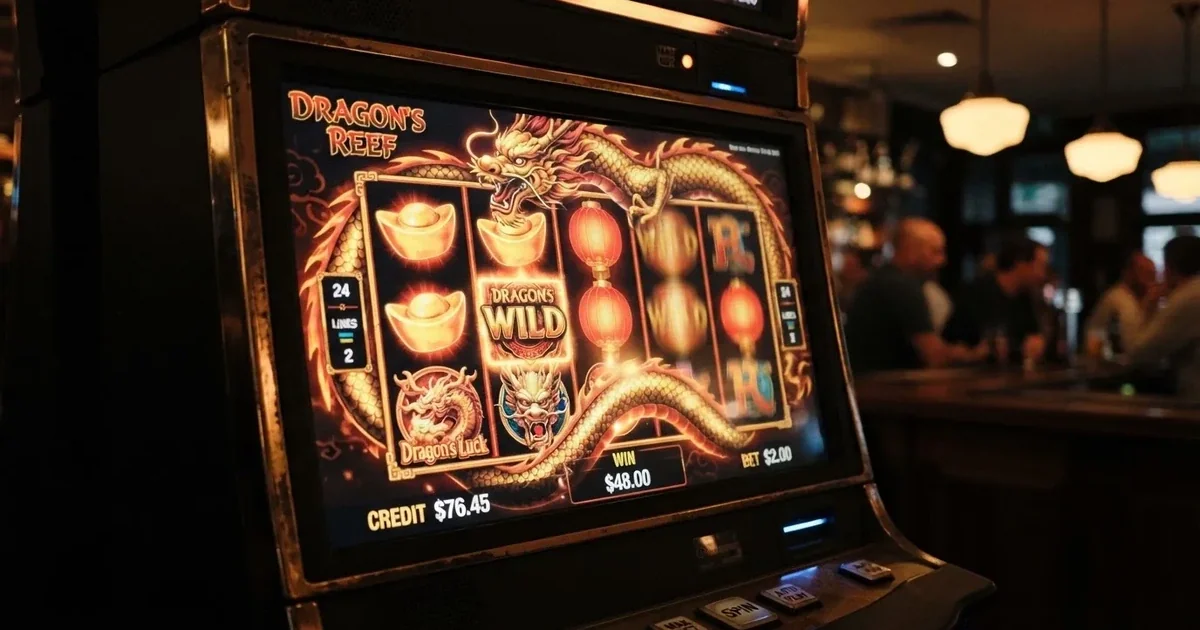
Current as of 28 October 2026 and checked against the ACMA’s published register of formal warnings and blocking requests.
Table of Contents
- Mobile and app claims around Dragon Link
- The Dragon Link game itself — what the reel set is
- Why no online Dragon Link is lawful in Australia
- Responsible play around a linked jackpot format
- The landscape of sites the ACMA has acted against
- How often the ACMA has asked ISPs to block a site
- What a player comparing options is actually choosing between
- The wider regulatory frame
- The maths behind the betting volume
- What an Australian player looking for Dragon Link should know in practice
- Frequently asked questions
Mobile and app claims around Dragon Link
The marketing around Dragon Link on a phone runs in two flavours, neither of them safe for an Australian player.

The first is the app store listing. Search “dragon link pokies app” or “dragon link casino app” and the result is a free download, usually packaged as a “social casino” with virtual credits and the genuine Dragon Link artwork. The reels spin, the bonus animation plays, the soundtrack is the same one a Crown Melbourne patron hears on the floor. The credits do not convert to cash. What the player has bought is the experience of the game without the wagering, which is fine so far as it goes — the issue is what the same listing pushes a player toward within a few taps. In-app offers route to a “real money” version that operates from an offshore licence, asks the player for a deposit, and from the moment that deposit clears sits outside any Australian consumer protection regime.
The second is the mobile site. A browser-based version of Dragon Link that runs on iOS and Android without an app store, branded with the same dragon icon and the same denomination ladder, marketed under the same Dragon Link pokie title. Same reel set, same bonus mechanics, same linked-jackpot copy on the splash page, and a deposit screen as soon as the player clicks through. From a regulatory point of view this is the same product as the desktop site: a prohibited interactive gambling service offered to a person physically in Australia.
The “Happy and Prosperous” reel set, which carries a dragon-and-lantern motif tied to the lunar new year, appears more often than the others in mobile packaging because the artwork is distinctive enough to license cheaply to a white-label casino builder. The reel mechanic is no different from any other Dragon Link set. A player who has only met the game on a phone has not played a stripped-down version; they have played an unlicensed copy that uses the licensed name to find them.
What the app and the mobile site share is the address the deposit goes to. The IGA applies to the provider, not the device.
The Dragon Link game itself — what the reel set is
Dragon Link is one of several linked-jackpot families Aristocrat has shipped into Australian clubs and casinos. Each family is built around a base game and a jackpot feature that shares a meter across every cabinet on the link. The version a player meets on the floor depends on the venue.

The base game is a five-reel video slot with twenty-five or fifty paylines depending on the configuration, and a denomination ladder that starts at one cent and climbs through five, ten and twenty cent credits. Each spin pays out according to its own paytable. The bonus round is triggered by six or more orb symbols landing in a single spin — the orbs lock in place, the rest of the reels respin, and any further orbs that land also lock, up to a maximum of fifteen. The round ends with each locked orb revealing either a jackpot tier, a “minor” or “mini” prize, or a cash value. The grand jackpot is the headline figure on the splash screen; it sits at a reset value, climbs as play across the link feeds it, and is won by filling the reel with orbs on a single bonus round.
What separates one Dragon Link set from another is the theme and the volatility band, not the bonus structure. “Happy and Prosperous” sits in the lower-volatility end of the family with a brighter symbol set; “Pearl River” and “Autumn Moon” run in the middle; the higher-volatility sets push the bonus frequency down and the headline grand up. A player who switches from one set to another is changing how often the feature lands and how the meter behaves between features, not changing the game itself.
The return-to-player figure printed on a Dragon Link cabinet is set by the state regulator and varies between jurisdictions. What sits on the cabinet is the figure the venue is licensed to operate at — it is not a guarantee of session outcome and the published number is the minimum, not the average.
| Jurisdiction | Minimum RTP (%) |
|---|---|
| New South Wales | 85 |
| Northern Territory | 85 |
| Queensland | 85 |
| Victoria | 85 (87 at Crown Melbourne) |
| ACT | 87 |
| Tasmania | 87 |
| South Australia | 87.5 |
| Western Australia | 90 |
Why no online Dragon Link is lawful in Australia
The Interactive Gambling Act 2001 prohibits the supply of online casino games — and online pokies are online casino games — to a person physically in Australia. The Interactive Gambling Amendment Act 2017 tightened the offence provisions and gave the ACMA a working set of enforcement tools. No state or territory issues a licence for online casino games. The activity is unlawful at the provider; an Australian resident who plays it commits no offence themselves, but the site they play on has none of the protections a player would assume by default.
The list of what is not covered is long. There is no Australian complaints body with jurisdiction over an offshore site. There is no Australian insolvency regime that follows the player’s balance if the operator goes under. The site can be added to a blocking list while a player’s balance is sitting in it — the ACMA has directed internet service providers to block more than 1,750 illegal gambling and affiliate marketing websites since the first blocking request in November 2019, and a blocked site does not unwind a deposit that has already cleared. A player who has put money in has no Australian route to get it back.
The credit card and digital currency ban that came in on 11 June 2024 applies to licensed Australian wagering services — debit cards, bank transfers, PayID/Osko and BPAY are the routes a licensed operator accepts. An unlicensed site asking for a credit card or a crypto deposit is signalling, by the payment screen alone, that it is not operating under Australian rules. The BetStop National Self-Exclusion Register, live since August 2023, only binds Australian-licensed wagering services — offshore casinos are not connected to it.
The Interactive Gambling Amendment (Gambling Reform) Bill 2026 passed Parliament on 19 August 2026, with advertising and inducement measures to commence on 1 January 2027. The law is on the books with a future start date; on a page read in 2026 it is not yet in force, and the prohibitions above are the ones that bind today.
Responsible play around a linked jackpot format
A linked jackpot is built to keep a player watching the reels. The grand meter climbs on every spin across the linked machines, the bonus animation is a longer and louder sequence than the base game, and the round itself runs longer as more orbs lock. Each of those design choices extends the average session length; the cumulative effect is the case the responsible-gambling literature has been making for years. State-level harm-minimisation measures respond to it in different ways.
Tasmania legislated mandatory pre-commitment cards for its poker machines and planned the nation-leading version of the measure, but implementation slipped from its earlier timetable to a start in late 2025. In Western Australia, poker machines are not allowed in pubs or clubs at all outside Crown Perth, which has roughly 2,500 machines approved by the state’s Gaming and Wagering Commission; outside that one casino floor the pub-and-club pokie does not exist in WA. New South Wales runs the largest installed base in the country — 87,298 gaming machines outside casinos across 2,195 venues as of June 2023, with player losses of A$8.18 billion in 2022–23. The cash flowing through the machines tells its own story; the cabinet format is the most-played gambling product Australians spend money on.
For a player who does sit down at a linked cabinet, the practical advice that the format itself rewards is a fixed time limit before the session starts. The bonus round encourages another spin because the meter is closer to the next tier; a preset time limit is the only thing that survives the second and third bonus round without being renegotiated. The National Gambling Helpline (1800 858 858) is free, runs 24/7, and offers chat at Gambling Help Online; BetStop covers licensed wagering only, so a player who has excluded themselves there and is still playing linked cabinets should know the register does not extend to club or casino floors. That is the limit of what consumer-protection architecture can reach.
The landscape of sites the ACMA has acted against
Each of the brands below is named because the ACMA itself issued a formal warning over it for offering prohibited services to Australians. The list is not a recommendation and not a ranking — the only common feature is that the regulator has called each one out. Where a research source carries a per-brand subject-support finding, that finding is shown; where it does not, the row stays silent on that column rather than fabricating a match. The ACMA action date, the operator named by the ACMA, and the brand itself are the three things the page can carry for every row.
| Brand | ACMA action and date | Operator named by the ACMA | Subject support |
|---|---|---|---|
| RocketPlay | Formal warning, March 2026; earlier Dama N.V., May 2022 | Pulsup Ltd | — |
| Level Up Casino | Formal warning, May 2022 | Dama N.V. | Listings reference Dragon Link on third-party B2B listings only |
| Woo Casino | Formal warning, March 2025 | Dama N.V. | — |
| Spirit Casino | Formal warning, May 2025 | Dama N.V. | — |
| National Casino | Formal warning, July 2025 | Consolutetish S.R.L. | Listings reference Dragon Link on third-party title listings only |
| Bizzo Casino | Formal warning, July 2025; earlier TechSolutions, 2022 | Consolutetish S.R.L. | — |
| Ignition Casino | Formal warning, July 2025 | Bamboo Media | — |
| Instant Casino | Formal warning, February 2025 | EOD Code SRL | — |
| Jackbit | Formal warning, April 2026 | Ryker B.V. | — |
| Casino Intense | Formal warning, April 2025 | Sterplay Holding Ltd | Listings reference Dragon Link on third-party Australian coverage only |
| Sky Crown | Formal warning, September 2022 | Hollycorn N.V. | — |
Two things stand out from the table without being restated cell by cell. The first is the repetition of Dama N.V. — three separate formal warnings, in three separate years, over three separate brands that share an operator. The second is the gap between an ACMA action and the next step. A formal warning is a regulatory step, not a blocking step. The blocking round reported on 26 June 2026 — which asked Australian ISPs to block 7Signs, ChromaBet, Donbet, Duospin, Freshbet, Slots Gem, Jacks Club, Lucky Start, Pointsbetz, Spinrise, Vinyl Casino and Wildsino — was the twelfth of its kind in 2026 and brought the running total of blocked sites to 1,751 since November 2019. The two registers are different: a warning tells the operator to stop, a blocking request tells ISPs to make the site unreachable. Some of the brands above have ended up on the blocking list, some have not, and the difference is a matter of compliance behaviour the regulator does not publish in advance.
How often the ACMA has asked ISPs to block a site
A rough rate from the blocking register is the one number the regulator’s own actions produce. The first blocking request went out in November 2019. By the end of June 2026 the running total sat at 1,751 blocked sites. That works out to somewhere between 250 and 260 blocked sites per year on average across the period, with the rate sitting higher in the years after the 2017 enforcement strengthening and lower in the early years of the register — call it a band of roughly two to three new blocking requests per working day across the period, with no single year hitting a clean round number. The figure is the regulator’s own pace, not a forecast.
What a player comparing options is actually choosing between
There is no version of this comparison that produces a winner. Every operator on the table is operating from an offshore licence that has no standing under the Interactive Gambling Act 2001, every one of them has been the subject of an ACMA formal warning, and the difference between them is the kind of difference that matters in a market comparison and not the kind that matters in a “where should I play” decision. The choice the page can usefully describe is which operator suits a particular reader who has decided to play regardless, which is a different question from whether to play.
RocketPlay sits on the most recent ACMA action in the table, with a formal warning to Pulsup Ltd over RocketPlay in March 2026. The brand is one of three the ACMA has warned under the Dama N.V. umbrella, the earlier one dating to May 2022 — a four-year gap between warnings to the same operator family. The page’s subject cuts against the brand directly: it offers the very product the page is describing as unlawful, and it has been told so twice by the same regulator.
Level Up Casino carries the May 2022 Dama N.V. warning, and is the only brand in the table where a third-party B2B listing carries a Dragon Link reference — a mention on a games provider page rather than confirmation of an online Dragon Link product. A player who has been told the game is online by an affiliate listing has been told something the listing’s own operator has been warned about.
Woo Casino and Spirit Casino together represent the second and third Dama N.V. warnings — March 2025 and May 2025, four months apart. The pattern is one operator fielding warnings across multiple brands in succession, and a player who reads the regulator’s behaviour as a story will read these two the same way.
National Casino and Bizzo Casino share a July 2025 warning to Consolutetish S.R.L., with Bizzo also carrying an earlier 2022 warning to TechSolutions. The latter is the clearest case in the table of a brand cycling through operators under continuing ACMA attention.
Ignition Casino sits under Bamboo Media from July 2025; Instant Casino under EOD Code SRL from February 2025; Jackbit under Ryker B.V. from April 2026; Casino Intense under Sterplay Holding Ltd from April 2025; Sky Crown under Hollycorn N.V. from September 2022. Each one is a single warning to a single operator; the only one carrying a third-party Australian-coverage listing is Casino Intense, where the reference comes from ABC reporting rather than from a casino product page.
The wider regulatory frame
Wagering — betting on races and sport before the event, plus lotteries and keno — is the only gambling product Australia licenses online, and the licensing happens in the Northern Territory. The Northern Territory Racing and Wagering Commission oversees 52 online bookmakers — Sportsbet, Bet365 and Ladbrokes among them — and the commission has no full-time staff and meets once a month in Darwin. That is the body the regulator is most familiar to ordinary Australians through. The Interactive Gambling Act and the ACMA are the body that the prohibition of online casino games runs through.
The ACMA also publishes a register of formal warnings, which is the source for every operator entry in the table above. The register does not list every illegal operator in the market; it lists the operators the regulator has chosen to publish a warning over, on a date the regulator has chosen, and the unpublished warnings outnumber the published ones. The cumulative effect of a published warning is a brand with an ACMA record in its profile, which is the kind of record a player can check before depositing.
Estimated losses to illegal sites sit at around A$3.9 billion a year according to H2 Gambling Capital’s 2025 estimate, with the share of gambling going through legal channels falling from 74 per cent in 2021 to 64 per cent. The market is large, the legal share is shrinking, and the regulator’s enforcement pace is the line the published register measures.
The minimum age is 18. Recreational gambling winnings are not assessable income and losses are not deductible, unless the person carries on a business of gambling — a model the ATO publishes. A site that markets an Australian player as a “professional” is selling a fiction the ATO will not back up at tax time.
The maths behind the betting volume
In 2020-21 Australians bet almost A$150 billion through gaming machines and lost A$12.18 billion on them, from a country with about 3 per cent of the world’s pub and club poker machines and 0.3 per cent of the global population. The ratio of money lost to money wagered across those machines sat at roughly 8.1 per cent — the average return-to-player across the Australian pokie estate, weighted by turnover. State-level minimums sit between 85 and 90 per cent, which means the average machine is operating closer to the bottom of its state’s allowed range than to the top.
New South Wales carries the largest installed base by a wide margin: 87,298 gaming machines outside casinos across 2,195 venues in June 2023, with player losses of A$8.18 billion in 2022-23. Queensland reported 21,122 machines across 351 venues in October 2023; Victoria sat at 26,380 machines outside Crown Casino in 488 venues in 2021-22 under a 30,000-machine statewide cap. Tasmania’s machines were operated under a Federal Group monopoly from 1968 until November 2021 legislation moved oversight to the Tasmanian Liquor and Gaming Commission; the nation-leading mandatory pre-commitment cards planned for those machines are now scheduled for late 2025. Western Australia has the most restrictive regime: poker machines were banned in pubs and clubs when Crown Perth opened in 1985, and Crown Perth’s own machine count has since grown from about 200 in 1985 to roughly 2,500, all approved by the state’s Gaming and Wagering Commission.
The figures behind the volumes are the same ones an offshore operator’s marketing copy never carries.
What an Australian player looking for Dragon Link should know in practice
The game exists on the floor. The denominations, the bonus round and the linked jackpot structure are described above, and a player who walks into a club or casino in New South Wales, Queensland, Victoria, the ACT, the Northern Territory, South Australia, Tasmania or at Crown Perth can play the game at a denomination and a return-to-player figure that the state regulator has approved. The 85-to-90 per cent return-to-player band is the minimum the cabinet is licensed to operate at; a venue with a higher average return is operating a cabinet closer to the ceiling of its state allowance.
The game does not exist online in any form that is lawful to sell to a person in Australia. Every site that markets itself as offering Dragon Link pokies to an Australian player is offering a product the Interactive Gambling Act 2001 prohibits. The ACMA’s published register is the place to check whether a specific site has been the subject of a formal warning; the blocking list is the place to check whether a specific site has been added to a blocking request; the credit-card and crypto ban applies to licensed Australian wagering and the absence of either on a payment screen is, by itself, a signal of where the site sits.
For a player who has decided to play on a cabinet regardless of what an online version would offer: pick a time limit before the session starts and stick to it. The National Gambling Helpline (1800 858 858) is free and runs 24/7; Gambling Help Online offers chat. BetStop is for licensed wagering services and will not exclude a player from a club floor. The cabinet does not respond to any of these systems once a player sits down, and the only consumer-protection measure that travels with the player to the machine is the one they set themselves.
Frequently asked questions
Is it legal to play Dragon Link online pokies for real money in Australia?
No. The Interactive Gambling Act 2001 prohibits the supply of online casino games — and online pokies — to a person physically in Australia, and the Interactive Gambling Amendment Act 2017 strengthened the offence provisions. No state or territory licenses online casino games. A site offering Dragon Link to an Australian player is operating unlawfully, and the Australian resident who plays it commits no offence themselves but has no Australian consumer protection if something goes wrong with the balance.
What triggers the bonus round on a Dragon Link pokies machine?
Six or more orb symbols on a single spin lock in place and start the feature. The remaining reels respin and any further orbs that land also lock, up to a maximum of fifteen. The round ends with each locked orb revealing a jackpot tier, a minor or mini prize, or a cash value. Filling the reel set with orbs on a single bonus round wins the grand jackpot.
Is Dragon Link available at regulated land-based venues in Australia?
Yes. Dragon Link cabinets are in clubs and casinos across New South Wales, Queensland, Victoria, the ACT, the Northern Territory, South Australia, Tasmania and at Crown Perth. Western Australia does not allow pub and club poker machines outside Crown Perth. Each state regulator sets the minimum return-to-player figure the cabinet is licensed to operate at, ranging from 85 per cent to 90 per cent.
How does the linked jackpot feature on Dragon Link differ from a standalone jackpot?
A standalone jackpot pays out from a single cabinet’s pool; a linked jackpot pays out from a meter fed by every cabinet on the link, which is why the headline grand figure on a Dragon Link cabinet climbs as play continues and why the figure is the same on every machine in a venue. The grand jackpot is won by filling the bonus reel set with orbs on a single bonus round.
Does a Dragon Link app on a phone offer a different game to the desktop version?
The reel mechanic, the bonus structure and the linked-jackpot copy are typically the same on a phone as on a desktop site — both are unlicensed copies of the Aristocrat game, branded with the same name and the same artwork, operating from an offshore licence that has no standing under Australian law. A social casino app with virtual credits is a different product, but it is rarely the only thing the listing pushes a player toward.