What 3-reel slots actually look like — and what the law around them in Australia looks like this year
 Available in US
The three-reel slot is the slot machine in its oldest surviving form: three vertical strips of symbols that spin and stop, a single line across the middle, and a payout table that says what each combination is worth. The format still turns up in pubs, clubs and casino floors in Australia. The same format, played for real money on a website, sits inside a different and far more restrictive legal frame — and that frame is the reason this page spends as much time on the regulator as on the reels.
Data current as of 23 September 2026, cross-checked against the Australian Communications and Media Authority’s public register of formal warnings and blocking requests.
Table of Contents
- Bonuses and free spins on a 3-reel format
- What a 3-reel slot actually shows on screen
- How 3-reel online play sits inside Australian law
- Responsible play and where help sits
- What the ACMA has acted against — and why the list is the list
- The shape of the market behind the table
- Where the reader stands after reading this
- Frequently asked questions
Bonuses and free spins on a 3-reel format
A bonus on a 3-reel game is the same kind of offer you’d see on any other slot, applied to a game with a thinner feature set. The format itself rarely carries its own bonus structure. The promotion usually lives above the reels: free spin packages on a named 3-reel title, a small cash match bundled with a playthrough requirement, or a no-deposit bundle of spins handed over for account creation. What the reels contribute is volatility — and a 3-reel game with a flat paytable tends to run cooler than a five-reel video slot stacked with bonus rounds.

The “free spins” tag is a marketing word, and it usually means something narrower than its face suggests. Free spins on a 3-reel slot are typically capped: a fixed stake per spin, a fixed number of lines, and a maximum cashout ceiling that applies even if the run goes well. A free spin package carrying a 40x wagering requirement on whatever it returns turns the bonus into a grinding exercise rather than a free look at the game. The house edge the underlying slot carries still applies during the free spins — the operator is giving the player turns on a machine that already profits in expectation, and the wagering multiplier is layered on top of that.
Cash bonuses on this format follow the same mechanics as cash bonuses anywhere else: a deposit, a matched percentage, a playthrough factor, and a list of games whose contribution rate sets how fast the requirement clears. A 3-reel slot often contributes 100% of each spin toward the wagering target, because it has no bonus rounds and no complicated feature weighting. That sounds generous until you notice that the contribution rate is set against the operator’s house edge, which the slot already realises in the background. The contribution rate is the speed of the grind; the house edge is whether the grind ever finishes in the player’s favour.
The takeaway that matters: the offer sits on top of a machine, not beside it. A bonus worth A$200 with a 40x playthrough means A$8,000 of turnover on the slot before the bonus becomes withdrawable, and the slot’s house edge runs across that full turnover. A free spin package with a 50x multiplier on the winnings does the same arithmetic with a smaller starting number and a sharper ceiling. The marketing word for either is “free.” The arithmetic underneath it is not.
What a 3-reel slot actually shows on screen
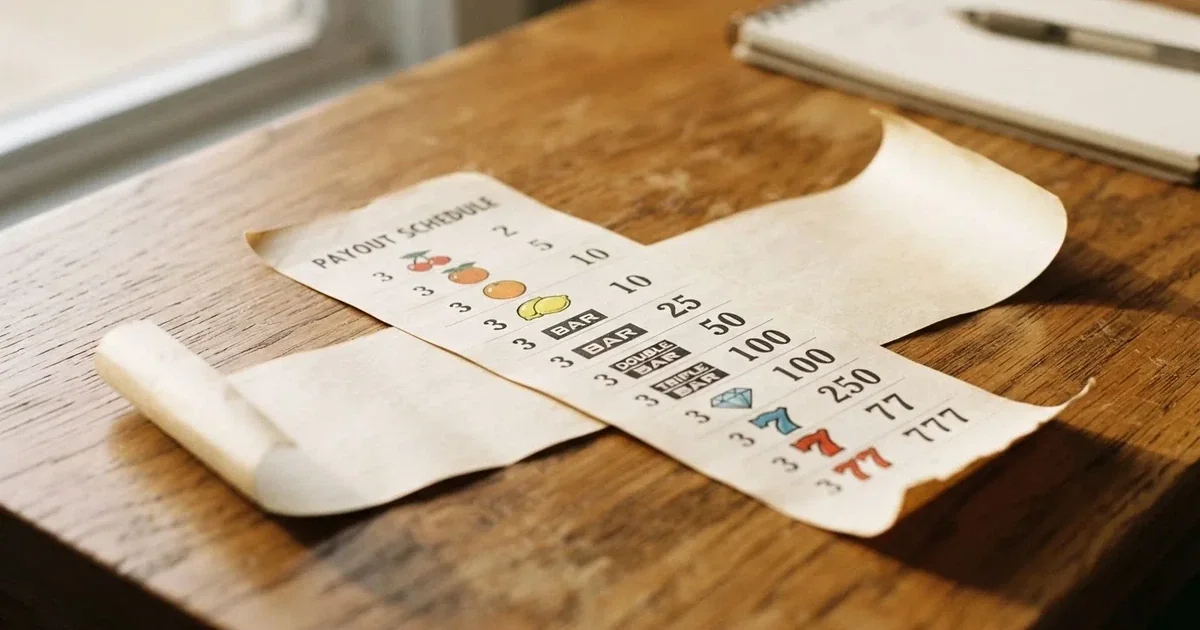
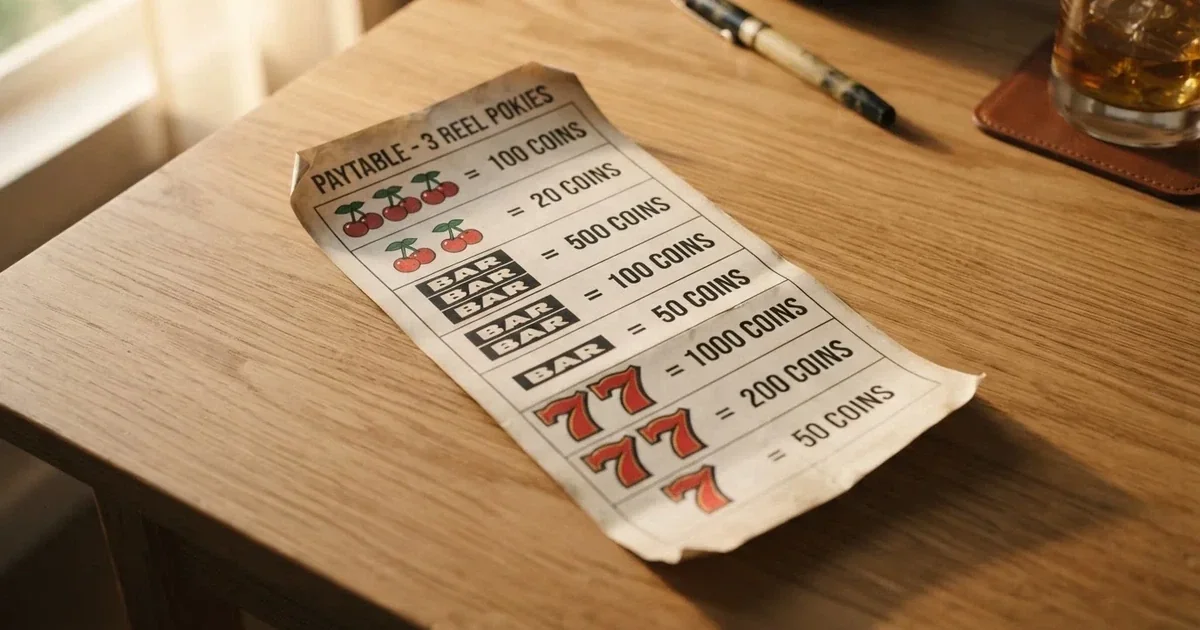
A classic 3-reel game runs three vertical strips, each carrying a small set of symbols — typically between eight and twelve distinct faces, depending on the machine. A payline runs across the centre; some 3-reel games carry three paylines (one across each row) and a few carry diagonal lines, but the centre line is the format’s defining feature. The payout table sits beside the reels and assigns a credit value to each combination of three matching symbols, with the top symbol paying the most and the lower symbols paying modest amounts. A wild symbol, when present, substitutes for others to complete a line, and a scattered bonus symbol can trigger a small feature round — though many 3-reel titles skip the bonus round entirely, in keeping with the format’s stripped-down character.

The arithmetic that defines a classic 3-reel game is short enough to follow by hand. With ten symbols on each reel, a machine offers roughly 1,000 distinct three-symbol combinations (10 × 10 × 10), and the paytable says how many of those combinations the player is paid for. A modern video slot, by contrast, can use five reels with fifty or more symbols per reel, producing odds as high as 300 million to one against a top combination. The 3-reel format is the opposite of that: short odds, frequent small wins, and a top prize that pays out often enough to matter. That’s what gives the format its reputation as a “low-volatility” play — though the paytable, not the reel count, is what actually decides that.
A paytable is also where the format hides its costs. A 3-reel machine with a flat top payout of 100 credits per line, when the line costs one credit, returns 100% of stake only on the rare combination that hits the top symbol three times. Every other combination returns less, and the gap between the top payout and the run of smaller payouts is where the house edge lives. A player who reads the paytable before pressing spin sees this immediately; a player who reads only the reels does not.
Why the format still turns up in clubs and pubs
Pokies-style slot machines outside casinos numbered 87,298 in New South Wales as of June 2023, 26,380 in Victoria across 2021–22, 21,122 in Queensland as of October 2023, 11,672 in South Australia in September 2023 and 3,587 in the ACT by November 2023. Many of those machines are 3-reel mechanical or hybrid machines — the format’s simplicity makes it cheap to maintain and easy for venue staff to audit. New South Wales legalised slot machines in 1956; by 2010 Australia operated an estimated 97,103 gaming machines outside casinos, a per-capita rate about five times that of the United States.
The reason the 3-reel format survives on a venue floor is the reason it doesn’t survive online in Australia: the venue floor is where state regulators can inspect the machine and certify its payout percentage, and the IGA explicitly carves out a regulatory frame for gaming machines in licensed premises. Online play, with no machine to inspect and no state to license it, falls into the prohibition.
Reading a paytable without being misled by it
A paytable is honest when it states the credit value of each combination, the cost per line, and the maximum payout. It is misleading when it states only the symbols and the line, leaving the player to infer the house edge from the symbol frequency. A player who wants to know what the machine pays back overall needs the machine’s payout percentage, which is set by the venue’s regulator and posted somewhere in or near the gaming area — not on the paytable itself. On an offshore website, no Australian regulator certifies that figure, and the “RTP” the site displays is the operator’s own claim. The figure may be accurate; nothing forces it to be.
How 3-reel online play sits inside Australian law
The Interactive Gambling Act 2001, strengthened by the Interactive Gambling Amendment Act 2017, makes it an offence to provide online casino games, online pokies or in-play betting to a person physically in Australia. No state or territory issues a licence for online casino games or online pokies. What is licensable is wagering on races and sport placed before the event, lotteries and keno — and in practice the licence work is done by the Northern Territory Racing and Wagering Commission, which regulates 52 of Australia’s online bookmakers, including Sportsbet, Bet365 and Ladbrokes, licensed in the Territory for tax reasons. The commission has no full-time staff and meets once a month in Darwin.
A 3-reel slot, played for real money on a website, sits inside the prohibited category. The format of the slot doesn’t change the prohibition — three reels, five reels, a jackpot, no jackpot, the law is the same. An offshore operator offering real-money 3-reel play to an Australian is offering a service that no Australian regulator has the power to license, and the law targets the provider rather than the player. The individual player is not prosecuted, but the player has no Australian consumer protection either: no local complaints body, no recourse if a withdrawal is refused, and no guarantee the site won’t be blocked with a balance still on it.
This is the frame that any comparison of “best 3-reel slots Australia” runs into on the first page. The phrase “best 3-reel slot” only has an honest meaning if the reader knows that no Australian-based site can legally offer it for real money, that any site that does offer it is operating outside Australian law, and that the regulator’s only tool against such sites is the same tool it has used against the eleven operators named below: a formal warning, followed where necessary by an instruction to Australian internet service providers to block the site.
What enforcement looks like in practice
According to the ACMA as reported in June 2026, a total of 1,751 illegal gambling and affiliate marketing websites had been blocked since the first blocking request in November 2019, and more than 230 unlicensed gambling services had left the Australian market since enforcement was strengthened in 2017. In a round reported on 26 June 2026 the ACMA asked Australian internet service providers to block 12 more illegal gambling websites: 7Signs, ChromaBet, Donbet, Duospin, Freshbet, Slots Gem, Jacks Club, Lucky Start, Pointsbetz, Spinrise, Vinyl Casino and Wildsino.
The blocking tool is slow, deliberate and public. A formal warning is published on the ACMA’s website with the operator’s name and the date; an ISP instruction follows, and the site becomes unreachable on Australian networks within days. The site can reappear under a new domain, the operator can reincorporate under a new corporate name, and the cycle begins again. The cumulative number is large because the game is large: H2 Gambling Capital’s 2025 report estimates that Australians lose about A$3.9 billion a year to illegal gambling sites, and that the share of gambling going through legal channels fell from 74% in 2021 to 64%.
How the blocking rate looks in plain arithmetic
Take the running total from the ACMA’s June 2026 report: 1,751 sites blocked, against the date of the first blocking request in November 2019. That works out to roughly 250 to 280 sites blocked per year on average over the period, with the rate picking up after the 2017 enforcement strengthening and the August 2023 launch of BetStop. The annual figure is a band rather than a single number because the monthly rounds vary — some months see no new blocks, some see a dozen — and the cumulative figure aggregates every site the ACMA has asked ISPs to block, including affiliate marketing pages that never ran real-money games themselves.
The honest reading of that band: the ACMA blocks at a steady pace, and the pace is below the rate at which new illegal sites appear. The 1,751 total is a measure of activity, not of resolution. An Australian player typing a domain into a browser in 2026 can still reach an offshore site that has never been blocked, and the same site may be reached by a domain the ACMA has not yet acted on. The blocking rate is the regulator’s answer; the answer does not match the scale of the problem.
Payments, age and the rules that apply even on offshore sites
Minimum age is 18 across every Australian state and territory for any form of legal gambling. Credit cards, credit-related products and digital currency are banned as payment for licensed online wagering since 11 June 2024, with penalties of up to A$247,500 for operators accepting them. Legal deposit routes for licensed wagering are debit card, bank transfer, PayID/Osko and BPAY. A site asking an Australian for a credit card or a crypto deposit is operating outside the Australian rules, and that’s another way of saying the site is offshore.
The 2026 reform: the Interactive Gambling Amendment (Gambling Reform) Bill 2026 passed Parliament on 19 August 2026; its advertising and inducement measures commence 1 January 2027 — law with a start date, not yet in force on a 2026 page. The new measures tighten what licensed wagering services can advertise and the inducements they can offer, but they do not, on their face, change the prohibition on online casino games.
Tax is the closing line of this section: gambling winnings of a recreational player are not assessable income under section 6-5 of the ITAA 1997, and losses are not deductible, unless the person carries on a business of gambling. The model is a clean one for the recreational player who happens to win; the same model offers no relief to the recreational player who has built up a year’s worth of losses.
Responsible play and where help sits
If 3-reel online slot play is being weighed at all, it should be weighed against what happens when the question moves from “which game?” to “how much?” That’s the moment the support services exist for, and they exist because the answer to “how much?” is often not the answer the player wants.
Free confidential help is available around the clock through Gambling Help Online, with chat and phone, and the National Gambling Helpline on 1800 858 858 is free and answered 24/7. The National Self-Exclusion Register, branded BetStop, has been live since August 2023 and binds every Australian-licensed online and phone wagering service — which means a player who has registered with BetStop cannot open a new account or place a bet with any licensed Australian wagering operator. BetStop does not bind offshore casino operators, which is the operative word: a self-exclusion from an Australian-licensed service does not exclude an Australian player from an offshore casino that has no connection to the register.
That gap is the structural problem the page keeps coming back to. The Australian framework of minimum age, payment restrictions, self-exclusion and consumer protection applies to licensed wagering. Offshore online casinos sit outside every line of that framework except the ACMA’s blocking tool. A player who has registered with BetStop and then opens an account with an offshore operator has not breached the self-exclusion — the operator has, because the operator should have checked the register, and didn’t. The check is the operator’s responsibility under Australian law if the operator were licensed. The operator is not licensed.
The state of the data on offshore play is what makes the support services matter. The H2 Gambling Capital estimate of A$3.9 billion a year flowing to illegal gambling sites is the headline figure, but it covers all illegal gambling, not 3-reel slots alone, and it cannot break the figure down by reel count. The figure is enough to say that the volume of offshore play in Australia is real, and that any reader considering joining it is one of a large group.
What the ACMA has acted against — and why the list is the list
The 11 brands below are not a ranking and not a recommendation. Each is listed because the ACMA itself issued a formal warning over it for offering prohibited services to Australians. The list is the regulator’s list, in the regulator’s order, and the columns are the things the regulator’s published record shows: the brand, the action, the date, the operator named in the action, and whether the page’s own research turned up a real connection between the brand and the subject of 3-reel slot play.
| Brand | ACMA action and date | Operator named by the ACMA | 3-reel slot support |
|---|---|---|---|
| RocketPlay | Formal warning, March 2026 (earlier warning to a different operator, May 2022) | Pulsup Ltd (Rocketplay) | — |
| Level Up Casino | Formal warning, May 2022 | Dama N.V. | Listings-only |
| Woo Casino | Formal warning, March 2025 | Dama N.V. | — |
| Spirit Casino | Formal warning, May 2025 | Dama N.V. | — |
| National Casino | Formal warning, July 2025 | Consolutetish S.R.L. | Listings-only |
| Bizzo Casino | Formal warning, July 2025 (earlier warning, 2022) | Consolutetish S.R.L. (earlier TechSolutions) | — |
| Ignition Casino | Formal warning, July 2025 | Bamboo Media | — |
| Instant Casino | Formal warning, February 2025 | EOD Code SRL | — |
| Jackbit | Formal warning, April 2026 | Ryker B.V. | — |
| Casino Intense | Formal warning, April 2025 | Sterplay Holding Ltd | Listings-only |
| Sky Crown | Formal warning, September 2022 | Hollycorn N.V. | — |
Two readings sit on top of the table. The first is the bare pattern: 11 formal warnings, scattered across 2022 to 2026, naming a dozen different corporate entities. The ACMA is not chasing one operator under many names; it’s chasing an industry. The second is the column on 3-reel slot support, where most cells carry an em dash because the research did not surface a verifiable connection between the brand and 3-reel slot play specifically. That absence is information — it tells the reader that “best 3-reel slot” is not a phrase these brands market themselves with, and that the operator’s promise of “the best 3-reel experience” is a marketing word layered onto a casino offering hundreds of games across every format.
What each entry actually tells the reader
A reader who reaches this page by typing a brand name will find that brand here, and the table will say what the ACMA said about it. A reader who reaches the page by typing “best 3-reel slots Australia” will find a list that is longer than any one operator’s catalogue, and the table will say what each operator was warned for. The page’s job in either case is to surface the regulator’s record — not to score the operators against each other.
Why no bonus terms are listed
The only sources for bonus terms on these brands were affiliate marketing pages, and the affiliate marketing pages themselves carry no Australian regulatory weight. A “200% welcome bonus” listed on an affiliate site for a brand the ACMA has warned is a marketing claim, not a fact. The page’s job is the regulator’s record, and the regulator’s record is what the table above carries.
The shape of the market behind the table
The 1,751 blocked-sites total and the A$3.9 billion annual loss figure are two readings of the same market. The first is a count of enforcement actions; the second is an estimate of the money those actions fail to stop. The gap between the two is the offshore online casino market in Australia, and the gap is large.
The legal channel — licensed wagering on sport and races, lotteries and keno, in-person gaming machines in licensed venues — captured 74% of Australian gambling spending in 2021 and 64% in 2025, by H2 Gambling Capital’s estimate. The decline is not because Australians stopped gambling; it is because the illegal share grew faster than the legal share. The 3-reel slot, as a format, is not a meaningful share of either total on its own — the illegal market is dominated by the same multi-reel video slots that dominate the global online casino market, with 3-reel titles occupying a niche.
The Northern Territory Racing and Wagering Commission’s structure — 52 licensed bookmakers, no full-time staff, monthly meetings — is the practical answer to “who regulates online gambling in Australia?” The commission is a tax-and-licence body for wagering, not a casino regulator. The casino regulator, for the in-person casino floor, sits in each state: the Victorian Gambling and Casino Control Commission in Victoria, the NSW Casino Control Authority in New South Wales, and so on. None of them has any online casino under its authority, because online casino is prohibited.
Where the reader stands after reading this
A reader who came to the page asking which 3-reel slot is “best” leaves with a smaller and a more useful question: whether online play at all is what they want, given that no Australian-based site offers it legally and every offshore site offering it sits outside Australian consumer protection. The “best” question, asked of an offshore casino, has no honest answer the regulator can certify.
The “free spins” question, asked of any operator on the table, also has no honest answer the regulator can certify. A bonus on an offshore site is a contract with an entity the ACMA has already determined is operating outside Australian law, and the terms of that contract are enforced, if at all, by the operator’s own jurisdiction.
The “best 3-reel slot” question, asked of the format itself, has a clean answer: the format is simple, the paytable is short, and the house edge is whatever the paytable and the symbol frequencies together produce. The same answer applies whether the slot is on a venue floor in Sydney, on a licensed cruise ship, or on an offshore website. The first two are inside Australian law and the third is not.
Frequently asked questions
What makes a 3-reel slot different from a standard five-reel video slot?
A 3-reel slot has three vertical strips of symbols and usually one or three paylines, with a short paytable that lists each winning combination and its credit value. A five-reel video slot has five reels, often forty or more symbols per reel, and dozens of paylines with bonus rounds, free spin features and progressive jackpots. The 3-reel format produces shorter odds and more frequent small wins; the five-reel format produces longer odds and rarer, larger wins.
Can 3-reel slot machines be found in licensed Australian pubs and clubs?
Yes. Pokies-style slot machines outside casinos numbered 87,298 in New South Wales as of June 2023, 26,380 in Victoria across 2021–22, 21,122 in Queensland as of October 2023, 11,672 in South Australia in September 2023 and 3,587 in the ACT by November 2023. Many of those machines are 3-reel or hybrid 3-reel formats, operating under state-level licensing and subject to regulator-set payout percentages.
Do 3-reel slots typically pay out differently than newer five-reel formats?
The payout structure is shorter and the top prize is paid more often, but the long-run house edge depends on the paytable and symbol frequencies, not the reel count. A 3-reel game with a low top payout and a high frequency of small wins can have a higher house edge than a five-reel game with a generous bonus feature, and the reverse is also true. The reel count shapes volatility; the paytable shapes the cost.
Is a 3-reel slot online the same game as a 3-reel machine on a casino floor?
The visual format is similar — three reels, a payline, a paytable — but the regulatory frame is not. A venue-floor machine is licensed by a state regulator, with a certified payout percentage and consumer protection rights. An online 3-reel slot on an offshore site is not licensed in Australia, the payout percentage is the operator’s own claim, and the player has no Australian consumer protection. The “same game” reading applies to the reels; it does not apply to the player’s position.
Are 3-reel slots for real money available legally from an Australian-based site?
No. The Interactive Gambling Act 2001, strengthened by the Interactive Gambling Amendment Act 2017, prohibits the provision of online casino games and online pokies — including 3-reel slots — to a person in Australia. No state or territory issues a licence for them. Every operator named in the table above was warned by the ACMA for offering exactly this kind of service.
Do reel count and paytable structure affect how a slot’s volatility is described?
Yes. A 3-reel game with a flat paytable tends to be described as low volatility because the top payout is small relative to the stake and the small payouts hit more often. A five-reel video slot with a large progressive jackpot and a long odds tail is described as high volatility because the same stake produces rare, large wins and long losing runs in between. The volatility label is a summary of the paytable shape, not a guarantee of any one session’s behaviour.
Written by the editors at Casino Safety Info.