
Best online casino with high cashback bonus australia 2026: what Australian players actually face
A page built around “the best online casino with high cashback bonus” lands a reader at a peculiar spot. The marketing word is one every punter has seen, the offer is genuinely on offer somewhere on the internet, and the phrase sits at the top of more than a few affiliate sites. The peculiarity is that the product is illegal where the searcher sits. No jurisdiction in Australia issues a licence for online casino games. The Interactive Gambling Act 2001 makes it an offence to provide online casino games, online pokies or in-play betting to a person physically in Australia, and the Australian Communications and Media Authority spends most weeks proving that the rule is real.

What follows is the gap between that pitch and the law. It explains the mechanics of a cashback bonus for a reader who wants to understand one, walks the legal frame that Australia puts around it, lists the offshore operators the ACMA has formally warned over the past few years for offering exactly this product to Australians, and points to what is genuinely available — licensed wagering on races and sport, land-based pokies venues, and the BetStop self-exclusion register for anyone who wants their own lever to pull.
Current as of 28 October 2026 against the ACMA’s published list of formal warnings and blocking actions, and against the Australian Communications and Media Authority’s own compliance notices for the brands covered below.
Table of Contents
- What “high cashback” actually pays out
- The legal frame around online casino bonuses in Australia
- What the ACMA has actually warned Australian-facing operators for
- Comparison of featured operators
- How the cashback pitch reaches an Australian player
- Crypto, anonymity and the cashback offer
- Reading an offshore offer in plain terms
- Where the player sits at the end of the offer
- Why an Australian reader ends up here
- What changes in 2026 and 2027
- A note on the offer’s tax position
- Frequently asked questions
What “high cashback” actually pays out
A cashback bonus is the simplest of the casino promotional offers to describe, and the easiest to read past. The site returns a percentage of what the player lost over a set window — usually a week, sometimes a day — as bonus credit or, less often, as cash. A “high cashback” pitch is just a bigger percentage. The numbers on the front of these offers sit anywhere from five per cent up to twenty-five per cent on the most generous weekly products, with tiered schemes that climb into the high teens for the players a casino wants to keep. The mechanism does not change with the size of the figure.

What does change is what the casino does with the cashback once it lands. The split between real-money cash and bonus funds is the first fork. A small number of offers — usually older brands, usually in Europe — credit cashback as withdrawable cash, in which case the player can request a payout the moment the cashback posts. Most operators credit it as a bonus balance, and that balance then carries its own turnover requirement: the player has to wager the cashback amount a further number of times before it converts to a withdrawable balance. Five times is generous, ten times is ordinary, anything north of that should be read as a flag. The conversion itself is sometimes capped, so a player who worked the offer perfectly may still walk away with only a fraction of what the headline percentage promised.
A second fork sits inside the loss calculation itself. Some offers return a percentage of net losses — deposits minus withdrawals during the window — which is the cleanest version. Others return a percentage of total bets placed, which inflates the headline number because losing bets and winning bets both count. A third version returns a percentage of house edge lost, which is mechanically the same as net losses for slots but materially different for table games, where the player can lose less than the bet in a single hand. The marketing line does not always say which version is in play; the terms page does, and reading it is the only honest way to know what the offer actually returns.
The third fork is the cap. A weekly cashback capped at a small dollar amount is not the same offer as the same percentage uncapped, and the difference shows up fast for a player who runs a normal session. A fifteen per cent cashback capped at A$50 looks generous on a quiet week; the same scheme uncapped runs into four figures for an active punter.
Why a high percentage is not always a better offer
The arithmetic behind an offer only works in combination with the other terms attached. A twenty-five per cent cashback with a ten-times wagering requirement and a cap at A$200 is, for most weeks, a worse deal than a ten per cent cashback with no wagering and no cap, because the bigger percentage feeds a balance that has to be worked harder to clear and stops earlier when the player has a good run. The percentage on the page is the easy number to compare; the percentage that matters is the one a player walks away with after the terms have done their work, and that one only becomes visible once the player knows what kind of punter they are.
That is the move the marketing word “high” tries to make. It is a number designed to be compared across sites, not a number that survives the comparison once the rest of the offer is read.
Where the cashback lands in plain numbers
A two per cent difference in cashback percentage is a much smaller number than the same two per cent looks at first glance, because it sits on top of money the player has already lost. A weekly A$1,000 net-loss session returns A$100 under a ten per cent scheme and A$120 under a twelve per cent scheme; the A$20 difference is two per cent of A$1,000 of loss, not of the bankroll. The headline reads like a two per cent improvement in the offer; the wallet reads like a two per cent improvement in the money the player has already given back to the house. For a player whose loss is small, the absolute dollar difference is even smaller — a A$200 week returns A$4 extra under the twelve per cent scheme. For a player whose loss is large, the same percentage gap is material but is paid out of a much heavier baseline loss.
This is the calculation that the marketing word tries to keep the reader from doing, and the one the page carries quietly as a check on the headline.
See also Welcome bonus offers aimed at Australians.
The legal frame around online casino bonuses in Australia
The Interactive Gambling Act 2001, as amended by the Interactive Gambling Amendment Act 2017, prohibits the supply of online casino games, online pokies and in-play betting to a person physically in Australia. The amendment raised the penalties and gave the ACMA a clearer set of investigatory and enforcement powers. What the law permits is wagering on racing and sport placed before the event, lotteries and keno — products that are licensed in practice by the Northern Territory Racing and Wagering Commission (NTRWC), which regulates 52 of Australia’s online bookmakers including the household names, and which operates with no full-time staff, meeting once a month in Darwin.
What the law does not do is licence the product the cashback pitch is selling. No Australian jurisdiction issues a licence for online casino games or online pokies. A brand offering a high cashback bonus to an Australian player is operating outside the Australian regime, and any licence the site displays is from a different jurisdiction, for a different purpose. The licence is not a sign that the site is Australian. It is a sign that the site is offshore.
The IGA targets the provider, not the individual player, so reading this page from Australia is not in itself an offence. The practical consequences fall on the operator and on the punter’s wallet.
How the ACMA enforces the prohibition
The ACMA’s main tools are formal warnings, blocking requests to internet service providers, and investigations that can lead to civil penalty proceedings. The cumulative picture, as the ACMA reported in June 2026, is that 1,751 illegal gambling and affiliate marketing websites had been blocked since the first blocking request in November 2019, and that more than 230 unlicensed gambling services had left the Australian market since enforcement was strengthened in 2017.
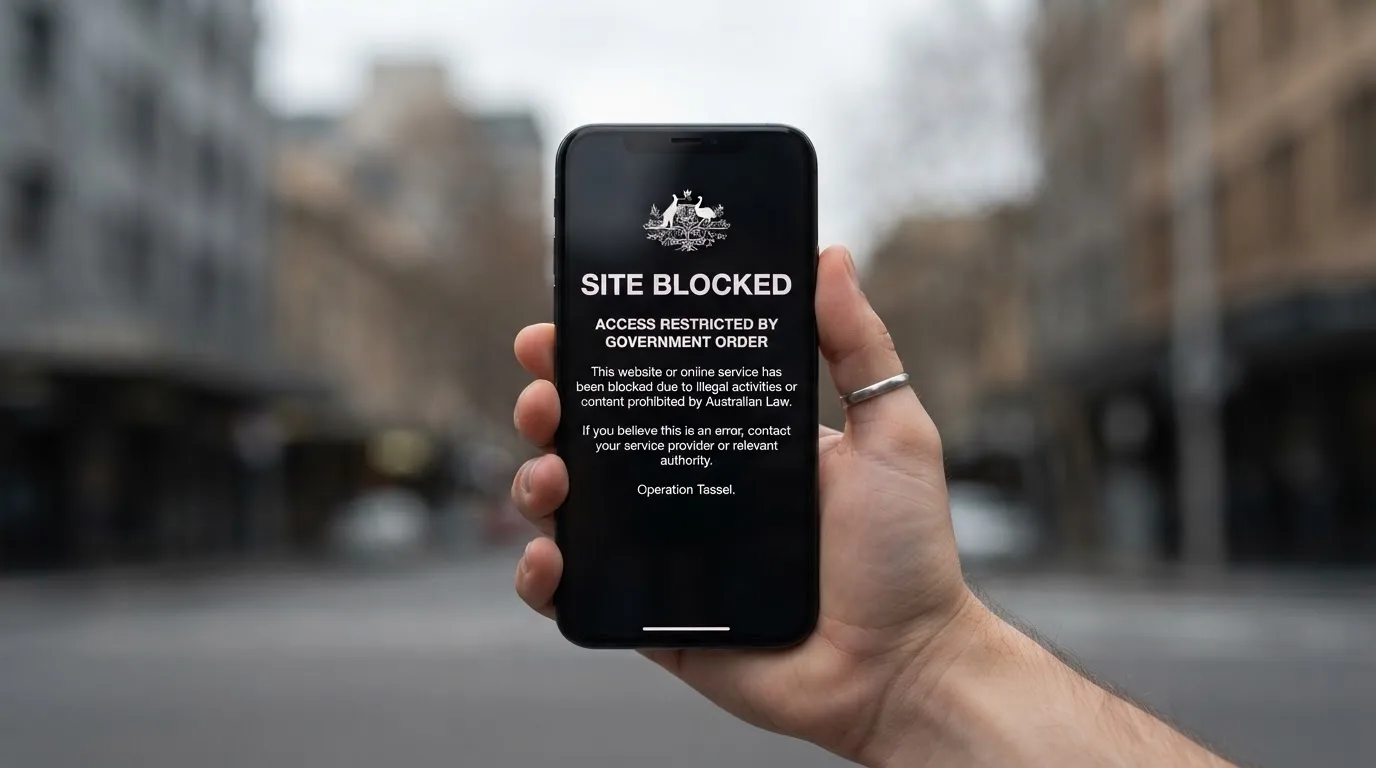
A single round reported in June 2026 asked Australian ISPs to block twelve more sites: 7Signs, ChromaBet, Donbet, Duospin, Freshbet, Slots Gem, Jacks Club, Lucky Start, Pointsbetz, Spinrise, Vinyl Casino and Wildsino. The blocking request is the visible end of the process; behind it is usually a formal warning to the operator, with the ACMA naming both the operator entity and the brand the warning covers. Some operators accumulate several warnings under several brands, and the ACMA publishes each one separately, with its own date and its own corporate entity named in the body of the notice.
What enforcement costs the player
A formal warning to the operator is the start of the ACMA’s process. A blocking request cuts the site off for Australian customers, which means a balance sitting in the player’s account becomes difficult or impossible to withdraw through the site’s own cashier. The offshore operator carries no obligation to return that balance through any Australian complaints body, and the ACMA’s brief stops at the operator and the ISP. The player who has just been blocked does not have a phone number to call. The offshore brand’s own terms of service usually say exactly that, in language the brand drafted for that situation.
That is the practical price the offer costs the reader. A high cashback bonus that pays out before the site is blocked is a different product from the same offer paid out the week after the ISP block lands, and the player cannot choose between them.
Payment-side enforcement that compounds the picture
Since 11 June 2024, licensed online wagering services in Australia cannot accept credit cards, credit-related products or digital currency as payment, with penalties of up to A$247,500 for the operator. The deposit routes the law permits for licensed wagering are debit cards, bank transfers, PayID/Osko and BPAY. A cashback casino asking an Australian player for a credit card or a crypto deposit is operating outside the Australian rules.
The banks add a second layer on top of the law. Westpac’s gambling block works at card level and refuses authorisation of transactions registered under the merchant category code for betting and casino gambling on eligible personal credit and debit cards. ANZ’s block, set up in the ANZ app, blocks gambling transactions made through a digital wallet such as Apple Pay on the linked card, not just on the physical card, and removing the block once it is on takes a 48-hour waiting period. Commonwealth Bank offers a gambling lock on eligible cards via the CommBank app, with the same caveat that not all gambling transactions can be guaranteed blocked. Westpac, ANZ and Commonwealth together cover most Australian card accounts, and the merchants they decline include offshore casinos that hold any Australian-facing data point.
Apple Pay, Google Pay and Samsung Pay collectively accounted for around 45 per cent of all card payments in Australia by number at the end of 2025, so a wallet-based block catches a meaningful share of the would-be deposit before the wallet’s own layer has any say. Apple states explicitly that it does not charge consumer fees for Apple Pay; any surcharge comes from the merchant’s processing fees, and the transaction limits and PIN requirements sit with the card issuer and the merchant, not with Apple. The Reserve Bank of Australia’s July 2025 review proposes removing surcharges only on eftpos, Mastercard and Visa card transactions and explicitly leaves American Express outside the proposed ban, so the surcharge question for Amex is unchanged by the review.
PayID-based instant transfers are available at over a hundred Australian financial institutions and arrive in under a minute through Osko, 24/7 including weekends. The payment confirmation screen shows the name of the account holder before the transfer is sent, and AP+ warns that being asked to transfer money to a PayID on an illegal gambling site almost certainly means a scam site — a check the player can run in seconds. Ordinary electronic bank transfers are not subject to AUSTRAC’s threshold-transaction-report rule, which applies only to physical cash transfers of A$10,000 or more, so the A$10,000 figure that hovers around gambling deposits does not carry the regulatory weight it carries in the cash economy. BPAY, which has been operating in Australia since 1997 and is owned jointly through Cardlink Services Limited by ANZ, Commonwealth Bank, NAB and Westpac, is a bill-payment service that runs through the payer’s own online banking and accepts the standard biller code and customer reference number on the merchant’s bill. None of these rails changes the underlying prohibition, but each one of them either tightens or loosens the friction a player has to push through to fund an offshore account.
Best online casino with high cashback bonus australia 2026 — More on this topic at casino safety.
What the ACMA has actually warned Australian-facing operators for
The list below is not a ranking. It is a sample of the operators the ACMA has issued formal warnings to for offering prohibited interactive gambling services to Australians, with the date the ACMA published each warning and the operator entity the ACMA named in it. Several operators appear more than once because they run more than one brand, and the ACMA names each brand separately in its own warning.
Comparison of featured operators
| Brand | ACMA action and date | Operator named by the ACMA | Subject support |
|---|---|---|---|
| RocketPlay | Formal warning March 2026; earlier warning to the same brand’s predecessor operator in May 2022 | Pulsup Ltd (2026); Dama N.V. (2022) | Listings-only |
| Level Up Casino | Formal warning May 2022 | Dama N.V. | Listings-only |
| Woo Casino | Formal warning March 2025 | Dama N.V. | — |
| Spirit Casino | Formal warning May 2025 | Dama N.V. | — |
| National Casino | Formal warning July 2025 | Consolutetish S.R.L. | Listings-only |
| Bizzo Casino | Formal warning July 2025; earlier warning 2022 | Consolutetish S.R.L. (2025); TechSolutions (CY) Group Limited and TechSolutions Group N.V. (2022) | Listings-only |
| Ignition Casino | Formal warning July 2025 | Bamboo Media | — |
| Instant Casino | Formal warning February 2025 | EOD Code SRL | Listings-only |
| Jackbit | Formal warning April 2026 | Ryker B.V. | — |
| Casino Intense | Formal warning April 2025 | Sterplay Holding Ltd | Listings-only |
| Sky Crown | Formal warning September 2022 | Hollycorn N.V. | — |
Every brand in this table offers a cashback product. That is the product category the ACMA has acted against them for. The warnings themselves do not name cashback schemes specifically; they cover the broader provision of prohibited interactive gambling services to Australians. The brands share a pattern the ACMA has flagged repeatedly: an offshore operator running multiple sites under multiple corporate entities, each carrying its own bonus pitch to Australian-facing visitors, with the corporate entity changing as the warnings land. The Pitch is replaced, the offer is not.
What the table does and does not say
The table is a record of regulatory action, not a measure of how much each brand returned to its players, how fast it paid out, or how aggressive its marketing was. None of those figures are in the public record, and the affiliate pages that carry them are not a reliable source for an editorial comparison. The licensing information a brand displays on its own footer is similarly out of scope here, because no Australian licence exists for the product on offer and any other licence is a different regime.
The brands marked with a dash in the Subject support column are not paired with a sourced cashback offer in the material this page is built from, so the comparison does not attempt to add a figure the source set does not carry. The brands with a listings-only marker carry the offer only as affiliate sites report it; this page quotes none of those terms, because they are the kind of figure that changes between visits and that the operator does not stand behind in the same language across its own pages.
A note on the reading: ACMA warning ≠ unsafe site, ACMA warning ≠ safe site
A formal warning from the ACMA is the regulator recording that the operator has offered a prohibited service to Australians, and it carries the regulator’s own evidentiary weight. It is not, by itself, a finding that the operator has refused to pay a player, rigged a game, or lost customer funds. The product category is the offence, not the conduct. A punter who plays at one of these brands and is paid out cleanly has still played at a site the ACMA has named; a punter who plays at a site not on this list and is not paid out has still had a bad outcome. The table is one input into the decision, not the decision itself.
How the cashback pitch reaches an Australian player
The offer rarely arrives at the front door. It usually lands in three layers: an affiliate review site that ranks “best cashback casinos” for Australian readers, the operator’s own landing page with the headline percentage and the welcome bonus wrapped together, and a follow-up email or in-platform message after a first deposit that says the player has been “selected” for the high cashback tier. Each layer uses the same word — “cashback”, “high”, “exclusive” — and each layer carries a different risk.
The affiliate layer is the one that ranks the brand against the brand. Affiliate sites are paid by the operator for the player they refer, which means their ranking is a function of the commission structure as well as the offer. The headline percentages they publish are the operator’s own. The bonus terms they quote are paraphrases of the operator’s own terms. A reader using an affiliate ranking is reading the operator’s own marketing through a paid intermediary.
The landing page is the second layer and the cleanest to read, because it is the only one where the operator stands behind the offer in its own words. The “Terms” link is the part of the page that decides what the offer is worth, and the link is often small, often at the foot of the page, and often carrying a different version of the same offer than the one on the front of the page.
The follow-up email is the third layer, and the one most often ignored. The “selected” framing implies a tier the player has earned by their play. The tier usually exists for every player who joins at the right deposit level, and the cashback percentage attached is the percentage the brand wanted to land in the first place. The player has not been selected; the offer has been scheduled.
What the affiliate ranking hides
The offer’s percentage is the figure the affiliate page leads with, and the figure the affiliate page knows it can quote from the operator’s own page. The terms are the figure the affiliate page paraphrases, because the operator’s own terms run to several pages of small print and the affiliate summary cannot reproduce them all. The summary says “10x wagering”, which the player reads as ten times the bonus. The actual term says ten times the bonus plus the deposit, which is twenty times the bonus in practice, or ten times only the deposit, which is half the apparent figure. The affiliate summary is not lying; it is condensing. The player who does not read the operator’s own terms reads the condensation as the offer.
What the operator’s own terms hide
The operator’s own terms are the legal document the player agrees to. They are also the document the operator will quote if the player disputes a withdrawal. A common pattern in this market is a term that says the operator can void winnings “in cases of bonus abuse”, with no definition of bonus abuse in the same document. The player who has played in good faith reads the term as irrelevant; the player who has triggered an automatic flag reads it as the reason for the voided balance. The document is written for the second case.
The offer’s headline figure does not survive the terms page in most cases. A reader comparing offers by the headline number is comparing offers that have not yet been read.
Crypto, anonymity and the cashback offer
A “crypto cashback casino” is, mechanically, the same offer as a fiat cashback casino, with three structural differences. The deposit runs through a cryptocurrency wallet rather than a card or a bank transfer. The balance is held in the same currency or in a stablecoin pegged to the US dollar. The withdrawal, when it works, is paid out in the same currency to the same wallet. The cashback percentage is paid out the same way. The wagering requirement is the same. The cap is the same. The “blockchain” framing the marketing uses is the deposit rail, not the product.
The anonymity claim that sits next to the crypto pitch is, in practice, narrower than it looks. The blockchain records the transaction in public, and the player’s wallet address is recorded on the casino’s side. KYC requirements — the verification of identity, address and source of funds that an Australian licensed operator must run — are run or not run by the offshore casino on its own policy, and the policy varies. Some offshore sites run no KYC up to a withdrawal threshold and full KYC above it; some run KYC at deposit; some run no KYC at all. The “no KYC” pitch and the cashback pitch are usually the same pitch, and both usually belong to the same offshore operator.
The legal position on the Australian side does not change with the deposit rail. The Interactive Gambling Act 2001 prohibits the supply of online casino games to a person in Australia. The deposit method is not part of the prohibition. A crypto deposit does not make the offer lawful. The 11 June 2024 ban on digital currency as a payment method for licensed online wagering means that licensed wagering cannot accept crypto at all; the offshore cashback site can, but cannot, by doing so, claim any closer relationship to the Australian regime.
The wallet layer
A player who pays in crypto is one blockchain transaction away from a balance the ACMA can ask ISPs to block the casino behind. The wallet is unaffected by the block. The casino’s own server is. The block cuts off access; the balance sits where it sat. A player who paid in fiat has the same exposure with the bank’s gambling block on top — a Westpac card block refuses authorisation of the merchant category code for betting and casino gambling, so the next deposit is declined before the casino ever sees it. The crypto deposit makes the player’s first step harder to block; it does not make the casino’s eventual block any less effective.
What a high cashback pitch on a crypto site actually offers
The same numbers as the fiat version, with the same kinds of terms, on a site that takes a deposit method Australian licensed operators cannot accept. The cashback percentage does not change. The wagering multiple does not change. The cap does not change. The legal status of the product does not change. The pitch is a marketing wrapper around the same offshore offer the fiat brand carries, and the only material difference is the rail.
Reading an offshore offer in plain terms
A cashback offer that survives the terms page is, mechanically, a small set of choices:
- What is being refunded. Net losses, total bets, or house edge. Net losses is the cleanest. The other two inflate the headline figure.
- What form the refund takes. Cash, bonus funds, or free spins. Cash is the cleanest. The other two carry their own conversion terms.
- What wagering requirement sits on the refund. Zero is the cleanest. Anything else is the offer’s real cost.
- What cap sits on the refund. None is the cleanest. A small cap is the offer’s real ceiling.
- What window the refund runs over. A short window is the cleanest. A long window pulls in weeks the player may have had a good run on.
A reader who can answer these five questions from the operator’s own terms page has the offer in the right shape to compare. A reader who cannot is reading the marketing word, not the offer.
The wagering requirement, stated plainly
A wagering requirement is the number of times the bonus balance has to be bet before it converts to a withdrawable balance. A 10x requirement on a A$100 bonus is A$1,000 of further bets, which on a slot machine at A$1 per spin is 1,000 spins. The expected loss on those 1,000 spins, at a typical slot return-to-player in the mid-nineties, runs to roughly A$50 of the bonus balance itself, before the conversion takes place. The headline A$100 cashback has cost the player about A$50 in expected value, plus whatever they lost to generate the cashback in the first place. The “free” word in “free cashback” is the marketing word. The math is not free.
The cap, stated plainly
A weekly A$50 cap on a twenty-five per cent cashback scheme is A$200 of net losses per week. A player who has a worse week than that sees the same A$50 cap, and the rest of the offer is held by the house. The cap is the offer’s maximum payout. The percentage is the offer’s slope up to that maximum. Comparing two offers by their percentage alone ignores the cap; comparing by their cap alone ignores the slope.
Where the player sits at the end of the offer
The cashback offer is the casino’s mechanism for retaining a player who is on their way out. It pays out after the player has already lost, in a form that often carries its own turnover requirement, at a percentage the operator chose knowing the player’s likely loss pattern. The offer is generous by the casino’s standards and modest by the player’s. The arithmetic in the previous section makes that clear: a ten-times wagering requirement on a cashback bonus costs the player roughly half the bonus in expected loss before the conversion. The “high” in the marketing pitch is a real number; the gap between the real number and the wallet number is the casino’s margin.
A reader comparing offers across brands will find that the percentage on the front of the page varies by a few points, the wagering requirement varies by a few multiples, and the cap varies by orders of magnitude. The variation in the cap is the most consequential and the least quoted. The variation in the percentage is the most quoted and the least consequential.
Why an Australian reader ends up here
The search that brings a reader to a page like this one usually starts with a comparison intent: the reader wants to know which site is offering the best cashback deal this week, and which of those deals is worth taking. The comparison is real for products that are lawfully available in Australia. Sportsbook operators licensed by the NTRWC run cashback products on racing and sport from time to time, with smaller percentages and tighter caps than the offshore casino version, and within the rules of the IGA.
For online casino games specifically, the comparison does not resolve to a recommendation. The product is prohibited in Australia. The brands offering the product are offshore, unlicensed in Australia, and on the ACMA’s list of formal warnings or blocking actions. The percentage on the offer is real, the balance on the offer is real, the chance of being able to withdraw the balance is shaped by the offshore operator’s own house rules and by the ACMA’s enforcement timetable.
What an Australian reader can do instead
The product category that the cashback offer sits in — online casino games, online pokies — is not available lawfully in Australia. The product categories that are available are wagering on racing and sport, lotteries and keno, and land-based casino gaming and pokies at licensed venues. The licensed wagering market is regulated by state and territory regulators, with the NTRWC covering the largest group of operators for tax purposes. The licensed wagering operators carry the consumer protections the IGA was drafted to extend: a complaints body, an internal dispute resolution process, and access to free help services if gambling stops being fun.
For a reader who is finding that the offshore search is not going where they want it to go, the licensed wagering market is the lawful alternative. The offer shapes are smaller, the bonuses are capped, the inducements are restricted by the 2026 reform bill that commences 1 January 2027, and the cashback product on racing and sport is the closest in shape to the offshore version that is lawfully available. For a reader who has decided that gambling has stopped being fun, the National Gambling Helpline is 1800 858 858, free, 24/7, with chat at Gambling Help Online, and BetStop — the National Self-Exclusion Register, live since August 2023 — binds the Australian-licensed online and phone wagering services to a player’s exclusion request. An offshore casino is not connected to BetStop, and a BetStop registration does not reach it.
What changes in 2026 and 2027
The Interactive Gambling Amendment (Gambling Reform) Bill 2026 passed Parliament on 19 August 2026. Its advertising and inducement measures commence on 1 January 2027, which means the law is on the books but is not yet in force on a page written for 2026. The 2027 commencement will tighten the rules around bonus marketing and sign-up inducements for Australian-licensed wagering operators, and will further narrow the gap between the lawful offer and the offshore one. A reader comparing offers on a 2026 page sees the current shape; a reader comparing offers on a 2027 page will see a different shape, and the comparison this page runs is the 2026 comparison.
A note on the offer’s tax position
Gambling winnings of a recreational Australian player are not assessable income under section 6-5 of the ITAA 1997, and losses are not deductible. A player whose gambling is a business carries a different position, and the ATO’s own guidance is the source that resolves that case. The page does not carry tax advice; the ATO does, and a reader with a tax question should run it past the ATO or a tax adviser. The “recreational player” exclusion covers most readers; the “business” case is narrow, deliberate and documented.
Frequently asked questions
What separates a cashback bonus from a deposit match bonus?
A cashback bonus returns a percentage of what the player has already lost over a window, paid out after the window closes. A deposit match bonus adds a percentage of the player’s deposit to the balance at the moment of deposit, before any play has happened. The deposit match sits at the front of the player’s session; the cashback sits at the back. The wagering requirement usually attaches to both, but it sits on different balances in each case.
Is cashback normally paid as real money or as bonus funds?
Most operators pay cashback as bonus funds, which then carry a wagering requirement and a conversion step before they become withdrawable. A smaller group of operators pay cashback as cash, which can be withdrawn as soon as it posts. The marketing line on the offer does not always say which version is in play; the terms page does, and the player who wants to know which version they have is reading the terms page.
Is it legal for an online casino to offer cashback to players in Australia?
No. The Interactive Gambling Act 2001 prohibits the supply of online casino games to a person in Australia. A cashback offer on those games is part of the supply. The ACMA’s enforcement record — 1,751 blocked sites and more than 230 unlicensed services having left the Australian market since 2017 — is the regulator’s response to that supply. The individual player is not the target of the law; the operator is.
Can a crypto casino offer cashback the same way as a fiat casino?
Mechanically, yes. The cashback percentage, the wagering requirement and the cap are the same figures on both rails. The legal position is also the same: the Interactive Gambling Act 2001 does not change with the deposit method. The 11 June 2024 ban on digital currency as a payment method for licensed online wagering means a licensed Australian wagering service cannot accept a crypto deposit; an offshore casino can, but does not, by doing so, move inside the Australian regime.
What terms typically cap how much cashback can be earned?
The three caps that recur across the market are the wagering multiple on the cashback balance, the maximum cashback payout over the window, and the games that count toward the qualifying loss calculation. Some offers exclude table games, or weight them at a fraction of their stake, so the cashback the player earns is the cashback on the games the operator chose. The terms page carries all three caps; the affiliate summary carries one or two; the front of the page carries none.
Does a high cashback percentage make up for other unfavourable bonus terms?
Usually not. A ten per cent cashback with no wagering and no cap pays out more, in expected value, than a twenty-five per cent cashback with a ten-times wagering requirement and a small cap, for most weeks the player actually runs. The percentage on the front of the page is the easy number to compare; the percentage that survives the terms page is the one that decides what the offer is worth. The two are not the same number, and the gap between them is the casino’s margin on the offer.