
What a Pokies Venue in Melbourne Actually Is in 2026 — and What an Offshore Pitch Isn’t
The pokies people play in Melbourne are sitting in pubs, clubs and a single integrated casino on the south bank of the Yarra River. There is no licensed online substitute for any of them — the Interactive Gambling Act 2001 makes offering an online casino game to a person in Australia a civil penalty, the 2017 amendments gave the regulator something to enforce with, and the ACMA has spent the years since issuing formal warnings and asking Australian ISPs to block the brands that try. By June 2026 the running total of blocked sites stood at 1,751, with twelve more added in the round reported on 26 June 2026.
Current as of 28 October 2026, checked against the ACMA’s published list of formal warnings and the public blocking record on the Interactive Gambling Act 2001.
Table of Contents
- Staying in control: the supports that exist, and the ones that don’t reach an offshore site
- Where the machines actually are: Crown, the suburbs, and the cap the state has set
- Paytables, payouts, and the maths behind a Melbourne spin
- Crown’s floor, the clubs’ floor: what a Melbourne pokies venue actually offers
- Putting the shortlist together: how any ranking of Melbourne pokies is built
- The shape of the Melbourne market in 2026
- Why no offshore “Melbourne pokies” casino can legally serve you
- Brand-by-brand: the offshore sites the ACMA has formally warned
- What readers ask first
- Frequently Asked Questions
Staying in control: the supports that exist, and the ones that don’t reach an offshore site
This is the section a Melbourne reader should land on before deciding which venue to walk into, because every support named here is run by an Australian government and every offshore site that advertises “Melbourne pokies” sits outside all of them.

BetStop, the National Self-Exclusion Register, went live in August 2023 and binds every Australian-licensed online and phone wagering service. A self-exclusion lodged there stops a person from opening new accounts with the major bookmakers — Sportsbet, Bet365, Ladbrokes and the rest of the Northern Territory-licensed set — and from using existing ones during the exclusion period. The mechanism works as advertised. It does not touch an offshore casino: those operators are not licensed in Australia, so they are not connected to BetStop, and a registration with BetStop has no effect on whether a brand the ACMA has already warned will accept the next deposit. The federal register, in other words, gives the punter a real door against the licensed bookmakers and not even a fence against the unlicensed sites.
The phone number to call is 1800 858 858, the National Gambling Helpline, free, every day of the year. The same service runs as a chat window through Gambling Help Online, with counsellors who understand the Victorian licensing and venue landscape and can refer on to face-to-face support in metropolitan Melbourne or in regional Victoria. State-level help lines and face-to-face counselling sit under the same banner, funded through the Victorian Responsible Gambling Foundation.
There is also a register specific to land-based venues, run by the Victorian Gambling and Casino Control Commission. It lets a person bar themselves from Crown Melbourne and from the clubs and hotels that have signed up to the scheme, which most of the larger suburban clubs have. That is the register to use when the intended play is in a pub or club, because the federal BetStop register does not engage with a venue that does not hold an Australian wagering licence. A tourist visiting Melbourne for a long weekend cannot use BetStop to exclude themselves from a suburban RSL; they have to ask the venue’s staff about the state scheme on the way in.
The single sharpest point about an offshore “pokies” site is that none of these pathways exist. There is no regulator a player can escalate a refused withdrawal to, no complaints body to file with, no enforcement outcome that follows the money back to the punter, and no self-exclusion a player can lodge that the site is required to honour. The ACMA’s blocking power exists precisely because that gap exists — the operator has no Australian accountability to lose, so the only lever the regulator has is the ISP-level block. Players do the arithmetic themselves.
Where the machines actually are: Crown, the suburbs, and the cap the state has set
A Melbourne reader who wants to play a real pokies machine has three categories of venue to choose from, and they are not interchangeable. The shape of the choice comes from how the state has organised the network, not from any single operator’s marketing.
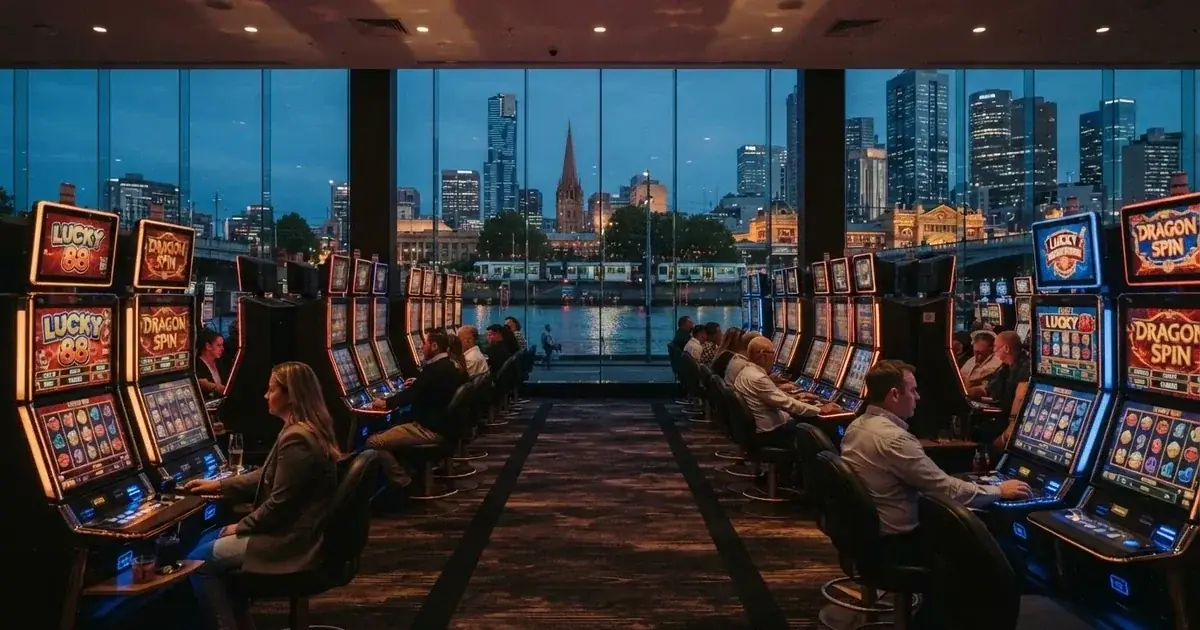
Crown Melbourne is the largest of the three. It sits on the south bank of the Yarra in a 510,000 m² complex that makes it the largest casino complex in the Southern Hemisphere. The site opened temporarily at the World Trade Centre on the north bank on 30 June 1994, then reopened in its permanent south-bank building on 8 May 1997, after Publishing and Broadcasting Limited had taken over the operation from Lloyd Williams. The gaming floor covers about 220,000 square feet with 540 licensed table games — 100 of them poker tables — and 2,500 poker machines. The complex carries 1,604 hotel rooms across three towers. Crown is the only Melbourne venue where a punter can sit down at a poker table, walk to a high-limit EGM room, and book a hotel room for the night without leaving the building.
Around it sits the suburban network. As of 2021–22, Victoria had 26,380 gaming machines operating outside Crown Casino across 488 venues, working under a statewide cap of 30,000 machines that has held since the earlier reforms. The cap is what bounds the network — the industry has not been adding venues, it has been rebalancing inside the ceiling. Melbourne’s share of those 488 venues runs across pubs and clubs in the inner city, the suburbs (North Melbourne, South Melbourne, Port Melbourne, East Melbourne and the western suburbs), and the city’s outer fringe.
The CBD has a handful of pubs within walking distance of Melbourne Central, and a small cluster around the edges of the legal and entertainment strips. A reader searching for pokies in Melbourne CBD will not find a high-density strip — they will find a small number of venues, each with a modest machine count, all working under the cap. The western suburbs — Footscray, Sunshine, Werribee — carry a much higher density and a longer political history of community pushback against new machines. A reader near Melbourne Airport is in the western-suburbs network, and the closest machines are typically inside a suburban pub or club within a short drive of the terminals.
The decision between Crown and a suburban venue is rarely about machine count alone. Crown carries the table games, the late-night opening hours, the restaurants, and the post-2021 regulatory architecture — the Special Manager, the VGCCC, the Finkelstein Royal Commission’s enduring effect on how the venue is run. A suburban pub carries proximity, cheaper parking, the food-and-drink spend that funds the community club, and a much smaller EGM cap per venue. For the punter who wants the maximum concentration of machines under one roof, Crown is the only choice. For the punter who wants to walk ten minutes from home, play a small session and leave, the suburban network is the network — and it is the network the state regulates most tightly.
The geography worth keeping in mind: the machines in North Melbourne, South Melbourne, Port Melbourne and East Melbourne all sit inside the same Victorian regulatory frame regardless of postcode. The differences between suburbs are social, not legal — opening hours, density of venues, the politics of the cap — and a player moving between them will not see the rules change.
Paytables, payouts, and the maths behind a Melbourne spin
The “best paying pokies in Melbourne” question does not have a single answer the regulator publishes. There is no Victorian statutory minimum return-to-player figure comparable to the 87.5 per cent floor South Australia sets for machines outside the casino, and the data Crown publishes on a per-machine basis is not in the public record. What a reader can establish is the band the industry operates inside, and the difference that band makes to the maths of a session.
South Australia’s floor sits at 87.5 per cent, with a general maximum bet of A$5.00 outside the casino, and Adelaide Casino itself runs with no maximum-bet limit at all — a structure worth comparing against because it lets a Melbourne reader see how a neighbouring state draws the line. Victoria regulates gaming machines through the VGCCC, with the 30,000-machine cap and venue-level licensing rules doing most of the work, rather than a flat RTP floor. The two regimes produce different kinds of player protection: South Australia’s is a per-spin floor and a stake ceiling; Victoria’s is a venue cap and a self-exclusion register. Neither approach publishes a per-machine payout ranking.
The number a Melbourne reader can hold onto is the take-rate. Victorians lost a record A$3.318 billion on electronic gaming machines in 2025–26, according to the Victorian Local Governance Association — the highest figure on record for the state, and a year-on-year increase. South Australia’s machine losses outside Adelaide Casino totalled about A$0.92 billion in 2022–23, equivalent to roughly A$497 per adult. The arithmetic that follows from those totals is that a typical Melbourne EGM punter is paying the house at a rate that compounds across many small sessions, not in one dramatic loss. A player who puts A$50 through a 90 per cent machine over a half-hour session should expect to come out with about A$45, and the difference — A$5 — is what the venue keeps. Across millions of sessions, that difference is the A$3.318 billion.
The “maximum cash payout pokies Melbourne” angle is one Crown’s marketing has used in the past. It refers to the largest single-line or progressive jackpot a venue will pay out without a manual hand-pay, not to the player’s expected return over time. A high payout ceiling does not change the house edge; it changes how often a player notices a big win, which is a different thing entirely. A reader holding the two figures in mind at once — a 90 per cent machine, a maximum cash ceiling — should see why the second does not redeem the first.
The “online pokies Melbourne no deposit bonus” angle, by contrast, leads straight to the brands further down. The phrase is search-engine vocabulary for the offshore sites that use a no-deposit incentive to acquire an Australian email address, and the ACMA has spent the last several years working through the list. The offer is the lure. The offer is also the case file when the regulator writes to the operator.
The arithmetic that frames the regulator’s own workload is straightforward. From the ACMA’s first blocking request in November 2019 to the 26 June 2026 reporting date, 1,751 illegal gambling and affiliate marketing websites have been blocked — a span of roughly six years and seven months, or about seventy-nine months. The implied rate is between 260 and 270 sites blocked per year, or roughly 22 sites per month, with the band set by whether the count is taken from the start of November 2019 or to the end of the reporting month. The 12-site round reported on 26 June 2026 — covering brands including 7Signs, ChromaBet, Donbet, Duospin, Freshbet, Slots Gem, Jacks Club, Lucky Start, Pointsbetz, Spinrise, Vinyl Casino and Wildsino — is one month’s typical workload. A reader holding that rate against the A$3.9 billion a year H2 Gambling Capital’s 2025 report estimates Australians lose to illegal gambling sites should see the gap the regulator is trying to close.
Crown’s floor, the clubs’ floor: what a Melbourne pokies venue actually offers
The shelf on specific games, providers and live tables in this market is thinner than a similar shelf would be in the online-casino space, because there is no app store of Melbourne venues to rank. The facts that exist are about the venues themselves, not the games on their floors.
Crown’s table-game spread is the largest in the Southern Hemisphere and the only one in Melbourne that supports a serious poker player. Of the 540 licensed table games, 100 are poker tables, with the remainder split across the standard casino fare. The EGM floor runs 2,500 machines, with a higher-density high-limit room off the main floor. A punter walking in for the first time will see the room split between low-stakes machines at the entrance, a tournament-poker area in the centre of the complex, and the high-limit rooms toward the back. The exact mix of machine titles is not in the public record — Crown does not publish a per-machine game list, and the regulator does not require it to.
The suburban venues tell a simpler story. A typical Melbourne pub or club runs between twenty and fifty EGMs, no table games, and the choice of title is determined by the venue’s gaming-machine operator under the state cap. The experience is calibrated for a short session: a drink, a spin, a conversation, a second drink. There is no poker table, no high-limit room, no hotel attached. The comparison to make is with a venue like Adelaide Casino — 90 gaming tables and 950 gaming machines under one roof, regulated by South Australia’s Independent Gambling Authority — which is large by Australian suburban standards but still under half the size of Crown’s machine count. Brisbane’s Treasury Casino, which closed on 25 August 2024 to make way for the new Star casino at Queen’s Wharf, ran 80 tables and over 1,300 machines; its replacement at the A$3.6 billion Queen’s Wharf precinct opened in stages beginning on 29 August 2024, under the same operator’s licence and under fresh public scrutiny about that licence’s standing.
The point that follows is one a Melbourne reader should hold onto when weighing a Crown session against a suburban one: the suburban machine is a faster, simpler experience, the Crown machine is part of a wider gambling floor, and the regulatory environment differs accordingly. Crown’s table games and hotel fall under the VGCCC’s casino-specific regime; the suburban pub falls under the VGCCC’s venue regime, with different opening-hour constraints and different self-exclusion mechanics. The two are not interchangeable.
Putting the shortlist together: how any ranking of Melbourne pokies is built
Any shortlist of the best pokies in Melbourne has to be built on a set of criteria the reader can apply themselves, because the market does not publish a ranking. The criteria that actually separate one option from another are these, and they do not all carry the same weight.
Proximity dominates for most Melbourne players. A reader in North Melbourne does not drive to Werribee for a session, and a reader in the CBD does not drive to the airport end of the network for a Crown alternative. The closest licensed venue with at least twenty machines is, for most readers, the practical answer, and the shortlist starts there. Travel time, parking and the cost of a meal and drink inside the venue are the next set of practical filters.
Opening hours matter for late-shift workers, and they vary. Crown’s main gaming floor runs through the night; many suburban pubs close the gaming room at midnight or earlier, in line with their liquor licence. A reader planning a session after 2 a.m. is effectively choosing between Crown and a small set of late-trading clubs, regardless of where they live.
Machine density per venue is the next filter. A 50-machine pub and a 30-machine pub are different propositions for a player who wants variety in titles; a Crown-sized 2,500-machine floor is in a different category entirely. For a reader who cares about a specific title — and most pokies titles are licensed across multiple venues — the question is which venue carries the highest concentration of machines in walking distance.
Table games enter the picture only at Crown. A suburban reader who also wants to sit at a poker table has one choice in Melbourne, and that choice comes with the rest of the Crown experience attached.
Return-to-player is the filter a reader has the least data for. Victoria does not publish a per-venue or per-machine RTP ranking, and the operator is not required to publish one. The qualitative position is that EGMs in Australian clubs and pubs typically return between 85 and 92 per cent to the player, with a long tail of lower-returning titles; the headline position is that Crown’s machines do not publish figures comparable to South Australia’s 87.5 per cent floor, because Victoria does not impose one. A reader optimising for payout percentage is optimising inside a band that is itself not transparent.
Food, beverage, parking and accessibility are the filters that decide between two otherwise-comparable venues, and they are the filters a player can actually evaluate by visiting. Crown carries the most developed food-and-beverage offering and the most expensive parking. A reader who wants a quiet suburban club and a free park is reading a different ranking than a reader who wants a poker tournament and a hotel.
The shortlist this comes to, in order: the closest suburban pub or club with at least twenty EGMs and a self-exclusion option in place; the closest comparable suburban venue if the first has poor reviews; Crown if table games or a 24-hour session are part of the plan; never an offshore site, because the question is “where do I play pokies in Melbourne”, and an offshore site is not in Melbourne.
The shape of the Melbourne market in 2026
The headline numbers in this market are the ones that frame every other choice a reader makes. The numbers, taken together, describe a legal market in which land-based venues are doing more business than ever, and an illegal market in which offshore brands are doing more business than the regulator can keep up with.
Victorians lost A$3.318 billion on electronic gaming machines in 2025–26 — a record, and the headline figure for any Melbourne reader. The take is concentrated in two places: Crown, with its 2,500-machine floor, and the 488-venue suburban network running 26,380 machines under the state cap. The total includes both venues’ share, and the year-on-year increase is what the Victorian Local Governance Association flagged when it published the figure on 1 September 2026.
The illegal market is harder to count but not invisible. H2 Gambling Capital’s 2025 report estimates Australians lose about A$3.9 billion a year to illegal gambling sites, and that the share of gambling going through legal channels fell from 74 per cent in 2021 to 64 per cent in 2025. The fall is the result the ACMA’s blocking programme is trying to reverse, and the per-year run-rate of new blocks is what the calculation in the previous section quantifies.
The licensed wagering market sits in a different frame. The Northern Territory Racing and Wagering Commission regulates 52 of Australia’s online bookmakers — Sportsbet, Bet365, Ladbrokes and the rest — licensed in the Territory for tax reasons. The commission has no full-time staff and meets once a month in Darwin, which is a fact about how the licensing is structured rather than about how it is enforced. Its job is to licence and supervise, not to set consumer-protection policy, and the consumer-protection policy for wagering is set nationally through BetStop and the credit-card ban.
The Melbourne-specific framing to return to is this: the legal pokies market in Melbourne is large, growing and entirely land-based. The illegal market is large, growing and entirely offshore. The reader’s choice is between them, and what each one actually costs is what the rest of this page is about.
Why no offshore “Melbourne pokies” casino can legally serve you
The offshore sites that advertise “Melbourne pokies” are doing so in a market where offering an online casino game to a person in Australia has been a civil penalty since 2017. The legal frame is short, the enforcement is public, and the conclusion is the one the regulator has already reached.
The Interactive Gambling Act 2001, as strengthened by the Interactive Gambling Amendment Act 2017, makes it an offence to provide online casino games, online pokies or in-play betting to a person physically in Australia. No state or territory licences these products. What is licensable is wagering on races and sport placed before the event, lotteries and keno — in practice licensed through the Northern Territory. The minimum age for any of it is 18. The 2017 amendments did not change who can play; they changed what the regulator can do about who is offering.
The ACMA is the regulator that uses those powers. It investigates, issues formal warnings under the Act, and directs Australian internet service providers to block illegal sites at the network level. The blocking is the lever that has produced the 1,751-site total since November 2019. The formal-warning process is what has produced the eleven-brand table further down. The two work together: the ACMA writes to the operator first, the operator either removes the offering to Australians or does not, and the ISP-level block follows when it does not.
The individual player is not prosecuted under the IGA — the Act is aimed at the provider, not at the punter. What the player loses by going offshore is the layer of consumer protection an Australian licence carries: no Australian complaints body, no recourse if a withdrawal is refused, and no guarantee the site will still be reachable next week. The ACMA’s blocking power operates at the ISP level, which means a balance held at an offshore site can become unreachable in a single round, without warning, and without a path for the player to recover it.
The payment frame reinforces the same conclusion. Since 11 June 2024, credit cards, credit-related products and digital currency have been banned as payment for licensed online wagering in Australia, with penalties of up to A$247,500 per offence for the operator. The legal deposit routes for licensed wagering are debit card, bank transfer, PayID/Osko and BPAY. An offshore site asking an Australian for a credit card or a crypto deposit is operating outside the Australian rules — which, given the offshore site is already outside the IGA, is one more rule it is not following.
The 2026 reform this page sits one step ahead of is the Interactive Gambling Amendment (Gambling Reform) Bill 2026, which passed Parliament on 19 August 2026 and whose advertising and inducement measures commence on 1 January 2027. The law is enacted; the relevant provisions are not yet in force on a 2026 page. When they come into force, the inducement language the offshore sites use — the “no deposit bonus”, the “free spins welcome”, the affiliate-marketing vocabulary — sits inside the regulator’s new remit. The brand-by-brand list further down is the snapshot of what the regulator has already done under the existing powers; the 2027 commencement is the snapshot of what more it will be able to do.
Brand-by-brand: the offshore sites the ACMA has formally warned
The brands in the table and the reviews that follow are not a ranking and not a recommendation. Each one is named because the ACMA itself issued a formal warning under the Interactive Gambling Act 2001 over it, for offering prohibited online casino services to people in Australia. The table lists the warning, the date and the operator the ACMA named; the reviews add what the public record shows about each brand.
| Brand | ACMA formal warning date | Operator parent (per ACMA) | Subject coverage |
|---|---|---|---|
| RocketPlay | March 2026 (also May 2022 under Dama N.V.) | Pulsup Ltd | — |
| Level Up Casino | May 2022 | Dama N.V. | Listings only |
| Woo Casino | March 2025 | Dama N.V. | Listings only |
| Spirit Casino | May 2025 | Dama N.V. | — |
| National Casino | July 2025 | Consolutetish S.R.L. | Listings only |
| Bizzo Casino | July 2025 (also 2022 under TechSolutions) | Consolutetish S.R.L. | — |
| Ignition Casino | July 2025 | Bamboo Media | — |
| Instant Casino | February 2025 | EOD Code SRL | — |
| Jackbit | April 2026 | Ryker B.V. | — |
| Casino Intense | April 2025 | Sterplay Holding Ltd | Listings only |
| Sky Crown | September 2022 | Hollycorn N.V. | Listings only |
The “subject coverage” column reflects what the public record carries about each brand beyond the warning itself. “Listings only” means the brand appears in third-party directories — general casino reference sites, Australian news coverage, the South Australian regulator’s own register — but not in any current consumer-facing review or offer document. An em dash means the public record carries no third-party listing the page can cite, only the ACMA warning.
RocketPlay — the most recent ACMA letter, addressed to a new operator parent
RocketPlay is the freshest entry on the list. In March 2026 the ACMA issued a formal warning to Pulsup Ltd over Rocketplay. The brand had earlier been the subject of a May 2022 warning issued to Dama N.V., one of six Dama N.V. casino brands covered in that round — a fact that makes RocketPlay the clearest case on the list of a brand migrating between operator parents without resolving the underlying prohibition. The March 2026 warning is to the new parent; the underlying offering is the same category of product. The verdict to reach on RocketPlay is the one the regulator has already reached twice: an offshore operator carrying an Australian-facing brand under an overseas corporate parent is not, on either occasion, a venue a Melbourne reader can play at with Australian consumer protection.
Level Up Casino — the original Dama N.V. brand from the May 2022 round
Level Up Casino was one of six brands the ACMA named in its May 2022 formal warning to Dama N.V., alongside Bambet, Dazard, Rocketplay, Wild Tornado and Cobra Casinos. The 2022 warning was the first salvo of the regulator’s expanded enforcement programme under the 2017 amendments, and Level Up Casino was named in the opening round. The public record carries third-party listings of the brand on general casino directories, but nothing in the way of a current Australian-facing offer document. The verdict the page reaches: the brand has been on the regulator’s list since the first round of formal warnings, and four years on there is no change to the underlying position. An Australian-facing brand on a third-party listing is still not an Australian-licensed venue.
Woo Casino — the paytable branding Dama N.V. tried next
Woo Casino was the subject of a March 2025 formal warning to Dama N.V., the second Dama N.V. brand named after the May 2022 round and the first warning of 2025 against the operator parent. The brand’s marketing language leans on payout-table vocabulary — return percentages, hit rates, volatility tiers — which is the kind of detail a Melbourne reader is more likely to encounter in a review site than on the regulator’s list. The listings-only column reflects exactly that: third-party directories carry the brand, the public regulator file does not extend beyond the warning. The verdict: Woo Casino is a Dama N.V. brand, and the ACMA’s March 2025 letter to Dama N.V. is the second formal warning the operator parent has received in three years. The pattern is the message.
Spirit Casino — the May 2025 follow-up to the Dama N.V. warning
Spirit Casino was named in a May 2025 formal warning to Dama N.V., the third Dama N.V. brand on the regulator’s list and the second warning in 2025 against the same operator parent. The combination of two warnings to the same parent in a single calendar year, three years after the original round, is what makes Spirit Casino distinct on this list. The verdict the page reaches: the regulator has now written to Dama N.V. three times across four years, and each letter has named a different brand. The strategy on the operator’s side looks like brand rotation; the strategy on the regulator’s side is unchanged.
National Casino — Consolutetish S.R.L.’s Australian-marketing brand
National Casino was named in a July 2025 formal warning to Consolutetish S.R.L., alongside Bizzo Casino in the same round. The brand has a presence on Australian-news and federal-infrastructure listings, which is how the listings-only column is populated; there is no separate consumer-facing review the page can cite. The verdict: National Casino is a Consolutetish S.R.L. brand, and Consolutetish S.R.L. is one warning old on this list. A new operator parent on the ACMA’s file is not, by itself, evidence of a different offering — it is evidence of a different corporate wrapper around the same prohibited product.
Bizzo Casino — the repeat offender
Bizzo Casino was named in the July 2025 formal warning to Consolutetish S.R.L., and had already been the subject of a 2022 formal warning to TechSolutions (CY) Group Limited and TechSolutions Group N.V. Two warnings, two operator parents, one brand — across a three-year gap — is the clearest repeat-offender case on the list. The pattern the page surfaces: the brand has migrated between two operator parents without resolving the underlying issue, and the ACMA has had to write twice. The verdict: a brand the regulator has had to write to twice is a brand the regulator has had to write to twice. Nothing on the public record suggests the third letter would be different from the first two.
Ignition Casino — the Bamboo Media operation
Ignition Casino was named in the July 2025 formal warning to Bamboo Media, in the same round as the Consolutetish S.R.L. letters. The brand name has been in intermittent use across the offshore market for several years, and the public record carries no third-party listing beyond the ACMA warning itself. The verdict to reach on Ignition Casino is narrower than the others: this is the operator parent that has appeared once on the regulator’s list, and the public file carries nothing more than the warning. A reader searching for the brand will land on a site that has been warned, on a parent that has been warned once.
Instant Casino — the fundamentals of an EOD Code SRL pitch
Instant Casino was the subject of a February 2025 formal warning to EOD Code SRL. The brand’s marketing leans on the “instant” framing — no account creation friction, no-deposit incentives, the kind of fast-onboarding language the ACMA’s 2027 inducement rules are written to address. The public record carries no third-party listing beyond the regulator’s warning itself. The verdict the page reaches: the offering the brand markets is the offering the regulator has warned the operator parent about. The mechanics the brand sells — instant access, low friction, fast withdrawals — are the mechanics an Australian consumer has no recourse on when the operator is offshore and unlicensed.
Jackbit — the prohibition the Ryker B.V. operation sits inside
Jackbit was named in an April 2026 formal warning to Ryker B.V., alongside CasinOK in the same round. Ryker B.V. is a crypto-friendly operator parent, and the brand’s deposit and withdrawal vocabulary reflects that — digital-currency rails, on-chain settlement language, the kind of payment frame the credit-card ban of 11 June 2024 was written to remove from licensed Australian wagering. A reader encountering the brand will notice the payment language first and the warning second. The verdict the page reaches: Jackbit is the clearest case on the list of a brand operating the kind of payment frame the Australian rules have explicitly closed for licensed operators. The fact that an offshore site is still using it is the prohibition, not the loophole.
Casino Intense — Sterplay Holding’s April 2025 letter
Casino Intense was the subject of an April 2025 formal warning to Sterplay Holding Ltd. The brand carries listings on Australian-news, industry-trade and South Australian regulator-adjacent sites, which is how the listings-only column is populated. The verdict the page reaches: a brand with broader listings coverage than most of the others on the list, but no Australian-licensed offering the page can identify. The listings are not endorsements, and the warning is not a listing. A reader finding the brand on a directory is finding it on a directory.
Sky Crown — the Hollycorn N.V. brand from 2022
Sky Crown was named in a September 2022 formal warning to Hollycorn N.V., alongside Blue Leo in the same letter. Hollycorn N.V. is one of the older operator parents on the regulator’s file, and the warning is the earliest formal-warning date on the list. The brand has listings coverage on general casino directories. The verdict on Sky Crown is about the age of the entry: a brand the ACMA wrote to in September 2022 is, four years on, still the subject of the same regulatory position. The 2017 amendments were in force when the warning was issued, and they remain in force now. The position has not moved.
What readers ask first
The questions below cover the core regulatory and practical aspects of the Melbourne pokies market, as set out in the preceding sections.
Frequently Asked Questions
Which Melbourne venues are actually licensed to run pokies?
Two licence categories. Crown Melbourne, under a casino licence from the Victorian Gambling and Casino Control Commission, runs the 2,500-machine integrated casino floor. Suburban pubs and clubs, under venue licences from the same regulator, run 488 venues and 26,380 gaming machines statewide, under the 30,000-machine cap. Nothing else is licensed to run pokies in Melbourne.
Are Melbourne pokies venues open 24 hours?
Crown’s main gaming floor operates through the night. Suburban pubs and clubs close their gaming rooms when the venue’s liquor licence requires, typically midnight on weeknights and 1 a.m. or later on weekends. A reader planning a session after 2 a.m. is effectively choosing Crown or a small set of late-trading clubs.
What identification does a Melbourne pokies venue ask for?
Crown requires photo ID at the entrance for gaming-floor access and uses it for the venue’s self-exclusion register and any transaction above the cash-handling threshold. Suburban pubs and clubs ask for ID on entry to the gaming room if the player appears under 25, under the state’s responsible-gambling obligations. Both regimes feed into the Victorian self-exclusion register the venues operate.
Can a visitor to Melbourne use BetStop at a local pub or club?
BetStop binds Australian-licensed online and phone wagering services, not land-based venues. A visitor who wants to exclude themselves from Melbourne pubs and clubs has to use the Victorian self-exclusion scheme, which Crown and most larger suburban clubs participate in. The two registers run under different legislation, and the visitor needs both if the exclusion is meant to cover online and land-based play.
How does the payout rate on Melbourne pokies compare with other Australian cities?
Victoria does not publish a statutory floor comparable to South Australia’s 87.5 per cent minimum return-to-player, and the per-machine data Crown and the suburban venues carry is not in the public record. South Australia’s 2022–23 machine losses outside Adelaide Casino ran to about A$0.92 billion, roughly A$497 per adult — the kind of comparator the A$3.318 billion Victoria lost on EGMs in 2025–26 should be read against.