
Best Booming Online Casinos in Australia — A 2026 Walk-Through
Booming Games is a real studio. The company — Booming Games (Malta) Limited, headquartered in Malta — supplies slot content to casinos and aggregators under a Malta Gaming Authority B2B licence (MGA/B2B/459/2018), a UK Gambling Commission account (#57254), and additional licences in Sweden, Ontario, Romania, Denmark, Greece, Belgium, Germany and Brazil. The studio publishes four new slots a month, with a maximum win of 5,000x stake on Tasty Rush Sweet Spots and Regal Coins Hold and Win, and 6,000x on Henhouse Hustle. None of this changes the central fact. None of those offshore casinos is licensed to operate in Australia.
This page walks through what an Australian player is actually looking at in 2026 when a search returns an offshore casino running Booming Games titles. The Interactive Gambling Act 2001, strengthened by the Interactive Gambling Amendment Act 2017, makes online casino play a prohibited service for anyone offered to a person in Australia. The eleven brands reviewed below are not a recommended shortlist. They are the brands the ACMA itself has acted against — for offering prohibited services to Australians — and the table records what each one says about Booming Games on its own pages and on the studio’s listings. The page covers the law, the help available when play turns compulsive, the money side, the bonus and mobile structures, what the games themselves carry on their paytables, and finally the brands themselves.
Data current as of 28 October 2026 and verified against the Australian Communications and Media Authority’s published enforcement record.
Table of Contents
- The Prohibition on Online Casino Play in 2026
- When Play Starts to Cost More Than Money
- Payments and Payout Speed for Booming Games Sites
- Bonuses and Free Spins at Booming Games Casinos
- Mobile Play and Apps at Booming Games Casinos
- What a Booming Games Paytable Typically Shows
- The Eleven Brands the ACMA Has Acted Against
- Fundamentals: What the 2026 Australian Market Actually Looks Like
- Frequently Asked Questions
The Prohibition on Online Casino Play in 2026
Australia’s rule on this is short, and the short version is the one to remember. The Interactive Gambling Act 2001, strengthened by the Interactive Gambling Amendment Act 2017, makes it an offence to provide online casino games, online pokies or in-play betting to a person physically in Australia. State and territory law does not save a site by licensing it; no state or territory issues a licence for online casino play. What is licensable is wagering on races and sport placed before the event, lotteries and keno. In practice the bulk of licensed online wagering is licensed in the Northern Territory — a quirk of the tax arrangements that has landed fifty-two online bookmakers, including Sportsbet, Bet365 and Ladbrokes, on the books of the Northern Territory Racing and Wagering Commission. The commission runs without full-time staff and meets once a month in Darwin.
For a player, the prohibition does not mean prosecution. The IGA targets the provider, not the punter. What it means is that an offshore casino offers no Australian consumer protection, no Australian complaints body, and no Australian recourse if a withdrawal stalls or a balance is voided. It also means the casino can be blocked by an Australian internet service provider at the regulator’s request — including with a balance still on it. The ACMA — the Australian Communications and Media Authority — runs the enforcement side. It investigates complaints, issues formal warnings, and asks ISPs to block illegal services. The regulator’s daily work is part-routing consumer complaints, part-tracking the offshore market as new brands appear and old ones rebrand under new operating entities, and part-pushing the named brands out of reach of Australian customers.
The financial scale of the unlicensed market is the backdrop to that enforcement. H2 Gambling Capital’s 2025 report estimates that Australians lose about A$3.9 billion a year to illegal gambling sites, and that the share of gambling going through legal channels fell from 74% in 2021 to 64%. The decline in the legal share, paired with the absolute size of the illegal losses, is the picture the ACMA’s blocking regime is trying to turn around.
The first blocking request went out in November 2019. By the round reported on 26 June 2026, the ACMA had asked ISPs to block 1,751 illegal gambling and affiliate marketing websites since that date, and more than 230 unlicensed gambling services had left the Australian market since the 2017 amendments tightened enforcement. Put that into a rate. Between November 2019 and June 2026 is roughly six years and seven months — about seventy-nine months. The 1,751 figure across that window works out to an average somewhere in the low twenties per month: between roughly 20 and 25 websites a month named for blocking, or somewhere in the 250-to-280 band when scaled to a year. The point of the rate is not the precise figure; both endpoints are moving. The point is that the ACMA has not been issuing one warning a year and calling it a round. The pipeline is full, and the pace has held across multiple governments.
The 26 June 2026 round alone named twelve sites: 7Signs, ChromaBet, Donbet, Duospin, Freshbet, Slots Gem, Jacks Club, Lucky Start, Pointsbetz, Spinrise, Vinyl Casino and Wildsino. These are the names added to the list that day; the round does not reset earlier blocks. Earlier rounds named other sets, including the eleven brands covered in the ranking later in this page.
The credit-card side closes another door. Since 11 June 2024 it has been an offence for an Australian-licensed wagering service to accept a credit card, a credit-related product or digital currency as payment, with penalties up to A$247,500 for the operator. Legal deposit routes for licensed wagering are debit card, bank transfer, PayID, Osko and BPAY. An offshore casino asking an Australian customer for a credit card or a crypto deposit is operating outside the Australian rules — not in a grey area around them, but outside them — and that is a behavioural signal worth reading for what it says about the operator’s posture toward Australian rules more generally.
The 2026 reform round finished in August. The Interactive Gambling Amendment (Gambling Reform) Bill 2026 passed Parliament on 19 August 2026. Its advertising and inducement measures commence on 1 January 2027 — a statute with a start date, not yet in force on a 2026 page. The prohibition itself is unchanged by the reform; what changes is the marketing framework around licensed wagering.
When Play Starts to Cost More Than Money
If reading about online casinos makes gambling feel like something that has to be chased rather than chosen, free confidential help is available around the clock. Gambling Help Online runs the National Gambling Helpline on 1800 858 858 — a free call, twenty-four hours a day, with web chat at gamblinghelponline.org.au. The service is staffed by counsellors rather than call-centre scripts, and it covers problem gambling support as well as the financial counselling that often goes with it.
For players who want the practical block rather than the conversation, BetStop — the National Self-Exclusion Register — has been live since August 2023. BetStop binds every Australian-licensed online and phone wagering service. A self-excluded punter cannot open a new account with a Sportsbet or a Ladbrokes for the period they nominate, and the operator is obliged to honour it. What BetStop does not cover is the offshore casino that has no Australian licence. An Australian punter can self-exclude from every Australian-licensed bookmaker on the register and still have full access to an offshore casino, because the offshore casino is not connected to the register, has no obligation to check it, and has no Australian presence to enforce against. BetStop is the strongest tool available inside the licensed market; it is not a tool against the unlicensed market.
This matters because the offshore market is where the offshore protections end. There is no Australian complaints body to write to when a withdrawal stalls. There is no Australian ombudsman to escalate to. There is no requirement for an offshore casino to hold player funds in segregation, to publish an RTP audit, or to answer a regulator’s letter. The licence displayed at the bottom of an offshore homepage is, in the Australian sense, decorative. Curaçao, Malta, the Philippines — these regimes license the operator, not the Australian transaction.
The ACMA’s blocking regime cuts at the provider side. From the player side, the practical protection is the helpline, the chat line and, if the casino is licensed somewhere trustworthy enough to take seriously, that other jurisdiction’s regulator. None of that replaces a regime that does not let the casino operate here in the first place. None of it makes a disputed offshore withdrawal easy to chase.
Payments and Payout Speed for Booming Games Sites
For Booming Games-powered online casino play, this section is informational rather than operational. There is no locally licensed product to bank into, so the deposit routes described here are what licensed Australian wagering accepts — and what an offshore casino’s deposit page usually looks like when the operator has not bothered to follow Australian rules.
The licensed side is a closed list. Since 11 June 2024, an Australian-licensed wagering service can accept a debit card, a bank transfer, PayID, Osko or BPAY. It cannot accept a credit card, a credit-related product, or any form of digital currency. The list is short on purpose: each named route is one a domestic bank can trace, block or reverse if the customer disputes a transaction, which is what makes the regime workable.
The offshore side is the open list. An offshore casino accepting Australian traffic will, in practice, accept whatever its payment gateway supports: Visa and Mastercard (often processed through an intermediary bank that has not been told the transaction is for online gambling, which is why some banks decline the charge and others post it without warning), bank transfers to overseas accounts, e-wallets such as Skrill, Neteller, MiFinity and Jeton, prepaid vouchers such as Paysafecard, and crypto. The crypto route is the one an offshore casino will most often push for the Australian market, because crypto settles fast, is hard for an Australian bank to recall, and is invisible to AUSTRAC on the Australian side. It is also precisely what an Australian-licensed operator is forbidden to accept. An offshore casino offering crypto to an Australian customer is, by that offer alone, outside the Australian framework.
The payout side inverts the asymmetry. Deposits clear in minutes through most of these routes. Withdrawals do not. A licensed Australian bookmaker pays out through the same route the customer deposited, normally within a working day or two, and the customer has the Australian-licensed framework behind them if it does not. An offshore casino’s withdrawal times are set by the operator, and the published “instant” or “within 24 hours” figures are aspirational rather than enforceable. A common pattern is that the first withdrawal is approved, but subsequent withdrawals trigger additional “verification” — a soft word for a process the casino can extend indefinitely. The customer is on the wrong side of the rule here. There is no Australian regulator to write to. The offshore regulator may respond, but the response time is in weeks rather than days, and the response content is often “the operator’s terms permitted this.”
The structural read for a player is straightforward. The deposit routes that are legal in Australia are the deposit routes an Australian bank will treat normally. The deposit routes an offshore casino pushes are the deposit routes an Australian bank will not treat normally. The payout side tells the same story in reverse: an Australian-licensed operator is on the clock; an offshore casino is on its own.
Bonuses and Free Spins at Booming Games Casinos
This section describes what bonus structures at offshore casinos typically involve. It is background reading, not a basis on which to claim one. The mechanics below are how this kind of offer is constructed across the offshore market — a structure that looks generous on the first line of the offer and reads differently on the third.
The headline number is the bonus amount, and the headline is the wagering multiple. A “100% match up to A$500” with a “40x bonus” wagering requirement means a A$500 bonus has to be wagered A$20,000 before any winnings become withdrawable. The wagering is calculated on the bonus alone on most offers of this shape; some operators calculate it on the deposit-plus-bonus, which roughly doubles the requirement again. A 40x-bonus structure is in the middle of the offshore range; 50x and 60x are common at brands pushing for higher headline amounts. The pattern is consistent: the bigger the headline, the heavier the requirement underneath it.
The “free spins” line deserves the same scepticism. A “200 free spins on Book of Booming” promotion typically credits the spins at a low per-spin value (A$0.10 to A$0.20), books the winnings as bonus funds rather than real money, and applies the same wagering requirement to those winnings as to the cash bonus. A maximum win cap is common — anything from 5x to 20x the bonus amount — and anything over the cap is removed at the withdrawal stage. The “free” in free spins refers to the spin, not to the winnings from the spin.
A “no deposit” bonus is the same structure with a smaller input. The casino credits a small bonus — typically A$10 to A$30 — or a small number of free spins, on registration, with no deposit required. The catch is in the withdrawal terms. No-deposit bonuses are almost universally capped at a small maximum cashout (A$50 to A$200 is typical), carry a heavier wagering multiple than the deposit bonus (50x to 80x is common), and require identity verification before the withdrawal can be processed. The verification is the structural reason no-deposit bonuses exist: the casino gets a verified customer record out of the transaction, which it can then market to. The player gets a small playable amount that is almost never the path to a real withdrawal.
Game weighting is where the wagering number can be quietly inflated. Most offshore casinos count slot play at 100% toward wagering, but table games, live casino and some high-RTP slots at 10% to 20% — or zero. A player who likes blackjack and accepts a bonus without reading the weighting table can clear 10% of the stated turnover and find themselves with an unwithdrawable balance. The weighting is in the terms page rather than the offer page, which is part of why the offer page can sound better than the actual terms.
A player who reads the offer properly comes away with a different picture than a player who reads the headline. The headline offer is sized to look generous. The terms are sized to make the offer expensive to clear and unrewarding to clear it well. The arithmetic underneath the headline is the offer.
Mobile Play and Apps at Booming Games Casinos
Booming Games builds its catalogue in HTML5, which is the technical short-hand for “designed to run in a phone browser without an install.” Every modern slot studio publishes in HTML5 by default; a studio that did not would be locking itself out of the mobile majority of online casino traffic. For a player, this means the same games that load on a laptop load on a phone, with the controls scaled for touch.
What that does not mean is that any particular offshore casino’s mobile site is good. The studio’s HTML5 is the game’s HTML5; the casino’s mobile wrapper is the casino’s problem. Offshore casinos vary from clean browser-based mobile sites to clunky reskins of their desktop pages. The wrapper controls the cashier, the bonus display, the support access, the verification upload — everything that is not a slot reel. A player who has used a licensed Australian bookmaker’s app will notice the difference: licensed Australian operators publish proper iOS and Android apps, with biometric login, push notifications the customer controls, and a cashier built around the deposit routes described in the section above. Offshore casinos mostly do not. They work in the browser. The browser experience varies by operator.
A specific note on apps. The Australian app stores do not host offshore casino apps. Apple’s App Store and Google Play both enforce policies that block real-money casino apps from unlicensed jurisdictions being made available to Australian customers. An offshore casino that tells an Australian customer to “download our app” is asking them to side-load an APK from the casino’s own site, which is a different proposition from installing through the App Store. The security review an app store runs does not run on a side-loaded file. The customer takes the casino’s word for what the app does.
The studio-side technical detail is the part of this section that travels well. A Booming Games slot opens in a phone browser at the same speed and with the same controls as it opens on a desktop. What happens around the game — the deposit, the withdrawal, the verification, the bonus — is the casino’s responsibility, and the casino’s mobile build is rarely the strongest part of its product.
What a Booming Games Paytable Typically Shows
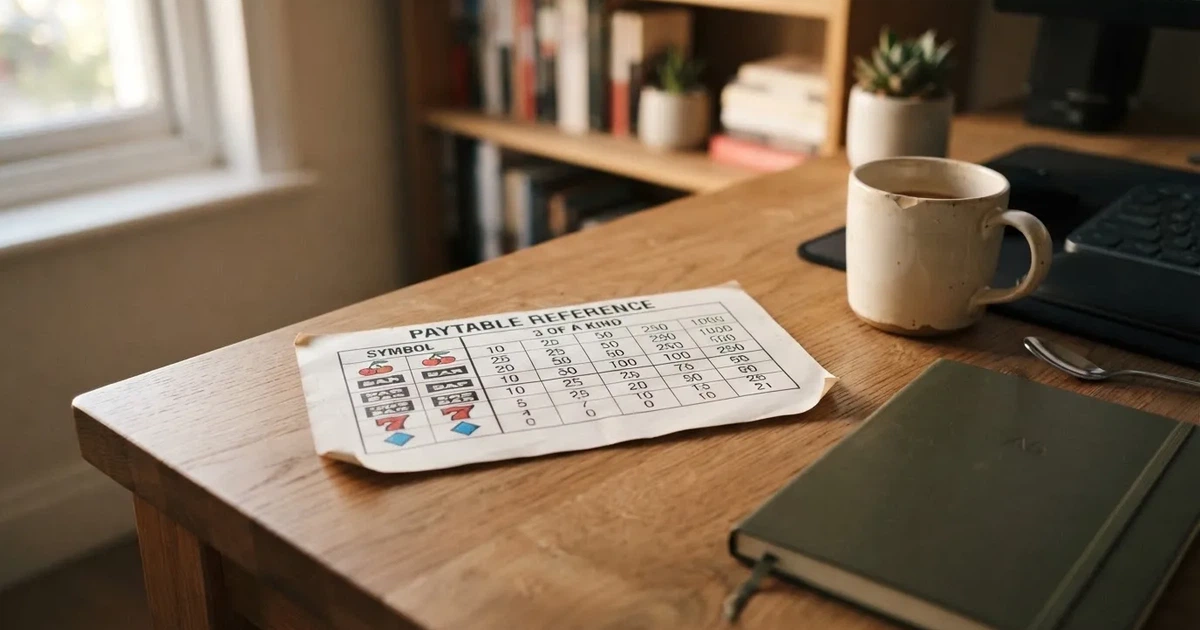
A paytable is the card a slot shows when the player taps the “i” or “?” button: a list of the symbols, what each one pays for a line of three, four or five, and the rules of the bonus features. For a Booming Games slot, the structure is recognisable across the catalogue, with the variation living in the theme and the feature set rather than in the math underneath.
The studio publishes four new games a month on its own site, and the catalogue covers classic three-reel shapes, five-reel video slots and the Hold and Win format that has become standard in the offshore market. Two of its slots — Tasty Rush Sweet Spots and Regal Coins Hold and Win — are advertised at a 5,000x stake maximum win, and Henhouse Hustle: Hold and Win at 6,000x. These are headline numbers; they describe the top end of a long-tail distribution, not the typical outcome of a session.
On the studio side, Booming Games (Malta) Limited is headquartered in Malta and holds a Malta Gaming Authority B2B licence numbered MGA/B2B/459/2018. It also holds a UK Gambling Commission account (#57254), and licences from Sweden’s Spelinspektionen, Ontario’s AGCO, and regulators in Romania, Denmark, Greece, Belgium, Germany and Brazil. The studio does not hold an Australian licence; there is no Australian regulator for game suppliers, because there is no Australian regulator for the product they would supply to. The studio describes itself as founded “nearly a decade ago” by a group of friends aiming to become one of the finest slot providers in the iGaming industry, without pinning down an exact founding year.
The paytable is the part of the slot the player can read before playing, and the part that varies least across the catalogue. A Booming Games paytable will show the high-pay symbols tied to the theme (food items in Tasty Rush, farm animals in Henhouse Hustle, coins in Regal Coins), the standard low-pay set (A, K, Q, J, 10 or styled equivalents), the Wild substitution rule and the Scatter trigger for the bonus feature. The bonus feature on the Hold and Win titles runs on a fixed grid with a defined set of prize symbols and a defined set of jackpot tiers. The math underneath the paytable is the Return to Player (RTP) percentage and the volatility rating — both published by some studios and not by others. Booming Games publishes some of these on a game-by-game basis and not others, which is a frustration for a player who wants to compare.
Three other studios named in the listings trail of the brands below are worth comparing against. Betsoft, founded in 2006, describes a catalogue of more than 200 RNG games spanning slots, table games, video poker and specialty titles, and states it partners with more than 500 operators across regulated markets in Europe, Scandinavia, Latin America and Africa under RNG certification from Quinel and Gaming Labs International and licensing through Italy’s ADM. Its slot The Slotfather — live since 13 December 2012 — runs at 95.69% RTP, “Medium” volatility, an 8.17% hit rate, on 5 reels and 30 paylines. Its slot Good Girl Bad Girl 2 runs at 96.22% RTP, “Very High” volatility, a 15.59% hit rate, on 5 reels and 20 paylines. 1spin4win, founded in 2021 and headquartered at Scharlooweg 39 in Willemstad, Curaçao under a Curaçao gaming licence, publishes a portfolio of more than 190 slots built in HTML5 for low-bandwidth connections, and reports more than 1,000 partnerships with online casinos and aggregators, with total bet sum up 46% in the first half of 2025 against the first half of 2024. Aristocrat Leisure, the Australian gambling-machine manufacturer founded in 1953 by Leonard Ainsworth, listed on the Australian Securities Exchange in 1996 under the ticker ALL, and now generating A$6.30 billion in annual revenue with A$1.55 billion of normalised net profit after tax and amortisation and 7,400 employees, runs its regulated online real-money-gambling business through Aristocrat Interactive, formed in April 2024 from the Anaxi unit and the newly acquired NeoGames group. Aristocrat is described as the largest gambling-machine manufacturer in Australia and the second-largest slot-machine manufacturer worldwide, behind International Game Technology. Aristocrat’s earlier bids — the US$1.3 billion Video Gaming Technologies acquisition in 2014, the US$500 million Plarium and US$990 million Big Fish Games deals in 2017, and the US$1 billion NeoGames deal in 2024 — trace a company that has been buying into online real-money gambling as a separate regulated business from its core land-based machine operation. None of this is Booming Games. The names look adjacent from the outside; the licences and the legal standing are different things.
A paytable is what the slot is. The maximum win is the top of the distribution. The RTP is the average over a very large number of spins. The volatility is the spread of outcomes around that average. A player who treats the paytable as the contract and the headline numbers as marketing is reading the slot the way the studio wrote it.
The Eleven Brands the ACMA Has Acted Against
The eleven brands below are not a ranking. They are the brands the ACMA itself has named in formal warnings or blocking rounds for offering prohibited interactive gambling services to people in Australia. The list is in the order the ACMA’s enforcement record places them. None of these brands is licensed to operate in Australia; the licence shown at the foot of any of their homepages is issued by an offshore regulator, and the offshore licence does not legalise the service in Australia. The table records the ACMA action, the operating entity the ACMA named, and what each brand’s own pages — and what third-party listings — say about whether Booming Games content is carried.
| Casino | Year first warned | Most recent ACMA warning | Operating entity (per ACMA) | Booming Games presence in listings |
|---|---|---|---|---|
| RocketPlay | 2022 | March 2026 | Pulsup Ltd (RocketPlay); earlier Dama N.V. | — |
| Level Up Casino | 2022 | May 2022 | Dama N.V. | Listed by Wazdan as a partner |
| Woo Casino | 2025 | March 2025 | Dama N.V. | — |
| Spirit Casino | 2025 | May 2025 | Dama N.V. | — |
| National Casino | 2025 | July 2025 | Consolutetish S.R.L. | Listed by Betsoft and Pragmatic Play as a partner |
| Bizzo Casino | 2022 | July 2025 | Consolutetish S.R.L.; earlier TechSolutions | — |
| Ignition Casino | 2025 | July 2025 | Bamboo Media | — |
| Instant Casino | 2025 | February 2025 | EOD Code SRL | — |
| Jackbit | 2026 | April 2026 | Ryker B.V. | — |
| Casino Intense | 2025 | April 2025 | Sterplay Holding Ltd | Listed by 1spin4win as a partner; reference at gamblingcommission.gov.uk |
| Sky Crown | 2022 | September 2022 | Hollycorn N.V. | — |
The fourth column records what each brand’s own pages — and what third-party listings — say about whether Booming Games content is carried. A dash means no Booming Games listing was found in the studio-side sources the research covered; the brand appears on this table because of its own ACMA record, not because of a confirmed Booming Games tie. The three entries with a named source — Level Up, National Casino and Casino Intense — carry third-party studio listings that confirm the operator carries real third-party content; none of those listings is from Booming Games itself.
RocketPlay — A Brand the ACMA Has Warned Twice
RocketPlay was first named by the ACMA in May 2022 as one of six Dama N.V. brands warned in a single round, and it was named again in March 2026 when the ACMA issued a fresh formal warning to Pulsup Ltd over RocketPlay.com.au. The intervening four years saw a change in the operating entity the regulator was dealing with — Dama N.V. in 2022, Pulsup Ltd in 2026 — and the regulator’s patience with the brand appear to have run out across both. The brand carries no listing for Booming Games content in the studio-side sources the research covered, so the Booming Games connection the search engine result implied is not confirmed by the studio’s own listings. The verdict, on the ACMA’s own record, is straightforward: a brand the Australian regulator has had to warn twice across four years, through two different operating entities, is not a brand an Australian player should be deciding to play at.
Level Up Casino — Six Years On, Still Outside the Framework
Level Up Casino was one of the six Dama N.V. brands the ACMA named in May 2022. The studio listings do pick the brand up — Wazdan’s partner pages include Level Up among its partners — but Booming Games’ own listings do not, and the studio-by-studio trail is what the research covers. The Wazdan listing is a positive signal that the brand carries third-party content from a regulated studio, which is more than some of the brands on this list can show, but it is not a Booming Games confirmation. The verdict is mixed. The ACMA action is the oldest on this list; there is no record of a follow-up warning in the years since. The underlying issue — the offering of prohibited services to Australians — has not changed in law, and the brand’s offshore licence does not address it.
Woo Casino — A March 2025 Warning Under Dama N.V.
The ACMA named Woo Casino in March 2025, again under Dama N.V. The studio’s own listings do not include this brand, so the connection implied by the search result is not supported. The ACMA action is recent; there is no earlier action on record for the brand. The verdict here is a single-data-point read: a brand the ACMA had to warn once is not, on its own, necessarily worse than the market around it — the ACMA has had to warn most of the offshore brands reaching Australian traffic — but the warning is the ACMA’s formal position, and the player who reads it knows what the regulator’s view is.
Spirit Casino — The Second Dama N.V. Warning in 2025
Spirit Casino is the second of the two Dama N.V. brands named in 2025, warned in May. The brand’s Booming Games content is not listed in the studio’s own partner pages, so the search-engine implication of a Booming Games–Spirit connection is not confirmed from the studio side. The ACMA action is recent. The verdict tracks the Woo Casino read with a two-month shift: a recent formal warning, no earlier record, and a market where being on the ACMA’s list is the norm rather than the exception.
National Casino — Third-Party Listings Without a Booming Games Confirmation
National Casino was named by the ACMA in July 2025, with the regulator naming Consolutetish S.R.L. as the operating entity. The studio listings do pick the brand up: Betsoft’s partner pages include National Casino, and Pragmatic Play’s pages include it as well. Booming Games’ own partner pages do not include the brand, so the implied search-engine connection is not confirmed at the Booming Games end. The verdict reflects a brand with a broader third-party content trail than most on this list, but a brand that nonetheless sits on the ACMA’s most recent warning list and is operating outside the Australian licensing regime. The Betsoft and Pragmatic Play listings mean the brand is buying content from studios that are not Booming Games; the absence of a Booming Games listing means the Booming Games side of the search result is the assumption rather than the confirmation.
Bizzo Casino — Two Warnings, Three Years Apart
Bizzo Casino has the longest tail on this list. The ACMA first named the brand in 2022 under TechSolutions (CY) Group Limited and TechSolutions Group N.V., and named it again in July 2025 under Consolutetish S.R.L. Two operating entities, three years apart, and the regulator has had to warn both. The brand’s Booming Games content is not listed in the studio’s partner pages. The verdict on this one is the harshest on the list: a brand the ACMA has had to warn twice across three years, with the operating entity changing in between, is a brand the regulator has decided will not comply without repeated action, and that pattern is what an Australian player is signing up to.
Ignition Casino — A July 2025 Warning to a New Operating Entity
The ACMA named Ignition Casino in July 2025, with Bamboo Media as the operating entity. This brand does not appear in the studio’s own partner listings. The verdict: a single, recent formal warning with no earlier record — the same shape as Woo Casino and Spirit Casino. Bamboo Media is a fresh operating entity in the research record; the regulator has not previously named it for any other brand.
Instant Casino — A February 2025 Warning Under EOD Code SRL
The ACMA named Instant Casino in February 2025, with EOD Code SRL as the operating entity. The brand carries no Booming Games content in the studio listings. The verdict: a single, recent formal warning; the brand is one of the more recent additions to the ACMA’s list and is operating under an entity that does not appear elsewhere in the research record.
Jackbit — The Most Recent Warning on This List
The ACMA named Jackbit in April 2026, with Ryker B.V. as the operating entity. The brand carries no Booming Games content in the studio listings. The verdict: the most recent action on this list, from a single named entity with no earlier record. Ryker B.V. is a fresh operating entity in the research record; the brand’s Australian-facing posture is a fresh question the ACMA has already answered once.
Casino Intense — Third-Party Listings, No Booming Games Confirmation
The ACMA named Casino Intense in April 2025, with Sterplay Holding Ltd as the operating entity. The studio listings pick the brand up — 1spin4win’s partner pages include Casino Intense — and the UK Gambling Commission’s published register also references the brand. Booming Games’ own partner pages do not. The verdict here is the inverse of National Casino’s: the brand has a meaningful third-party content trail, but that trail runs through 1spin4win and the UK Gambling Commission’s register rather than through Booming Games directly. The ACMA action is recent, and the brand is operating outside the Australian regime.
Sky Crown — An Older Entry with No Follow-Up
Sky Crown was named by the ACMA in September 2022, with Hollycorn N.V. as the operating entity. The brand carries no Booming Games content in the studio listings. Sky Crown is one of the older entries on this list — the ACMA’s earliest action on record sits here — and there is no follow-up warning in the research record. The verdict: a brand the regulator warned early in the post-2017 enforcement cycle, with no further action on record, but a brand whose offering of prohibited services to Australians remains the legal status quo.
The shape of this list tells its own story. Three of the eleven brands — Woo, Spirit and Level Up — sit under Dama N.V., with RocketPlay joining them under that same entity before its own 2026 re-warn under Pulsup Ltd. Two brands — Bizzo and National Casino — sit under Consolutetish S.R.L. The remaining six sit under six different entities. The list is not a coordinated set of brands from one operator group ignoring the ACMA; it is the ACMA naming whatever brand, whoever the operator, when the regulator has a basis to act. The mix of operating entities is the mix an Australian player is dealing with — a marketplace the ACMA approaches one operator at a time rather than as a single block.
Fundamentals: What the 2026 Australian Market Actually Looks Like
A player who has read this far has the layout of the market. The Interactive Gambling Act 2001 prohibits the offering of online casino games, online pokies and in-play betting to anyone in Australia, and the prohibition is enforced by a regulator with a steady pipeline of named brands, blocking requests and formal warnings. The offshore market is not licensed in Australia, is not subject to Australian consumer protection law, and cannot offer the customer any Australian complaints body to write to when something goes wrong. The licensed Australian market covers wagering on races and sport, lotteries and keno, with a closed deposit list and an established self-exclusion register. Booming Games itself is a real studio with a real licensing footprint, just not in Australia, and its slots appear on offshore sites that the ACMA has named in formal warnings.

The practical choices fall into three rough buckets, and they are not equally supported by the law. The first is the Australian-licensed bookmaker — wagering on sport and races, lotteries, keno, with the protections that come with an Australian licence: a closed payment list, BetStop, an Australian complaints body, and a regulator that can actually reach the operator. The second is the offshore casino that does not target Australian customers specifically and accepts them in passing. The third is the offshore casino that markets to Australian customers, often through affiliate sites designed to look like review pages. The second and third are both outside Australian law. The third is the one the ACMA most often has to act against.
For a player who has decided to play anyway, the operational details that follow from the law matter more than the marketing on the casino’s homepage. The casino can be blocked by an Australian ISP at the regulator’s request, including with a balance on it. The casino has no obligation to verify the player is over 18 in the Australian sense — Australian law cannot reach the casino to enforce that obligation. The casino’s KYC process exists to satisfy the casino’s own payment processor, not an Australian regulator, and the customer data the casino collects through that process is held offshore and outside Australian privacy law. None of this is a comment on the casino’s intentions. It is a comment on the law’s reach.
For a player who has not decided, the calculus is the same one the law has already made. Online casino play is a prohibited service in Australia. Offshore operators offering it to Australians are the operators the ACMA names in the rounds that have averaged somewhere in the low twenties per month across the last six and a half years. A punter who plays at one of those operators is not a punter the Australian framework protects, regardless of what the homepage says.
The choice, then, is not between two equal offers of online casino play. There is no locally licensed offer to choose between. The choice is between the Australian-licensed wagering on sport and races, which the law permits, and the offshore offer, which the law prohibits. The eleven brands in the ranking are the ACMA’s view of that offshore offer, with names attached.
Tax is the closing detail for an Australian recreational gambler. Gambling winnings are not assessable income under section 6-5 of the Income Tax Assessment Act 1997, and losses are not deductible, unless the person carries on a business of gambling. A casual punter who hits a withdrawal from an offshore casino does not owe tax on it; the offshore casino will not withhold any. The ATO treats recreational gambling as a private recreational activity, and the offshore casino’s home regime treats it as a commercial transaction. The two treatments do not collide, because neither is the Australian framework.
Frequently Asked Questions
Is Booming Games itself a casino operator, or just a slot studio?
Booming Games is a slot studio, not a casino operator. The company — Booming Games (Malta) Limited, headquartered in Malta — supplies slot content to casinos and aggregators under a Malta Gaming Authority B2B licence. It does not run an end-customer casino of its own; the games on the Booming Games website are demos, not real-money play.
Can Booming Games titles be played for real money at any locally licensed Australian casino?
No. Online casino play and online pokies cannot be licensed anywhere in Australia, so no Australian-licensed casino offers real-money slots of any kind, Booming Games included. The Booming Games slots that accept real money are on offshore casinos, which the ACMA has named in formal warnings.
What does a Booming Games paytable typically show?
A Booming Games paytable shows the theme-tied high-pay symbols, the standard low-pay set (A, K, Q, J, 10 or styled variants), the Wild and Scatter rules, and the bonus feature trigger. For Hold and Win titles, the paytable also shows the fixed grid, the prize symbols and the jackpot tiers. Maximum wins run up to 5,000x or 6,000x stake.
Why do offshore casinos keep highlighting Booming Games to Australian players?
Offshore casinos market Booming Games the way they market any well-known studio: the name lends familiarity to a homepage the customer has not heard of. The pitch works because Booming Games is a legitimate, licensed studio, and the licensing makes the casino look more credible than it is. The licensing is real; the inference is not.
What consumer protection covers an Australian playing at an offshore casino?
Effectively none from the Australian side. The Interactive Gambling Act 2001 targets the provider, not the customer. An offshore casino’s home regulator may respond to a complaint, but the response takes weeks and follows the operator’s terms. BetStop binds Australian-licensed operators only. The Australian protection that applies is the ACMA’s blocking regime, which closes the site rather than unwinding a disputed withdrawal.