
Best RTP Pokies in Australia 2026: Reading the Number That Matters
A high return-to-player figure is the most quoted selling point of any pokies machine. It is also the most easily misunderstood. The figure sits printed somewhere on the machine or on its help screen, often in small type, and it tells a player what the machine is programmed to return over an enormous number of spins — not what it will return on the next fifty. This guide explains how that figure is set in Australia, where it must legally appear, why the offshore sites that promise the highest numbers cannot actually deliver them to Australians, and how a player should weigh the figure against the rest of what a machine does.
Data current as of 28 October 2026. Licence status verified against ACMA formal-warning and blocking notices published on the regulator’s own site.
Table of Contents
- How to Read a Pokies RTP Figure
- The Australian Minimums, State by State
- Where the Figure Has to Appear
- What RTP Says About Wins, and What It Does Not
- The Online Picture in Australia
- The Pubs, Clubs and Casinos That Actually Run the Machines
- How a Shortlist of High-RTP Machines Is Built
- The Brands the ACMA Has Formally Warned
- The Paytable, the Math, and What a Figure Carries
- The Choice a Player Is Making
- Responsible Gambling and Where Help Is Found
- What the ACMA Enforcement Round Looks Like
- What the 2026 Reform Changes
- The Numbers That Actually Carry Weight
- Closing the Loop
- Frequently Asked Questions
How to Read a Pokies RTP Figure
RTP stands for return-to-player. It is the share of every dollar a machine takes in that it is programmed, on average, to give back across the full life of the game. A machine with a 90% RTP keeps, on average, ten cents in the dollar. A machine at 95% keeps five. The difference sounds small until it is run across a year of play.
Three things the figure is not. It is not the chance of winning on any single spin — every spin is independent, and the result is decided the moment the reels stop. It is not a guarantee that any player will see that return — the figure is an average over an enormous sample, and any session of normal length can sit well above or well below it. And it is not a setting a venue can quietly change after the machine is on the floor. Australian regulators require the figure to be disclosed on the machine, and the minimum is set in law.
The published figure is calculated across simulated play — billions of spins run in software before the game ever reaches a pub or club. A player sitting at the machine plays through a tiny, unrepresentative slice of that history. The figure is therefore a forecast of the machine’s behaviour over time, not a prediction of what it will do this afternoon.
The Australian Minimums, State by State
Each Australian state and territory sets its own minimum return-to-player. The numbers cluster, but they are not identical, and a player who moves between jurisdictions is moving between different floors for what a machine may return.
New South Wales, the Northern Territory, Queensland and most of Victoria set the floor at 85%. Crown Melbourne sits at 87% by agreement with the Victorian regulator. The Australian Capital Territory and Tasmania both run at 87%. South Australia is set at 87.5%. Western Australia, the outlier, has held a 90% minimum since Crown Perth opened in 1985 — and that casino is the only place outside the state where ordinary punters can sit at a poker machine at all.
Those are floors, not targets. A venue or a casino operator can install machines that return more than the minimum, and the highest figures found on Australian floors tend to sit a few percentage points above the floor in each state. The licensed machine in front of a player will carry a figure somewhere between the legal minimum and whatever the operator has chosen for that title.
Where the Figure Has to Appear
Australian regulation requires the RTP to be disclosed on the machine, not buried in marketing. A player who cannot find the figure on the cabinet, on the help screen, or in the printed information attached to the machine is looking at a game whose return has not been presented in the form the rules require. The disclosure exists so a player can compare one machine against another in the same venue, and one venue’s floor against another in the same state.
For the online sites that accept Australian players, there is no Australian rule that applies. The Interactive Gambling Act makes it an offence to provide online casino games — including online pokies — to a person physically in Australia. Any figure an offshore site publishes is a number the operator chose to print; it is not certified by an Australian regulator and it is not enforced against the player who finds it wrong. The offshore figure may even match the Australian onshore minimum, but it is still not the same product — the offshore site sits outside every Australian consumer protection.
What RTP Says About Wins, and What It Does Not
A higher RTP figure does not mean bigger individual wins. It means the machine returns a larger share of what it takes in, across the long run. A 95% machine does not pay out more often than a 90% one; the payouts are structured to add up to a higher share, with the difference distributed across thousands of spins in ways a player cannot easily see.
What a higher figure does tend to mean is that the machine runs closer to break-even for the player across the long run. That sounds like a benefit. In a setting where the house edge is between 5% and 15% depending on the title and the jurisdiction, the difference between 90% and 95% is the difference between losing ten cents in the dollar and losing five. On an afternoon’s play that distinction rarely shows up. Across a year of regular sessions it is meaningful.
A higher figure also does not change the volatility of the game. Volatility is how the wins are distributed — whether a machine pays out small amounts often, or larger amounts rarely. A high-RTP machine can still be highly volatile, meaning long stretches with little back and the occasional large win. A player who picks a machine on RTP alone and ignores volatility is picking on half the information that matters.
The Online Picture in Australia
Online pokies are prohibited for people in Australia under the Interactive Gambling Act 2001, strengthened by the Interactive Gambling Amendment Act 2017. No Australian state or territory licences online casino games or online pokies. What is licensable in Australia is wagering on racing and sport placed before the event, lotteries, and keno. That is the regulatory floor a player is standing on before considering any online offer.
The Northern Territory Racing and Wagering Commission regulates most of Australia’s licensed online bookmakers — including Sportsbet, Bet365 and Ladbrokes — because the operators incorporate in the Territory for tax reasons. The commission runs with no full-time staff and meets monthly in Darwin. The bookmakers it regulates offer wagering on sport and racing, not online pokies.
The picture on offshore sites is the inverse. The ACMA had asked Australian internet service providers to block 1,751 illegal gambling and affiliate marketing websites as of June 2026, with the first blocking request issued in November 2019. That works out to roughly 264 sites blocked per year across the period enforcement has been running. The figure is not a forecast of the next round; it is a measure of how many sites have appeared and been acted against, and the pace has not slowed. More than 230 unlicensed services have left the Australian market since 2017, when enforcement was strengthened.
The economic case for the enforcement sits in plain numbers. H2 Gambling Capital’s 2025 report estimates Australians lose about A$3.9 billion a year to illegal gambling sites, and the share of gambling going through legal channels fell from 74% in 2021 to 64%. A player looking at a high RTP figure on an offshore site is looking at a product sitting inside that A$3.9 billion figure, not beside it.
The Pubs, Clubs and Casinos That Actually Run the Machines
Electronic gaming machines operate in every Australian state and territory, and each jurisdiction regulates their design and operation separately. The first legal poker machines in the country ran in New South Wales registered clubs from 1956, and the country’s machine base has grown from there. In 2020–21 Australians bet almost A$150 billion through gaming machines and lost A$12.18 billion on them, across a country with roughly 3% of the world’s pub and club poker machines and 0.3% of the global population.
New South Wales carried 87,298 gaming machines outside casinos across 2,195 venues as of June 2023, with player losses of A$8.18 billion in 2022–23. Queensland had 21,122 machines across 351 venues in October 2023. Victoria ran 26,380 machines outside Crown Casino across 488 venues in 2021–22, under a statewide cap of 30,000. Western Australia’s pub and club floors carry no machines — Crown Perth’s roughly 2,500 machines, grown from about 200 in 1985, are the only legal machines in the state.
Tasmania ran under a single-operator monopoly held by the Federal Group from 1968 until legislation in November 2021 ended it and moved oversight of the machines to the Tasmanian Liquor and Gaming Commission. Tasmania also planned nation-leading mandatory pre-commitment cards, with implementation delayed until late 2025. The pre-commitment system, when active, sets a spending limit a player agrees to in advance and is independent of the RTP figure — the limit caps losses, the figure shapes how fast they accumulate.
How a Shortlist of High-RTP Machines Is Built
A comparison of high-RTP pokies is built on a small number of inputs. The first is the disclosed RTP figure on the machine itself, or in the technical sheet the manufacturer publishes for the regulator. The second is volatility — a published rating from the manufacturer, sometimes carried on the game’s information screen, that tells a player whether the machine pays out small amounts often or larger amounts rarely. The third is the game design — the number of paylines, the bonus features, the bet size required to qualify for the top prizes.
A serious comparison drops machines whose RTP figure cannot be verified. A machine that prints no figure, or whose figure is only available on a marketing page rather than the cabinet, is not a candidate. The same applies to a machine whose volatility is described vaguely — “medium to high” with no further breakdown — rather than rated on the standard scale.
The order a shortlist takes depends on what a player is choosing between. A player who wants a long session on a small bankroll wants high RTP and low volatility — the figure that returns the most, distributed in a way that keeps the bankroll alive long enough to enjoy the session. A player chasing a larger single prize wants high RTP and high volatility — the same average return, but concentrated in fewer, larger payouts. The two profiles want different machines, and a list that ranks by RTP alone serves neither well.
A shortlist that lists offshore sites alongside licensed Australian venues is mixing two products that do not compare. The licensed Australian venue operates under state law, with a disclosed and enforced RTP, with a regulator the player can complain to, and with the protections that follow. The offshore site operates under no Australian law, with an RTP figure the operator chose to print, with no regulator the player can reach, and with the protections that do not follow. Both can carry an RTP figure in the high nineties; only one of them is a regulated Australian product.
The Brands the ACMA Has Formally Warned
The following eleven brands have each received a formal warning from the ACMA for offering prohibited services to Australians. They are listed here because the regulator itself acted against them, not because any of them is a recommended place to play. Online casino games cannot be licensed in Australia; a formal warning means the regulator has found a site offering them anyway.
| Brand | ACMA action and date | Operator named by the ACMA | Subject support |
|---|---|---|---|
| RocketPlay | Formal warning, March 2026 (Pulsup Ltd); earlier Dama N.V., May 2022 | Pulsup Ltd | — |
| Level Up Casino | Formal warning, May 2022 | Dama N.V. | listings-only (Bgaming) |
| Woo Casino | Formal warning, March 2025 | Dama N.V. | — |
| Spirit Casino | Formal warning, May 2025 | Dama N.V. | — |
| National Casino | Formal warning, July 2025 | Consolutetish S.R.L. | listings-only (en.wikipedia.org) |
| Bizzo Casino | Formal warning, July 2025 (Consolutetish S.R.L.); earlier 2022 (TechSolutions) | Consolutetish S.R.L. | — |
| Ignition Casino | Formal warning, July 2025 | Bamboo Media | — |
| Instant Casino | Formal warning, February 2025 | EOD Code SRL | — |
| Jackbit | Formal warning, April 2026 | Ryker B.V. | — |
| Casino Intense | Formal warning, April 2025 | Sterplay Holding Ltd | listings-only (Abc.net.au, acma.gov.au, Crownmelbourne.com.au) |
| Sky Crown | Formal warning, September 2022 | Hollycorn N.V. | — |
The “Subject support” column records what those listings report about whether the brand carries high-RTP pokies content, and only that — it is not the operator’s own statement, and it does not convert a formal warning into an endorsement of the product. Where research carries no information on a brand’s high-RTP pokie content, the column carries the no-data marker rather than a guess. A player looking at any of these brands is looking at a site the regulator has formally warned for offering prohibited services in Australia; the high RTP figure the site may publish sits inside that fact, not beside it.
The Paytable, the Math, and What a Figure Carries
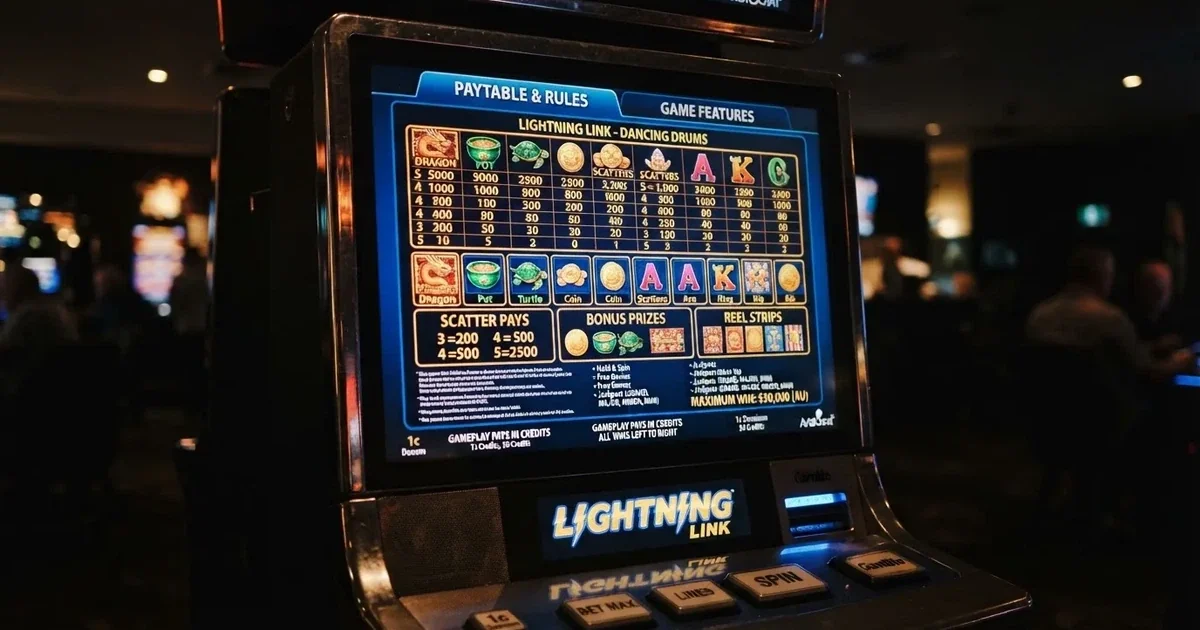
The paytable on a pokies machine is the screen that lists what each symbol combination pays, what the bonus features trigger, and what the maximum payout is. The RTP figure is calculated from that paytable, weighted by how often each combination lands across the billions of spins the software simulates. A player who reads the paytable is reading the inputs to the figure the regulator has stamped onto the cabinet.
What the figure carries is a sense of how much of every dollar comes back across the long run. What it does not carry is the volatility — the distribution of payouts — and that distribution is what decides the texture of a session. A player sitting down at a 95% machine with high volatility will see long quiet stretches and occasional large payouts. The same 95% on a low-volatility machine will pay smaller amounts more often. The figure is the same; the experience is not.
The arithmetic is the same for any machine, anywhere. The house keeps the share the figure does not return. On a 90% machine the house keeps 10 cents in the dollar. On a 95% machine it keeps 5. The difference, run across the year, is the difference between an expensive hobby and a slightly more expensive one. Neither is a path to profit; both are paths to a regulated entertainment product that returns most of what it takes in, in a jurisdiction where the consumer protection machinery actually works.
The Choice a Player Is Making
A player reading the term “best RTP pokies” is making two decisions at once. The first is which machine, on which floor, in which jurisdiction, with which figure and which volatility profile. The second is whether to play that machine at a regulated Australian venue at all, or to look offshore for a higher figure with no Australian rule behind it.
The honest read of the first decision is that high-RTP machines exist in every Australian state and territory. The floor varies; the machines above the floor vary; the published figure is on the cabinet. The comparison is between products the regulator has inspected, with a complaints body the player can reach if a payout is refused.
The honest read of the second is that the offshore figure is not the regulated product. The offshore site can publish any figure it likes; it cannot make the figure enforceable by an Australian regulator, because the regulator’s jurisdiction ends at the coast. The player comparing a 96% offshore figure against a 92% onshore one is comparing a number an operator chose to print against a number a regulator stamped onto a cabinet. The offshore number is not better — it is just less accountable.
What the choice comes down to is the kind of protection a player wants when something goes wrong. A machine that refuses a payout at a regulated Australian venue is a machine the venue operator and the state regulator can be asked about. A site that refuses a withdrawal is a site the player has limited recourse against, sitting in a jurisdiction the ACMA can ask ISPs to block but cannot otherwise reach.
Responsible Gambling and Where Help Is Found
The responsible gambling supports relevant to high-RTP pokies in Australia run through state-level self-exclusion registers, the National Self-Exclusion Register known as BetStop (live since August 2023), and Gambling Help Online, which carries the National Gambling Helpline on 1800 858 858. The Helpline is free, runs 24/7, and is reachable by chat as well as by phone.
BetStop binds Australian-licensed online and phone wagering services — that is, the licensed bookmakers regulated by the Northern Territory Racing and Wagering Commission and their state-level equivalents. An offshore casino is not connected to BetStop, which is one of the consumer-protection gaps the offshore product carries. A player who has self-excluded through BetStop and then opens an offshore account has not broken the exclusion — the offshore account was never inside it. The exclusion is doing what it was designed to do, on the product it was designed to cover.
State-level self-exclusion registers cover the venues themselves. A player who excludes from a venue or a chain of venues cannot be paid a machine payout at those venues for the period of the exclusion. The exclusion, again, applies to the regulated product. The offshore site carries no equivalent, because no Australian regulator binds it.
The minimum age for any gambling activity in Australia is 18. The credit card ban that took effect on 11 June 2024 — applying to credit cards, credit-related products and digital currency used as payment for licensed online wagering — is another consumer protection the offshore product does not carry. A site asking an Australian for a credit card or a crypto deposit is operating outside the Australian rules; the payment method alone is a signal the product is not the regulated one.
What the ACMA Enforcement Round Looks Like
The ACMA’s enforcement work runs in two parallel tracks. The first is the formal warning, issued to the operator behind a site offering prohibited services to Australians. The second is the blocking request, sent to Australian internet service providers asking them to block access to those sites at the network level.
The June 2026 round added twelve sites to the blocking list: 7Signs, ChromaBet, Donbet, Duospin, Freshbet, Slots Gem, Jacks Club, Lucky Start, Pointsbetz, Spinrise, Vinyl Casino and Wildsino. Each of those names is the site the ACMA named in that round; the operators behind them sit in various offshore jurisdictions, not in Australia.
The blocking list now runs to 1,751 illegal gambling and affiliate marketing websites since the first blocking request in November 2019. The pace — roughly 264 sites per year over the period — has held fairly steady, which is itself information. New sites appear faster than the existing ones are resolved, which is why the round keeps producing new names rather than winding down.
The formal warning track has produced its own record. The ACMA issued a formal warning to Pulsup Ltd over Rocketplay in March 2026, to Ryker B.V. over Jackbit and CasinOK in April 2026, to Bamboo Media over Ignition Casino and to Consolutetish S.R.L. over National Casino and Bizzo Casino in July 2025, to Sterplay Holding Ltd over Casino Intense in April 2025, to EOD Code SRL over Instant Casino in February 2025, and to Dama N.V. over Woo Casino in March 2025 and Spirit Casino in May 2025. Earlier warnings cover Hollycorn N.V. over Sky Crown and Blue Leo in September 2022 and Dama N.V. over Bambet, Dazard, Level Up, Rocketplay, Wild Tornado and Cobra Casinos in May 2022. The list is the regulator’s own; this guide is not adding to it.
What the 2026 Reform Changes
The Interactive Gambling Amendment (Gambling Reform) Bill 2026 passed Parliament on 19 August 2026. Its advertising and inducement measures commence on 1 January 2027. A reader on this page in 2026 is reading law that has been passed but not yet commenced — the relevant measures are not in force, and any change to what offshore sites can advertise to Australians sits ahead of the calendar rather than behind it.
The reform does not change what is licensed onshore. Online casino games remain prohibited; the only licensable online products remain wagering on racing and sport placed before the event, lotteries and keno. The reform targets how licensed operators and offshore operators alike can advertise, with the inducement measures aimed at the kind of bonus offer and sign-up deal that has driven the offshore traffic in the first place.
A player reading this page before commencement is reading a market in transition. The blocking round continues. The formal-warning round continues. The A$3.9 billion estimated annual loss to illegal sites continues. The reform adds another lever on top of those, with a start date a few months ahead.
The Numbers That Actually Carry Weight
Several figures on this page are worth holding in mind, because they are the ones that change the decision rather than decorate it.
The minimum RTP by jurisdiction, from 85% in New South Wales, the Northern Territory, Queensland and most of Victoria to 90% in Western Australia, sets the floor under what any licensed machine can return. A machine carrying a figure below the floor of the state it sits in is not a licensed machine.
The 1,751 sites blocked since November 2019, at roughly 264 per year, sets the scale of the offshore market the ACMA is acting against. The June 2026 round alone added twelve names; the next round will add more.
The A$3.9 billion in estimated annual losses to illegal gambling sites, and the fall in legal-channel share from 74% in 2021 to 64%, sets the economic gravity a player is sitting inside. The high RTP figure an offshore site publishes is one input into that gravity, not a counterweight to it.
The 2026 reform’s commencement date of 1 January 2027 sets the timeline. A reader on this page in 2026 is reading the law as passed, not as in force; the inducement measures begin next year.
The 1,751 blocked sites and the 6.5 years between November 2019 and June 2026 produce a blocking rate in the band of roughly 260 to 270 sites per year, assuming the pace has held across the period. The figure is a measure of the offshore market’s turnover, not a forecast of the next round — but it tells a player how much churn the regulator is dealing with, and by extension how much new offshore product keeps appearing to be blocked.
Closing the Loop
A high RTP figure on a pokies machine is a useful number, and a player who reads it correctly is reading one input into a decision that has several others. The figure is on the cabinet. The state has set a minimum. The volatility profile shapes what the figure feels like in practice. The venue is licensed. The regulator has a complaints body. The payout, if disputed, has somewhere to go.
The same figure on an offshore site is the same number with none of the structure behind it. The regulator cannot enforce it. The complaints body cannot reach it. The blocking round has already covered the operator, or will. The site is sitting inside the A$3.9 billion annual figure, and the 1,751-and-counting blocked-sites list, and the reform’s inducement measures when they commence.
The choice a player makes when they read the term “best RTP pokies Australia” is the choice between a regulated product with a stamped figure and an unregulated product with a printed one. Both can carry a high RTP number. Only one of them is the Australian product the term refers to.
Frequently Asked Questions
What counts as a ‘high’ RTP figure on an Australian pokies machine?
The legal floor sits between 85% and 90% depending on the state, so anything meaningfully above the floor for the relevant jurisdiction is a high figure for that floor. Western Australia, with a 90% floor, sees fewer machines above the floor than a state with an 85% floor, because the operator has less room to go higher. A figure of 95% or above is unusual on an Australian licensed floor, and a figure above 97% is rare enough to warrant a closer read of the paytable.
Is RTP the same thing as the chance of winning on any single spin?
No. RTP is the share of every dollar returned across an enormous simulated number of spins. The chance of any single spin producing a payout of any size is set by the paytable and is independent of the RTP figure. A high-RTP machine can produce long stretches with no payout at all, and a low-RTP machine can produce an early payout that the long run then averages out. The figure describes the average, not the next spin.
Where is a pokies machine’s RTP figure legally required to be disclosed in Australia?
The figure must appear on the machine itself or on its help screen, and in the printed information attached to the cabinet. A machine whose figure is not on the cabinet, and is only available through marketing material, has not met the disclosure requirement. The same rule does not apply offshore — an offshore site can publish any figure it likes, on any page it likes, with no Australian regulator behind the number.
Can a venue change a machine’s RTP setting after it’s installed?
No. Australian licensed machines are sealed, and the regulator inspects the seal. A venue cannot quietly lower the figure to recover margin, and a player who finds the figure has changed since the last visit is looking at an unlicensed modification. The technical sheet the manufacturer files with the regulator matches the figure on the cabinet, and any gap between them is the regulator’s problem to find.
Does a high RTP figure mean smaller or larger individual wins?
It means neither. The figure is the average return, and the distribution of that return — the volatility — is a separate property of the game. A high-RTP machine with low volatility pays smaller amounts more often. A high-RTP machine with high volatility pays larger amounts less often. The total across enough spins adds up to the same high figure; the experience of getting there is different.
How does the number of pokies machines vary between Australian states?
New South Wales carries the largest machine base by a wide margin, at 87,298 machines outside casinos across 2,195 venues as of June 2023, with player losses of A$8.18 billion in 2022–23. Victoria runs 26,380 machines outside Crown Casino across 488 venues under a statewide cap of 30,000. Queensland runs 21,122 machines across 351 venues. Western Australia runs no machines outside Crown Perth’s roughly 2,500, because the state banned poker machines in pubs and clubs when Crown Perth opened in 1985.