
Best Casino in Tasmania: The Two Venues, the Game Floor, and the Online Sites Australians Cannot Legally Use
Data current as of 28 October 2026 · verified against the Australian Communications and Media Authority’s published formal warnings, the Tasmanian Liquor and Gaming Commission, and the federal Interactive Gambling Act 2001.

Tasmania runs two casinos and only two — Wrest Point in Hobart and the Country Club in Launceston — both under the same family-owned operator, Federal Group, that has held Tasmania’s gambling licence for decades. There is no third venue, no licensed online casino, and no state-level licence that would make one possible: the Interactive Gambling Act 2001 closes that door federally, and the Australian Communications and Media Authority spends each year closing it again by blocking the offshore sites that try to offer their services to Australians anyway. The choice a Tasmanian (or a Tasmanian visitor) actually has, then, is not “which site” but “which venue, which floor, which game — and what to do about the offshore sites whose ads still find their way into an inbox.”
This page lays out both doors. The first part is the two real casinos — where they sit, what they run, the age rule, the hotels around them and the table games on the floor. The second part is the regulatory frame that decides what is and is not legal for an Australian gambler: the IGA itself, the ACMA’s enforcement record, the cashless gaming card that landed in Tasmanian hotels and clubs in late 2025, and the responsible-gambling support that is actually Australian, not a chat window on an offshore site. The third part is a shortlist of the eleven brands the ACMA has named in formal warnings over the past four years — written not as a ranking to choose from but as a record of what Australians have been advertised, why each was warned, and what the listings say about the brand beyond that warning. The article closes on the practical question — what the two casinos offer, and what an Australian’s options really are — without recommending either.
Table of Contents
- Wrest Point and the Country Club: The Two Casinos Tasmania Actually Has
- What the Game Floor Looks Like at Wrest Point and the Country Club
- Hotels, Bars and the Surrounding Precinct
- What the Law Says About Online Casinos in Australia
- Responsible Gambling in Tasmania
- The Eleven Brands the ACMA Has Named in Formal Warnings
- The Two Casinos, in the Order Most People Will Visit Them
- Frequently Asked Questions
Wrest Point and the Country Club: The Two Casinos Tasmania Actually Has
Wrest Point, Hobart — Australia’s First Legal Casino
Wrest Point sits on Sandy Bay Road in the Hobart suburb of Sandy Bay, about three kilometres south of the city centre, looking back over the Derwent River. It opened on 10 February 1973 as Australia’s first legal casino, and the building has since been absorbed into a hotel complex with around 200 rooms, several restaurants and the Myer Point drinking and dining precinct that overlooks the water. The casino floor takes up much of the lower levels, and most of what a visitor notices on the way in is the bar-and-bistro spine that connects the gaming rooms to the hotel lobby. Sandy Bay itself is a quiet residential and student pocket, so the surrounding streets are mostly houses, small cafes and a couple of motels — the busy part of Hobart is back across the river, with Wrest Point’s own facilities doing most of the heavy lifting on food, drink and accommodation for casino visitors.
The building has gone through several expansions since 1973, and a stay there tends to feel like a single block of hospitality rather than a casino-with-a-hotel-attached: the gaming floor connects directly to the reception, several of the bars overlook the river, and the upper floors hold the function rooms that Federal Group markets to conferences. The casino itself runs a standard mix of table games and electronic gaming machines, with a poker tournament schedule and a few hundred pokies laid out in tiers around the main bar.
Country Club Casino, Launceston — the Northern Venue
The Country Club Casino and Resort sits on Country Club Avenue in Prospect, just over the bridge from Launceston’s central business district, and was opened by Federal Group in 1982. The design was modelled on the stately homes of the American South — a deliberate Georgian style chosen to suit the rural landscape and the farmland around the edge of Launceston — which gives the building the look of a country manor from the outside and a working resort from the inside. The complex includes a hotel, an 18-hole golf course that wraps the property, a spa, conference facilities and several restaurants, with the casino floor tucked into the lower levels of the main building.

For visitors, the practical difference between the two venues is mostly geography. Wrest Point draws the Hobart crowd and the cruise-ship day-trippers from the port; the Country Club draws Launceston’s locals, the Tamar Valley wine region, and the north-west touring route that ends at Cradle Mountain. Both venues are owned and operated by Federal Group, the Farrell family-controlled Tasmanian company that took the gaming monopoly in the state under the Gaming Control Act 1993 and continues to hold the casino licences directly.
The Federal Group Monopoly and What Happened to It
Federal Group’s history in Tasmanian gambling goes back further than either casino. The group originated as the Federal Coffee Palace Company Limited, founded in Melbourne in June 1885; the Farrell family acquired majority ownership of its holding company by 1989 and privatised the group in 1990. Under the Gaming Control Act 1993, Federal Group held the exclusive licence to operate electronic gaming machines outside its two casinos in Tasmania — a privilege that, at its peak, delivered operating profit through the Mulawa Holdings structure of nearly $24.4 million in the year to 30 June 2018, on revenue of $543 million, while paying about $75 million in gaming taxes and licence fees to the Tasmanian government. In August 2017 the group relinquished that monopoly, allowing individual pubs and clubs in Tasmania to hold their own machine licences. The casino licences themselves were not affected by that decision: Federal Group remains the operator of both Wrest Point and the Country Club.
What the Game Floor Looks Like at Wrest Point and the Country Club
Table Games on Offer
Both venues run the standard Australian casino table-game mix — blackjack, roulette, baccarat, and the main stud and draw poker formats. Craps is also available at Wrest Point, which is the more consistently American-style of the two floors; the Country Club, by virtue of its smaller footprint, runs a tighter game list with a heavier weighting toward electronic gaming. Players who specifically want a live baccarat or craps table in Tasmania will find the deeper schedule at Wrest Point, while the Country Club suits a visitor who wants to combine a casino evening with a meal in the resort’s restaurant or a round on the golf course the following morning.
A working knowledge of the games matters more at Wrest Point than at the Country Club, because the table minimums tend to sit a notch higher in Hobart — a function of the venue’s history as the only high-limit Australian casino game floor in the country for the first decade of its life. New players on either floor should ask the dealer or floor supervisor about minimum and maximum stakes before sitting down; the casino will not advertise these on the table itself, and the difference between a $5 minimum and a $25 minimum is the difference between an evening and a half-hour.
Electronic Gaming and the Move to Cashless Carded Play
Pokies, the Australian term for slot-style gaming machines, make up the bulk of the gaming floor at both venues. The two casinos are, however, treated differently under the cashless gaming card reform that landed in Tasmanian hotels and clubs in December 2025: under that reform, hotel and club poker machines began mandatory carded play from that month, with default loss limits of $100 per day, $500 per month and $5,000 per year — limits raisable only after a minimum 24-hour waiting period. The system is overseen by the Tasmanian Liquor and Gaming Commission, and as of September 2024 no casino rollout date had been set. Practically, this means a player walking into Wrest Point or the Country Club today is still on the casino’s own cash-and-card system, not the state-monitored cashless card; once the casino rollout lands, the same daily, monthly and yearly ceilings will apply to casino play, with the same 24-hour wait before any of them can be raised.
For a player who is travelling through Tasmania and plans to play on a single evening, the absence of the cashless card at the casino is good news — they can settle their play at the cashier’s window and walk out. For a Tasmanian local who plays regularly at either venue, the eventual rollout will be the moment the state’s loss-limit framework begins to govern casino play as it already governs pub and club play. The cashless card is not a ban on gambling and not a sobriety test; it is a record-keeping system that lets the venue, the player and the regulator see the same numbers.
Age Limit and Entry Rules
The minimum age to enter either casino and to play any game on the floor is 18. The rule is the same across Australia — the Interactive Gambling Act 2001 and every state and territory gaming statute converge on 18 as the universal gambling age, and Tasmania’s casino operators enforce it at the door with photo identification. New players should expect to be asked for ID on first entry even if they look over 25; it is faster than arguing at the door. The two casinos do not admit anyone under 18 to the gaming floor at any time, and do not allow anyone under 18 in the gaming rooms even as a spectator after hours.
A related rule worth knowing is that Federal Group runs a venue self-exclusion scheme on top of the federal BetStop register, and a player who wants to bar themselves from Wrest Point or the Country Club can do so through either system. Venue-level exclusion is faster and is enforced at the door; the national register (see the responsible-gambling section below) takes longer to apply and binds more services, but does not bind any offshore casino. The two systems are not mutually exclusive, and a player who wants both should register for both.
Hotels, Bars and the Surrounding Precinct
Staying at Wrest Point
Wrest Point’s hotel rooms sit in two adjoining towers that share the riverfront with the casino building. A room booking here is usually the easiest answer to “where do I stay to be near the casino” in southern Tasmania, because the casino floor is one lift ride from the lobby and the Myer Point precinct — the casino’s own collection of restaurants and bars on the upper level — runs without the venue having to be a separate outing. Rooms look out over the Derwent, the bridge and the Hobart CBD; the casino rooms on the lower floors are less about the view and more about the convenience. For visitors who want to be on the casino floor for an evening session and at a Tasmanian wine region’s breakfast table the next morning, Wrest Point is the obvious base.
The bar that has come to define Wrest Point in public discussion is the casino rooftop bar, which sits at the top of one of the towers and looks north over the river and the city. It is not the only bar in the building, but it is the one with the view, and it is the reason the casino turns up in Tasmanian tourism guides as a destination rather than just a gaming venue.
Staying at the Country Club
The Country Club’s hotel has fewer rooms than Wrest Point’s but a quieter setting: the property sits inside its own grounds, on the edge of the golf course, and the building’s Georgian styling carries through to the interior. A stay here usually combines a casino visit with a meal in one of the resort’s restaurants and, for many visitors, a round of golf the next morning. Launceston’s CBD is across the river and a short drive away, but most of what a casino visitor needs — restaurants, bars, the spa — is on-site.
Walking-Distance Hotels and Nearby Accommodation
For visitors who would rather not stay inside either casino complex, the surrounding neighbourhoods have a small set of independent options. Sandy Bay, where Wrest Point sits, has a handful of motels and B&Bs within a five-to-ten-minute walk of the casino’s front door; the inner Hobart suburbs north of the river are a fifteen-minute drive and hold most of the city’s chain hotels. Around the Country Club, Prospect and the neighbouring Launceston suburbs have a smaller motel cluster, and the CBD itself has the bulk of Launceston’s hotel rooms about ten minutes away by car.
There is no casino district in Tasmania — neither Wrest Point nor the Country Club is embedded in a strip of competitor venues, and the casino visitor is unlikely to be picking between two floors on the same night. The choice is between two cities, and the practical question is which one the visitor’s itinerary puts them closer to.
What the Law Says About Online Casinos in Australia
The Interactive Gambling Act 2001 and What It Prohibits
The Interactive Gambling Act 2001, strengthened by the Interactive Gambling Amendment Act 2017, makes it an offence to provide online casino games, online pokies or in-play betting to a person physically in Australia. The law does not prohibit wagering on races and sport that is placed before the event, lotteries and keno — those are licensable, and in practice the Northern Territory Racing and Wagering Commission regulates 52 of Australia’s online bookmakers, including Sportsbet, Bet365 and Ladbrokes, licensed in the Territory for tax reasons and meeting once a month in Darwin in a commission that has no full-time staff. What no state or territory licenses is online casino games. The IGA targets the provider, not the individual player: an Australian who opens an account with an offshore casino is not personally breaking the law, but the site they are using is breaking it by offering services to Australians.
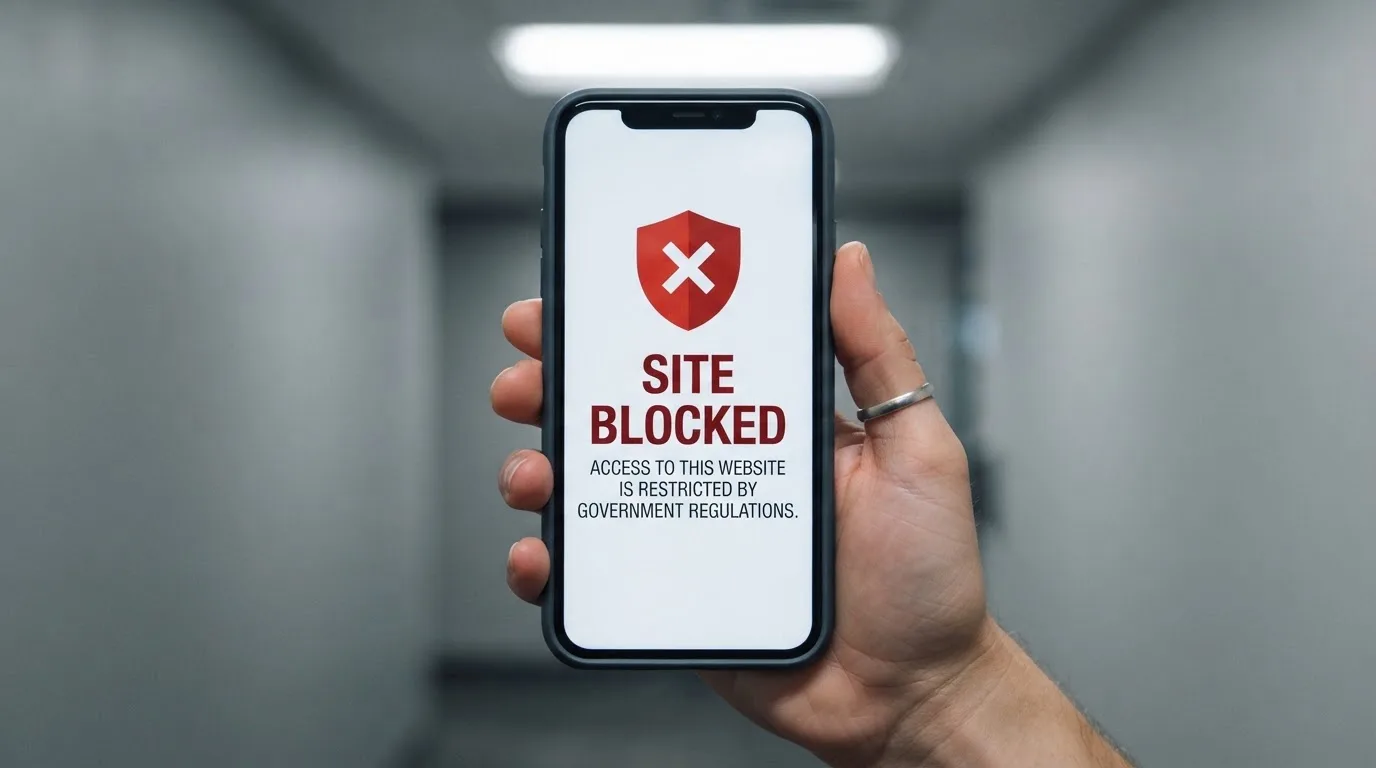
The 2017 amendments gave the Australian Communications and Media Authority (ACMA) its current enforcement powers, and the ACMA has used them consistently since. In a single round reported on 26 June 2026, the ACMA asked Australian internet service providers to block 12 more illegal gambling websites — 7Signs, ChromaBet, Donbet, Duospin, Freshbet, Slots Gem, Jacks Club, Lucky Start, Pointsbetz.com, Spinrise, Vinyl Casino and Wildsino — bringing the total number of illegal gambling and affiliate marketing websites blocked since the first blocking request in November 2019 to 1,751. More than 230 unlicensed gambling services have left the Australian market since 2017. The blocking is real: the site stops loading on Australian internet connections.
What a Formal Warning Means
A formal warning is the ACMA’s first recorded enforcement step, sitting below a civil penalty proceeding but above a quiet note. Each warning names the operator company behind the site and the URL the ACMA says it acted against; the warning is published on the ACMA’s website and remains on the public record. A site that has been warned once and continues to offer services to Australians will, on the ACMA’s recent pattern, be warned again and eventually blocked. A player using the site at the time of blocking may still have money sitting in the account, and the ACMA has no power to force a payout — the offshore operator is outside Australian consumer law.
Payments, Credit Cards and Crypto
From 11 June 2024, credit cards, credit-related products and digital currency are banned as payment for licensed online wagering in Australia, with penalties of up to $247,500 for operators who accept them. Legal deposit routes for licensed wagering are debit card, bank transfer, PayID/Osko and BPAY. An Australian-licensed wagering service that asks for a credit card or a crypto deposit is operating outside its own rules. An offshore casino that asks for either is also outside the Australian rules entirely, because the offshore site is not licensed in Australia at all. The payment method an offshore site accepts is, in practice, a tell: a deposit through PayID or BPAY signals a service that interfaces with Australian banking rails; a request for Bitcoin, Tether or a credit card signals a service that has made no attempt to comply with Australian payment law.
The Interactive Gambling Amendment (Gambling Reform) Bill 2026
The Interactive Gambling Amendment (Gambling Reform) Bill 2026 passed Parliament on 19 August 2026; its advertising and inducement measures commence 1 January 2027. The bill is law with a start date — not yet in force on this 2026 page — but it signals the direction the federal framework is moving: tighter rules on how licensed wagering services advertise and what inducements they can offer, and a continued tightening of the prohibitions on offshore casino services aimed at Australians. The Tasmanian reader is unlikely to see a dramatic change in what is on offer in the two casinos; the change is at the licensed wagering end of the market, where the inducements and sign-up offers Australian bookmakers currently run will be the first to fall under the new rules.
Tax Position on Recreational Gambling
Gambling winnings of a recreational player in Australia are not assessable income under section 6-5 of the Income Tax Assessment Act 1997, and losses are not deductible. A punter who hits a $4,000 jackpot at Wrest Point does not owe tax on it; a punter who loses $4,000 across the year cannot claim it back against other income. The model only changes if the person carries on a business of gambling, which the Australian Taxation Office interprets narrowly: a professional poker player with a documented profit motive and a structured income is the closest the ATO comes to a “yes”, and even then the criteria are tight. The default for almost every Tasmanian casino visitor is no income, no deduction, no need to lodge a return on gambling activity alone.
Responsible Gambling in Tasmania
BetStop and the National Self-Exclusion Register
BetStop, the National Self-Exclusion Register, went live in August 2023 and is the federal government’s self-exclusion tool for Australian-licensed online and phone wagering services. Registration is free and can be done online; the minimum exclusion period is three months, and the register binds every Australian-licensed wagering operator. The register does not bind offshore casinos — a brand not licensed in Australia is not on BetStop’s list of services to exclude from. A player who wants to be barred from Wrest Point and the Country Club as well as every Australian-licensed wagering service should combine BetStop with venue-level exclusion, which Federal Group runs at the door.
Gambling Helpline Tasmania and Free Counselling
Gambling Helpline Tasmania (1800 858 858) is run by Anglicare Tasmania’s Gamblers Help Service and provides free 24-hour phone counselling for anyone affected by gambling in Tasmania. The same number can help arrange venue self-exclusion at Wrest Point or the Country Club. In-person counsellors are based in Hobart, Launceston, Devonport and Burnie, and the same service runs the Gambling Help Online chat for anyone who prefers text. The helpline is the single Australian-language, Australian-licensed support option a Tasmanian player can call at 3am; it is also the only one with the authority to coordinate venue exclusion at either casino.
Cashless Gaming Card and Player-Loss Visibility
The Tasmanian cashless gaming card reform that took effect for hotel and club pokies in December 2025 is, in its quieter sense, a responsible-gambling tool. Default loss limits of $100 per day, $500 per month and $5,000 per year are not prohibitions; they are visibility, in the form of numbers the player can see on the card reader and the venue can see on the back end. A player who never reaches $100 in a day will not notice the limit at all. A player who reaches it will know exactly when and where the day’s spend stopped — and a player who tries to raise the limit will wait 24 hours first, which is the period the system gives the impulse to cool. The casino rollout is still pending, but the hotel and club experience is already the model Tasmanian players are living under for poker-machine play outside the two casinos.
ACMA Enforcement as a Responsible-Gambling Layer
It is a fair reading of the ACMA’s blocking programme to describe it as responsible-gambling infrastructure, even though the ACMA itself frames it as consumer protection. Australians who click through to a blocked site and see the ACMA notice — the standard landing-page block in Australia — are encountering one of the few friction points the law puts in front of an offshore casino’s customer acquisition. The friction is light, and many users still proceed anyway, but the notice is there for a reason: each blocking round reaches an audience that is, on average, more likely to be a casual user than a hardened punter, and the landing-page message reaches them at the moment they are thinking about depositing.
The Eleven Brands the ACMA Has Named in Formal Warnings
The table below lists the eleven online casino brands the ACMA has issued formal warnings against in recent years. Each entry is sourced from the ACMA’s own published warnings, with the operator company the ACMA named and the date the warning was issued. The table is not a ranking, not a comparison of products, and not a recommendation; the source material for it is the ACMA’s enforcement record, not a review of the games. Where research turned up independent descriptions of the brand from listing sites or press coverage, those are noted in the row; where it turned up nothing beyond the ACMA warning, the row stays empty rather than padded out.
| Brand | ACMA action and date | Operator named by the ACMA | Subject support |
|---|---|---|---|
| RocketPlay | Formal warning, March 2026; earlier Dama N.V. warning, May 2022 | Pulsup Ltd | — |
| Level Up Casino | Formal warning, May 2022 | Dama N.V. | Listings only |
| Woo Casino | Formal warning, March 2025 | Dama N.V. | Listings only |
| Spirit Casino | Formal warning, May 2025 | Dama N.V. | — |
| National Casino | Formal warning, July 2025 | Consolutetish S.R.L. | Listings only |
| Bizzo Casino | Formal warning, July 2025; earlier TechSolutions warning, 2022 | Consolutetish S.R.L. | — |
| Ignition Casino | Formal warning, July 2025 | Bamboo Media | — |
| Instant Casino | Formal warning, February 2025 | EOD Code SRL | — |
| Jackbit | Formal warning, April 2026 | Ryker B.V. | — |
| Casino Intense | Formal warning, April 2025 | Sterplay Holding Ltd | Listings only |
| Sky Crown | Formal warning, September 2022 | Hollycorn N.V. | Listings only |
Several brands appear under the same operator company. Dama N.V. accounts for four of the eleven: RocketPlay, Level Up Casino, Woo Casino and Spirit Casino, with the warning dates spanning May 2022, March 2025 and May 2025. Consolutetish S.R.L. accounts for two of the eleven: National Casino and Bizzo Casino, both warned in July 2025. The repetition is worth knowing for a reader who has seen a brand advertised and wants to know who, at the corporate level, is behind the warning: the ACMA names the operating company, not the front-end brand, and a brand rebranded by the same operator typically reappears on the warning list within months.
What the ACMA Warnings Tell a Tasmanian Reader
A Tasmanian reader who has been advertised any of the eleven brands by email, social media or a search result is, on the ACMA’s record, being advertised a service that is being offered to Australians in breach of the Interactive Gambling Act 2001. The “best casino in Tasmania” does not appear in the list because it is not online; the brands in the list are not best at anything that matters in Tasmania, because they cannot legally serve the Tasmanian reader at all. A useful working test for the next time the same reader sees a new brand advertised: search the ACMA’s published warning register for the brand name and the operator company. If either turns up, the reader is looking at an offshore site offering a prohibited service to Australians — irrespective of what the site’s own footer says about its Curacao or Anjouan licence.
Blocking Rate: How Many Sites the ACMA Has Pulled Off Australian ISPs
The arithmetic the ACMA’s record allows is a simple blocking rate, and the result frames how quickly the offshore industry’s offers to Australians are being removed.
Inputs:
- Cumulative illegal sites blocked: 1,751 (as reported in June 2026)
- First blocking request issued: November 2019
- Window from first blocking request to the June 2026 report: roughly 6.6 years (≈ 80 months)
Calculation: 1,751 ÷ 80 ≈ 21.9 sites blocked per month; or, put another way, roughly 263 sites blocked per year on average across the period.
Result: an average blocking rate of around 22 sites per month over the 6.6 years since November 2019 — with the understanding that the rate has not been even: the early years saw fewer blocks, the most recent rounds have been heavier, and the December 2024 ban on credit-card and crypto deposits for licensed wagering removed a payment route that several offshore services had been leaning on.
The blocking rate matters because it tells a reader what the ACMA is up against, not what it has won. An industry that loses 22 sites a month from the Australian internet but launches 22 more in the same window is unchanged; an industry that loses 22 a month and cannot replace them is shrinking. The H2 Gambling Capital 2025 estimate is that Australians lose about A$3.9 billion a year to illegal gambling sites, and that the share of gambling going through legal channels fell from 74% in 2021 to 64% — a 10-point drop across four years, against a federal blocking programme that has removed 1,751 sites over the same period. The two figures are consistent only if the ACMA’s block list is catching sites Australians are not using, while the active offshore brands Australians do use are running on new domains the block list has not yet caught. The blocking rate is real, and it has not yet bent the curve.
The Two Casinos, in the Order Most People Will Visit Them
Which Casino to Visit — the Practical Choice
For a visitor with one night in Tasmania and a casino on the itinerary, the choice is essentially between Hobart and Launceston. Wrest Point in Hobart is the more central of the two: it is the historic venue, the larger of the two floors, the one with the rooftop bar, and the one most Hobart-bound visitors will end up at because they are already in Hobart. The Country Club in Launceston is the more resort-like of the two: smaller casino floor, larger grounds, the golf course and the spa. A visitor combining the casino with a Cradle Mountain drive or a Tamar Valley wine itinerary will pass the Country Club on the way and will find it the natural stop.
For a Tasmanian local, the choice is geography. Hobart residents play at Wrest Point; Launceston and the north-west play at the Country Club; the casino is not a destination Tasmanians travel between cities to visit. Both venues are open to anyone over 18 with photo identification, and neither requires a membership, a booking or a fee to walk in.
What Each Venue Costs the Player
The casino floor at Wrest Point and the Country Club runs on standard Australian casino economics: the house edge on blackjack sits in the low single digits with optimal play, the roulette edge is built into the wheel, the pokies return to player rate is set by the Tasmanian regulator and applies equally across the two venues. A player who treats the evening as entertainment rather than investment will see similar numbers at either venue, and the choice between them is, again, geography rather than mathematics.
The cost a player does not see is the cost of the cross-subsidy. Federal Group’s Tasmanian casino operation pays significant gaming taxes and licence fees to the Tasmanian government — about $75 million a year in the year to 30 June 2018, on Mulawa Holdings’ $543 million of revenue — and that tax take funds Tasmanian government services. The punter’s loss is partly the operator’s revenue, partly the state’s tax take, and partly Federal Group’s retained profit, in proportions the player cannot see on the table. It is the same structure at every Australian casino, and it is worth knowing because it answers the question of what the casino is for in Tasmania: it is a state-regulated gambling venue that delivers a measurable tax stream, not a private entertainment business with a gambling licence attached.
Frequently Asked Questions
What is the name of the main casino in Tasmania?
Tasmania has two casinos and no single “main” venue, but Wrest Point Hotel Casino in Hobart is the historic anchor — Australia’s first legal casino, opened 10 February 1973. The Country Club Casino and Resort in Launceston opened in 1982 and is the second venue. Both are operated by Federal Group.
Where is the casino in Tasmania located?
Wrest Point is on Sandy Bay Road in the Hobart suburb of Sandy Bay, about three kilometres south of the city centre, on the western shore of the Derwent River. The Country Club is on Country Club Avenue in Prospect, on the Launceston side of the river, just outside the central business district. Both are signposted from their respective city centres.
What is the minimum age to enter the casino in Tasmania?
Eighteen. The rule applies across both Wrest Point and the Country Club and is enforced at the door with photo identification. No one under 18 is admitted to the gaming floor at any time, even as a spectator.
Does the casino in Tasmania offer table games such as blackjack and baccarat?
Both Wrest Point and the Country Club offer blackjack, roulette and baccarat on the main floor. Craps is more reliably available at Wrest Point, which has the larger table-game schedule. Poker tournaments are also run at Wrest Point. The Country Club’s table offering is narrower and is balanced by a heavier electronic gaming mix.
Are there hotels within walking distance of the casino in Tasmania?
Yes, in both cases. Wrest Point’s own hotel sits directly above the casino, and Sandy Bay has a small cluster of independent motels within walking distance. The Country Club’s hotel is on-site, and the surrounding Prospect neighbourhood and Launceston CBD have motel and chain-hotel options within a short drive. Neither casino sits in a hotel strip; both have their own hotel and a small ring of nearby options.
Can Australians legally play at an online casino instead of visiting the casino in Tasmania?
No. The Interactive Gambling Act 2001, strengthened by the Interactive Gambling Amendment Act 2017, makes it an offence to provide online casino games, online pokies or in-play betting to anyone in Australia, and no Australian state or territory licenses them. Australians are not personally prosecuted for playing, but the offshore sites they would be using are breaking Australian law by offering the service. As of June 2026, the ACMA has blocked 1,751 illegal gambling and affiliate marketing websites since November 2019, and an offshore casino account holds no Australian consumer protection, no Australian complaints body and no guarantee that a withdrawal will be honoured — including after the site is blocked.