
Real Money Pokies Australia App in 2026: What the Offshore Pitches Won’t Tell You
Every mobile casino pitch aimed at an Australian reader this year follows the same shape: an app icon, a headline number, a tap-to-install button, and not a single line about whether the underlying product is lawful in the country the reader lives in. This page takes that pitch apart the way a reader actually needs it taken apart — what the offshore app is, where the boundary sits, and what a punter loses by stepping across it.
Data current as of 28 October 2026, verified against the Australian Communications and Media Authority register of formal warnings and blocked-website notices.
Table of Contents
- Payments and payout speed at a real money pokies app
- Mobile and app delivery for real money pokies
- How offshore pokies apps compare
- The fundamentals of real money pokies in Australia
- The legal frame for pokies apps in Australia
- Responsible play and what the support system actually offers
- The operators on the ACMA’s enforcement record
- How quickly the ACMA’s blocking list grows
- Pokies apps and payment methods, in plain terms
- Choosing among real money pokies apps — and choosing against them
- FAQ
Payments and payout speed at a real money pokies app
What a real money pokies app does with a player’s money — how it takes deposits, how long it holds withdrawals, what it does with balances when a bank or regulator intervenes — is the most concrete difference between an offshore product and a licensed one. The sites covered below sit firmly in the offshore camp. This section sets out what they typically advertise on those pages, then says what those terms actually mean once an Australian reader sits down to read them.
The deposit menu offshore pokies apps present
The marketing pages for offshore pokies apps usually lead with a “Banking” or “Payments” page that lists a dozen or so methods. The headline options are almost always the same handful: Visa, Mastercard, a few e-wallets (the brands change, the names are interchangeable), a couple of cryptocurrencies, and sometimes a bank-transfer fallback. The Australian-facing versions of these pages show two specific Australian payment rails more often than the global versions: PayID/Osko and BPAY, both of which work through the local banking network in Australian dollars.
What that menu does not show is the rule that governs an offshore site’s use of those methods. Under amendments that took effect on 11 June 2024, credit cards, credit-related products and digital currency are banned as payment for licensed online wagering in Australia. Penalty for an operator is up to $247,500 per offence. PayID, BPAY and ordinary debit-card transfers are the methods that survive that rule — and only for operators licensed in Australia. An offshore casino accepting a deposit from an Australian cardholder is not subject to the rule; the rule is what governs the licensed side of the fence.
The withdrawal promise and the withdrawal that arrives
Offshore pokies apps generally claim three withdrawal windows: “instant” for crypto, “same day” for e-wallets, and one to five business days for bank transfers. The figures on these pages are working assumptions drawn from what other readers have reported elsewhere; research has not produced a confirmed payout time for any of the brands covered here. What is confirmed is structural.
A real money pokies app operating outside the Australian regulatory perimeter has no obligation to honour any of those timings. There is no dispute resolution body the player can reach without paying for it. If a withdrawal is refused, or the site goes dark, the player has no registered Australian complaints channel to write to. The site’s own licence — wherever that licence was issued — is what the player has, and the terms a player agreed to on signup are what those licences read against.
What happens to a balance when a site is blocked
The Australian Communications and Media Authority’s blocking notices do not freeze player funds; they direct Australian internet service providers to make the domain unreachable from Australian IP addresses. A site can be blocked with a balance still sitting in a player’s account. The site’s own terms almost always reserve the right to refund withdrawals back to the original deposit method — which, for an offshore casino blocked in Australia, may be a payment method the player can no longer reach from Australia either. There is no Australian ombudsman with jurisdiction over the operator to intervene on the player’s behalf.
The point the deposit menu is selling
An offshore app’s deposit menu is doing a specific job: it is positioning the site as familiar, fast and dollar-native. The presence of PayID or BPAY on a banking page does not change the offshore fact. It changes the perceived friction, which is exactly the metric marketing wants to improve. For a punter comparing real money pokies apps, the deposit menu is the easiest surface to read and the least informative. The block, the licence, and the dispute path are the surfaces that matter.
See also Bonuses.
Mobile and app delivery for real money pokies
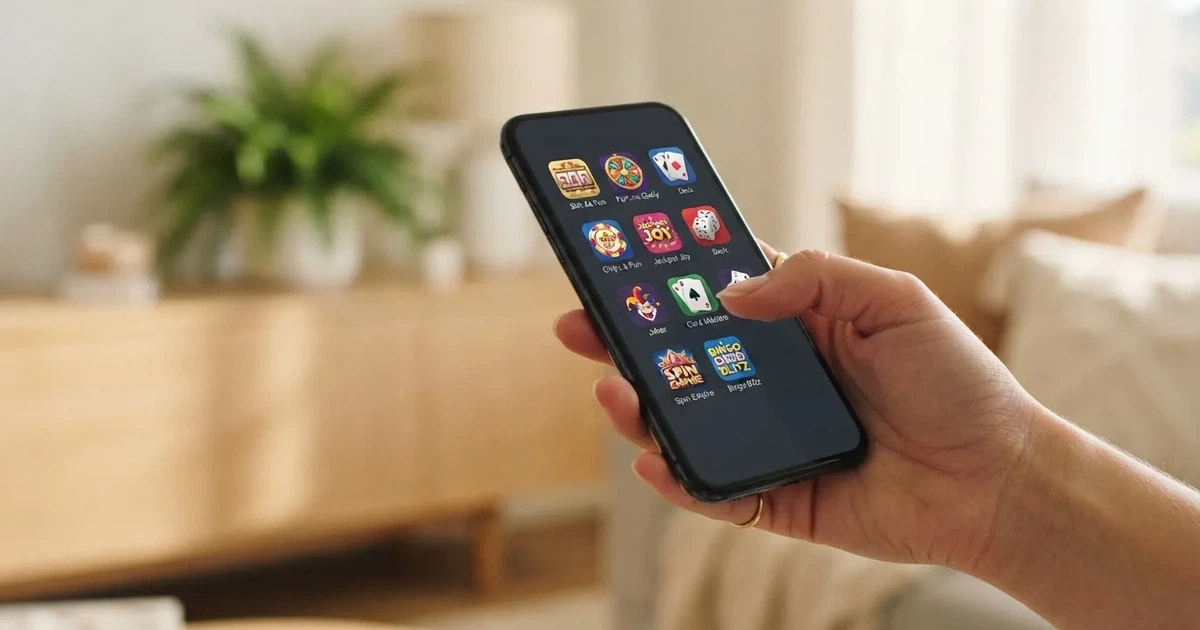
The “app” in a real money pokies app is a real piece of software, and how it is delivered decides what an Australian reader can actually do with it. This section walks through what real-money pokies apps typically are, where they sit on the phone, why they behave differently across Android and iOS, and what changes when a punter runs the same game through a mobile browser instead.
What “real money pokies app” usually means in marketing
The phrase covers three different products, and the marketing pages rarely distinguish between them:
A downloadable casino app, distributed through the Apple App Store or Google Play in some markets and through the operator’s own APK file in others. When such an app ships for real-money casino play in Australia, it almost always does so from an offshore operator whose app store listing is not visible to Australian storefronts. The operator’s site typically offers an “Android download” link and an “iOS install” link that routes through TestFlight or an enterprise-distribution workaround, because the standard App Store rejects real-money gambling apps that target Australian users.
A mobile-browser casino, which is not an app at all but is described as one. The browser tab loads an HTML5 client that fills the phone screen. Native app stores do not see this product at all, which is part of why offshore operators favour it: there is no app-store gatekeeper to argue with.
A progressive web app, which adds a bookmark-to-home-screen shortcut and some local cache, but is functionally the same as the mobile browser. This is the most common ship shape for offshore pokies apps targeting Australian readers right now.
Why some apps only work on one platform
The Android/iOS split that offshore pokies sites sometimes advertise comes down to how each platform handles real-money casino apps. Apple’s App Review Guidelines prohibit real-money gambling apps from storefronts in jurisdictions where the product is unlicensed; that prohibition is enforced uniformly across the Australian storefront. The Apple path for an offshore operator is either an enterprise certificate — fragile, frequently revoked — or a redirected install through TestFlight, which the operator does not control and Apple can withdraw at any time.
Google Play enforces a narrower real-money gambling policy that allows apps from licensed operators in certain jurisdictions. Offshore operators without an Australian licence are outside that envelope as well. Many simply sidestep the storefront by shipping an APK file from their own servers. That sidestep is why some offshore sites advertise “Android download” prominently but offer no equivalent iOS path: the Android sidestep is comparatively easy, and the iOS sidestep is not.
The result, from the player’s side, is a familiar asymmetry. The same game, on the same operator, on the same account, can be installed on an Android phone by tapping a downloaded file. On an iPhone, the install path may be a TestFlight link, a third-party PWA bookmark, or no path at all. Marketing material that says “available on Android” without specifying iOS is often a workaround in plain sight.
Playing the same title through a mobile browser
A punter on a phone who navigates to the operator’s mobile site rather than installing the app gets a near-identical product. Modern HTML5 casino clients draw, animate and run the same number generators as the downloadable client. Performance differences exist — the app version keeps some assets locally, so first-load is faster on the app — but they are cosmetic, not mechanical. The same random seed governs the same reel-strip output; the same return-to-player figure is published; the same bonus mechanics trigger on the same combinations.
What changes between the two paths is logistics. An app icon on a home screen is one tap from play; a mobile-browser tab is one tap plus whatever browser chrome the phone shows. An app can store a session token longer than a browser session; that is sometimes a feature, sometimes a feature the punter would rather not have. The gambling mathematics are identical, and the legal position is identical on either path — both sit outside Australian licensing.
The UI moves designed for touchscreens
Pokies on a phone are not a desktop game resized; the genuine offshore product has been laid out for a finger. Reel-strip animations run vertically, with tap targets at the bottom of the screen rather than across a horizontal bar. Spin, max bet, autoplay and menu buttons sit inside the natural arc the thumb reaches. Bets are typically set with steppers rather than free-entry fields, which speeds up stake changes and makes them less error-prone than desktop play.
For the player, the touchscreen layout has one practical consequence: it makes the game feel faster. Decisions that take a second on a desktop — confirm the stake, confirm the autoplay count — collapse into a single thumb-tap on a phone. Sessions that drift past an hour on a desktop compress more tightly on a phone, because the friction between bets is lower. The marketing page calls this “seamless play”; the mechanism describes itself.
How offshore pokies apps compare
The eleven brands below all have one thing in common: each has been the subject of a formal warning from the ACMA under the Interactive Gambling Act 2001, for offering online casino games to people in Australia. They are listed in the order research sets them, and the comparison that follows treats each as an example of how an offshore real money pokies app typically presents itself to an Australian reader — not as a ranked shortlist of where to play.
| Brand | ACMA action | Operator named in ACMA notice | Subject support |
|---|---|---|---|
| RocketPlay | Formal warning, March 2026 (and an earlier Dama N.V. warning, May 2022) | Pulsup Ltd (RocketPlay) | — |
| Level Up Casino | Formal warning, May 2022 | Dama N.V. | listings-only (per BGaming) |
| Woo Casino | Formal warning, March 2025 | Dama N.V. | — |
| Spirit Casino | Formal warning, May 2025 | Dama N.V. | — |
| National Casino | Formal warning, July 2025 | Consolutetish S.R.L. | listings-only (per en.wikipedia.org) |
| Bizzo Casino | Formal warning, July 2025 (and a 2022 warning to TechSolutions) | Consolutetish S.R.L. | — |
| Ignition Casino | Formal warning, July 2025 | Bamboo Media | — |
| Instant Casino | Formal warning, February 2025 | EOD Code SRL | — |
| Jackbit | Formal warning, April 2026 | Ryker B.V. | — |
| Casino Intense | Formal warning, April 2025 | Sterplay Holding Ltd | listings-only (per ABC, acma.gov.au, Crown Melbourne) |
| Sky Crown | Formal warning published by ACMA (Hollycorn N.V. PDF, September 2022) | Hollycorn N.V. | — |
The table’s “subject support” column is the cross-reference the research carries for each brand on the casino-game subject matter. A no-data entry means the research carried no independent listing for that brand on the subject. The listings-only entries cite what research did find — third-party listing pages that mention the brand — and never the brand’s own marketing.
Three pieces of context sit behind every row of that table. First, the ACMA’s formal warnings are enforcement actions against the operator, not findings against individual players; the punter does not face prosecution for using these sites. Second, the licence number any of these sites displays in its footer is whatever licence it carries in its home jurisdiction — Curacao, Anjouan, Kahnawake — and is not an Australian licence. Third, the ACMA’s blocking action works by directing Australian ISPs to make the domain unreachable from Australian IP addresses, which can render an account on the site inaccessible while balances remain nominally on the books.
What the comparison actually shows
The numbers in the third column, where they exist at all, are dates the operator’s name was published in an ACMA notice. They are not measures of how aggressively a brand markets to Australian readers, how many players it has, or how long its Australian-facing site has been live. They are markers from a regulator’s enforcement log, used here to identify the brands, not to assess them.
The fuller picture an Australian reader needs to take from this table is the negative shape: the brands listing a payment method or a payout time on their banking pages have not been verified for it by any Australian body, and the cross-references that would let a reader confirm those terms have not been produced. The table says that plainly in its cells — and the cells say more than the brands’ own marketing, which says nothing about any of it.
How this comparison is ordered
Research ordered these eleven brands by the date of the ACMA notice most recently published against each operator, and that order is the order used here. The reasoning is straightforward: a 2026 warning is the freshest signal of regulator activity available, and the table reads from most-recent-ACMA-action forward. The order is not a ranking, not a recommendation, and not an editorial preference among offshore operators; it is the chronological shape of the enforcement record.
The fundamentals of real money pokies in Australia
Real money pokies in Australia has a deeper and more complicated history than the offshore marketing pitches acknowledge. The machines that sit in pubs and clubs across every state and territory are themselves tightly regulated products — and the offshore apps that claim to offer the “same” game are offering something quite different.

What a “pokie” actually is in Australian law
A pokie, in the Australian vernacular, is an electronic gaming machine of the kind that operates in pubs, clubs and casinos under state-by-state licensing. They first appeared in registered clubs in New South Wales in 1956. New South Wales today operates more than 87,000 of these machines outside casinos, with player losses on them in 2022–23 alone running at A$8.18 billion. Queensland has roughly 21,000 of them across 351 venues; Victoria has another 26,000 outside Crown Casino, governed by a statewide 30,000-machine cap. Western Australia banned the machines in pubs and clubs in 1985 when Crown Perth opened; it remains the only Australian jurisdiction where the pub and club machines are absent.
Each jurisdiction separately regulates the design and operation of its machines. The legal minimum return-to-player varies: 85 per cent in New South Wales, the Northern Territory and Queensland; 87 per cent in the ACT and Tasmania (87 per cent at Crown Melbourne, generally 85 elsewhere in Victoria); 87.5 per cent in South Australia; 90 per cent in Western Australia. These are the floor figures the licensed machines are built to clear. The offshore pokies apps operate to a different baseline, set by whoever licences them and bound by no Australian floor.
The scale of the licensed side
Australians bet roughly A$150 billion a year through gaming machines and lost about A$12.18 billion on them in 2020–21. The country has approximately 3 per cent of the world’s pub and club poker machines and roughly 0.3 per cent of the global population, which is the kind of ratio the literature likes to quote because it lets the rest of the sentence go unsaid. Tasmania held its first machines under a monopoly licence held by the Federal Group from 1968 onward; legislation passed in November 2021 ended that monopoly, and oversight moved to the Tasmanian Liquor and Gaming Commission. The same jurisdiction began planning nation-leading mandatory pre-commitment cards for its machines, with implementation now scheduled for late 2025.
The point to take from those numbers is that the licensed Australian market is not a small one or a marginal one. It is a market large enough for the offshore operators to want a piece of it, and that is exactly what the ACMA’s enforcement record is the response to.
Where the offshore app sits inside that picture
An offshore real money pokies app is not the same product as a licensed Australian pokie. The licensed Australian machine has a state-set minimum return-to-player, a state-set design, a venue where the machine sits under supervision and a regulator the player can call. The offshore app sits on a phone, runs under whatever rules the operator’s home jurisdiction imposed, answers to whatever dispute body that jurisdiction recognises, and cannot be reached through any Australian consumer-protection channel. The brand name may be the same; the game in the app may even be titled to match a venue favourite. The licence behind it is a different licence.
A small clarification on terminology
A “real money pokies app” is, in the strict Australian sense, not a thing. The terms name an offshore product that real-money wagering apps for slot-style games would be, if such apps were licensed for Australian players — which they are not. The licensed Australian product is a venue machine, not an app. What readers see under that term in marketing is the offshore version, and the term itself is doing some of the work that the legal position would otherwise take care of.
The legal frame for pokies apps in Australia
The legal frame for a real money pokies app targeting Australian readers is a single statute and the regulator charged with enforcing it. Everything else — the offshore licence, the brand’s own complaints procedure, the payment-rail restrictions inside Australia — sits downstream of that statute.
The Interactive Gambling Act 2001
The Interactive Gambling Act 2001 (IGA), as tightened by the Interactive Gambling Amendment Act 2017, makes it an offence to provide online casino games, online pokies or in-play betting to a person physically in Australia. No state or territory issues a licence for an online casino product; the IGA carves that boundary out of the Australian regulatory perimeter entirely. Wagering on races and sport before the event, lotteries and keno can be licensed in Australia and are — in practice licensed by the Northern Territory, where the Northern Territory Racing and Wagering Commission oversees 52 of the country’s online bookmakers. The commission is itself the subject of a reform bill, described in ABC reporting in April 2026 as a body that meets once a month in Darwin and has no full-time staff. None of that changes the IGA boundary: online casino games and online pokies remain a prohibited interactive gambling service, full stop.
How the regulator enforces the rule
The Australian Communications and Media Authority investigates complaints, issues formal warnings to operators, and can direct Australian internet service providers to block illegal sites from Australian networks. As of June 2026 the ACMA reported a cumulative blocking total: 1,751 illegal gambling and affiliate marketing websites blocked since the first blocking request in November 2019, with more than 230 unlicensed gambling services having left the Australian market since enforcement was strengthened in 2017. In the round reported on 26 June 2026 alone, the ACMA asked ISPs to block twelve more domains — 7Signs, ChromaBet, Donbet, Duospin, Freshbet, Slots Gem, Jacks Club, Lucky Start, Pointsbetz, Spinrise, Vinyl Casino and Wildsino.
The blocking tally, taken as the running arithmetic it actually is, gives a rate that has been remarkably consistent. From the first blocking request in November 2019 to the figures published in June 2026, the ACMA’s blocking requests cover roughly six and a half years and 1,751 sites; that works out at an average rate somewhere in the band of roughly 270 sites per year, or just over one site blocked every working day over the period — with the underlying cadence tighter in some years and looser in others as enforcement rounds cluster.
The rule applies to the operator, not to the player. The IGA targets the provider; an individual Australian player using an offshore site is not the subject of prosecution. That distinction is worth holding onto because it is what every “is this legal for me” consumer question eventually reaches, and it is the wrong question to ask. The right question is what consumer protection the player has, and the answer to that is none.
A reform on the books but not yet in force
The Interactive Gambling Amendment (Gambling Reform) Bill 2026 passed Parliament on 19 August 2026 and carries advertising and inducement measures scheduled to commence on 1 January 2027. It is law with a future start date — useful context for an editor mapping the regulatory direction, not yet an active enforcement tool on a 2026 page.
Payments inside the IGA frame
Amendments in force since 11 June 2024 ban credit cards, credit-related products and digital currency as payment for licensed online wagering in Australia. Penalty for an operator accepting those methods in the licensed space is up to $247,500. The deposit routes that survive for licensed wagering are debit card, bank transfer, PayID, Osko and BPAY. The rule binds licensed operators; an offshore casino sitting outside the perimeter does not observe it. A punter asked for a credit card or a crypto deposit by an offshore site is being asked to use a method the Australian rule says licensed operators cannot accept, and the request is itself an indicator of which side of the boundary the operator sits on.
Real Money Pokies Australia App in 2026 — More on this topic at casino safety.
Responsible play and what the support system actually offers
A real money pokies app page that does not say anything about responsible play is a page that has not yet read its own subject. This section describes what is available to a reader who has decided the offshore route is not for them, and what the offshore path means for the support system that does exist.
BetStop, the National Self-Exclusion Register
BetStop is the National Self-Exclusion Register, live since August 2023. It allows a person to register once and exclude themselves from every Australian-licensed online and phone wagering service simultaneously. The register covers licensed wagering — sports betting, racing, lotteries, keno. It does not extend to offshore casinos, because the offshore operators are not part of the Australian perimeter and are not integrated with the register. A person who has self-excluded under BetStop and then opens an account with an offshore pokies app has no equivalent protection on that side; the exclusion does not travel.
Gambling Help Online
The National Gambling Helpline, 1800 858 858, is free, available 24/7 and offers chat via Gambling Help Online. The service is staffed by counsellors trained in problem gambling and is not bound by what the caller has or has not played. Callers can talk about losses on offshore sites, about urges to use them, about money missing from a blocked account, about debt accumulated across them. The helpline is the right place to start regardless of which part of the gambling market has caused the problem.
Why an offshore site gives none of that
A pokies app that has no Australian consumer protection also has no seat at the support-system table. There is no equivalent of BetStop on the offshore side, no Australian complaints body a punter can write to, and no guarantee that a self-exclusion request sent to the operator will be honoured by sister sites run by the same parent company. The helpline numbers above sit outside any of that — they are Australian, they are free, and they answer regardless of where the play happened.
Keeping real money pokies in perspective
A punter who has been playing offshore pokies apps and is finding it difficult to stop is in the position BetStop is built to help with, even though BetStop itself does not bind the sites they have been using. The first step is the helpline or the chat service; both are free and both are there. The second step, for someone who wants to bring their own behaviour to a stop, is the self-exclusion register. For someone whose problem is not their behaviour but their money, the helpline can connect them with financial counselling. None of those steps require the punter to resolve the offshore question first; the offshore question is what may need resolving after.
The operators on the ACMA’s enforcement record
What follows is the operator-by-operator detail for the eleven brands in the comparison table. None of these write-ups is a recommendation, and none of them describes a place to play. They each describe a brand the ACMA has acted against, and what the action covers — for the reader who needs to recognise a brand’s name in marketing material, or who has encountered it already.
RocketPlay
The ACMA issued a formal warning in March 2026 against Pulsup Ltd over RocketPlay. The same brand sits under the earlier May 2022 Dama N.V. warning, which covered six casino brands at once: Bambet, Dazard, Level Up, Rocketplay, Wild Tornado and Cobra Casinos. The 2022 and 2026 notices name different operating companies, which is characteristic of the offshore market — operators restructure and rebrand under new corporate shells while keeping their player lists. Research carried no independently sourced material on RocketPlay’s game or banking terms; what is shown to a player is what the operator publishes on its own pages.
Level Up Casino is one of the six brands caught in the May 2022 Dama N.V. warning. The brand surfaces in third-party listings, which is the only cross-reference research carried for it; there is no Australian source confirming its offer. The brand’s house edge on the games it hosts is whatever the underlying provider publishes — typically the same figures a player finds in any offshore casino — and the licence the brand displays is whatever Dama N.V. held at the time the warning was issued.
Woo Casino
The ACMA issued a formal warning over Woo Casino in March 2025, naming Dama N.V. as the operator. Woo Casino is one of two Dama N.V. brands caught in 2025; the other is Spirit Casino. The brand’s publishing footprint online is what the operator controls; the ACMA’s enforcement file is what the regulator controls, and the two do not overlap. A reader encountering Woo Casino’s name on an affiliate page is encountering a brand the regulator has already named in a notice.
Spirit Casino
The May 2025 ACMA warning named Dama N.V. over Spirit Casino. The brand has no independently sourced cross-reference in research; what the operator publishes is the only public description available. The single relevant fact for an Australian reader is the warning itself.
National Casino
The ACMA issued a formal warning in July 2025 over National Casino, naming Consolutetish S.R.L. as the operator. The brand surfaces in third-party listings — including an en.wikipedia.org entry — which is the only cross-reference research carried for it. The brand’s earlier history under different operators is not in the ACMA’s published notice for July 2025; the warning covers the operator named and the period applicable. A reader cross-referencing the brand against Australian enforcement files finds the Consolutetish S.R.L. warning and nothing more for this brand in the research window.
Bizzo Casino
The July 2025 ACMA warning over Bizzo Casino named Consolutetish S.R.L. An earlier ACMA warning in 2022 named TechSolutions (CY) Group Limited and TechSolutions Group N.V. over Bizzo. The same brand has been the subject of two separate warnings four years apart, naming two separate operators. That pattern repeats across the offshore market: a brand gets caught, the operating company behind it changes, and the brand name returns to enforcement on a different corporate filing.
Ignition Casino
The ACMA issued a formal warning in July 2025 over Ignition Casino, naming Bamboo Media as the operator. Ignition is the brand better known in the United States market; the ACMA notice marks the Australian-facing operation as one the regulator has formally cautioned. A reader who knows Ignition from a U.S. affiliate site is not dealing with a licensed Australian product.
Instant Casino
The ACMA issued a formal warning over Instant Casino in February 2025, naming EOD Code SRL as the operator. The brand surfaces in research with no third-party cross-reference — what the operator publishes is what readers see. The relevant fact, again, is the regulator’s notice itself.
Jackbit
The ACMA issued a formal warning in April 2026 over Jackbit, naming Ryker B.V. as the operator. The 2026 warning is the most recent ACMA notice in this comparison set; the brand and its operator are the freshest entry in the regulator’s enforcement log for the brands covered. A reader who has only just encountered Jackbit at the time of reading has no Australian-source confirmation that anything about its offer has changed since the April 2026 action.
Casino Intense
The ACMA issued a formal warning in April 2025 over Casino Intense, naming Sterplay Holding Ltd as the operator. The brand surfaces in research with third-party cross-references — ABC reporting, the ACMA’s own notices, Crown Melbourne material — which is a different shape of trace than the bare no-data entries elsewhere in this set. None of those cross-references are endorsements; they are third-party pages that mention the brand, and that distinction is what “listings-only” means in research. The licence number on the operator’s footer is whatever Sterplay Holding Ltd holds; no Australian body has confirmed it as part of any Australian authorisation.
Sky Crown
The ACMA issued a formal warning over Sky Crown, naming Hollycorn N.V. as the operator. The warning is published in the ACMA’s “Formal Warning – Hollycorn N.V. (Sky Crown and Blue Leo)” PDF of September 2022, which covers both Sky Crown and Blue Leo. The brand has no third-party cross-reference in research. The relevant shape of the brand’s position is the same as the others here — an ACMA notice, an offshore operator, and no Australian licensing behind either.
How quickly the ACMA’s blocking list grows
The arithmetic of the ACMA’s blocking record is worth doing once, because the rate is what tells an Australian reader how durable any single offshore domain is going to be.
The first blocking request the ACMA made went out in November 2019. The total the regulator reported in June 2026 was 1,751 illegal gambling and affiliate marketing websites blocked, with more than 230 unlicensed gambling services having left the Australian market since enforcement was strengthened in 2017. From November 2019 to June 2026 is roughly six and a half years. 1,751 blocked sites divided across that window gives an average of somewhere in the band of roughly 270 sites per year, or just over one site blocked every working day across the period.
That figure is a band, not a single point, because the ACMA does not publish monthly totals. The visible enforcement pattern — a large cluster of notices in the June 2026 round alone — suggests the cadence runs in bursts rather than as a steady metronome. What it means for a reader is straightforward: the average domain an offshore pokies app sits on does not stay reachable from Australia for long. A punter who funds an account on a site that gets blocked in the next enforcement round cannot reach the domain through their Australian ISP, may or may not be able to reach the support inbox, and has no Australian body to write to about the resulting balance.
Pokies apps and payment methods, in plain terms
The reason this page separates payments from the rest is straightforward: payment is the part of the offshore product a player can verify on their own, and it is also the part most likely to mislead. This section puts the deposit menu, the withdrawal claim, the support statement and the regulator’s position side by side.
What the deposit page usually shows
The deposit page on an offshore pokies app almost always leads with a row of brand logos — Visa, Mastercard, a few e-wallets, often a Bitcoin symbol. An Australian-facing version of the page may add PayID, BPAY or POLi. Each logo has a minimum-deposit figure next to it. The figures are aggressive: low minimums designed to let a new account try the product with a small deposit and see what happens.
What the deposit page does not say is that the same logo row on a licensed Australian wagering site would exclude Visa and Mastercard credit (as of 11 June 2024) and would exclude all crypto. The logos mean different things on the two sides of the boundary. On the licensed side, they are the surviving options from a banned list. On the offshore side, they are what the bank processor will let through; the Australian rules do not reach the operator, but they do reach the Australian banks.
What the support statement usually says
The customer-support page on an offshore site almost always offers a 24/7 live chat, an email address and occasionally a telephone number. The chat is staffed by the operator; the email goes to the operator’s inbox; the telephone, where one is offered, routes back to the operator or to an outsourced call centre. None of those channels are Australian. None of them are compelled by an Australian regulator to answer. None of them are bound by an Australian dispute resolution procedure.
The withdrawal that takes three weeks is not a withdrawal that has failed
A common complaint pattern across offshore pokies apps is a withdrawal that moves from “instant” to “pending” to “under review” to “additional verification required”. The site has not refused the withdrawal in those cases; it has changed the conditions on it. The terms the punter agreed at signup typically include a clause allowing the operator to demand additional documents at any time, and the operator uses that clause the same way banks used to use “talk to the manager”. There is no Australian body to escalate to.
The way Australian banks fit in
Australian banks do screen transactions against known gambling-merchant categories. A punter whose card is declined at an offshore casino may simply be hitting their bank’s own merchant filter. The decline is a consumer-protection story with no actor the punter meets; it is the bank’s policy working in the punter’s favour. Where the card is processed despite the filter, the bank’s liability is generally the same as it is for any disputed transaction — there is no Australian gambling-specific resolution path.
Choosing among real money pokies apps — and choosing against them
The first half of this page has spent its time on what an offshore real money pokies app actually is. The second half of an honest answer has to say who actually buys into the proposition and what the proposition is worth to them.
The reader who is going to play offshore anyway
A punter who has decided that an offshore pokies app is where they are going to play — perhaps because the licensed venues are not convenient, perhaps because the licensed product does not include the titles the punter wants, perhaps for other reasons that are the punter’s own — should at least pick from the brands that have an explicit record. The reason is not that one is safer than another; it is that the ACMA warning list is a public, dated record that the punter can read and recognise. The brands that do not appear in the warning list are not safer; they have simply not yet been caught on the same evidence.
The reader who is open to the licensed alternative
A punter who is genuinely open to the licensed Australian product has a different shape of decision to make, and it is mostly about venue. Pokies are a venue-bound experience in licensed Australia; they do not exist as a downloadable app. The licensed alternative is a drive to a pub or club with machines, a casino visit, or a wagering app restricted to sports and racing under a Northern Territory licence. The product is different, the consumer-protection posture is different, and the budget a player spends is money they can get back through the same banking rails they used to deposit it.
The reader who would rather not play at all
A punter who has concluded that real money pokies is not for them has the support system set out above waiting. BetStop is the structural answer for someone who wants to exclude themselves from licensed wagering; the helpline is the practical answer for someone who wants to talk before making decisions. Neither path requires the punter to do anything about the offshore sites they may already have accounts with; if those accounts still hold balances, the offshore site’s own support inbox is what the punter has, and what they have is what the punter has.
The honest summary
A real money pokies app, in Australia, is always an offshore product, and the marketing dollars the offshore operators spend are aimed at making that fact less visible than it is. The product itself is not dramatically different from what licensed Australian venues offer — a slot machine is a slot machine — but the regulatory frame is dramatically different. The licensed frame has a venue, a regulator and a complaints body. The offshore frame has terms and conditions, a foreign licence, and the ACMA’s blocking list.
FAQ
Is a “best real money pokies app” different from an ordinary free pokies app?
Free pokies apps exist in the legitimate Australian app stores — they run a slot-style game with credits that cannot be withdrawn, like any play-money casino product. A “real money” version of the same product, distributed through the same stores, would be a real-money gambling app; the Apple App Store and Google Play in Australia block that category for unlicensed operators. Marketing material describing a “best real money pokies app” is therefore almost always describing an offshore product downloaded from the operator’s own servers, which is a different delivery path and a different legal position from the play-money app the same punter can reach from the Australian app store.
Does a real money pokies app with “no deposit required” still count as real-money play?
Yes. “No deposit required” describes a signup promotion — bonus credits added to an account without the punter having to make a deposit first — and is not a way around the IGA. The promotional credits are still payable only through the operator’s own cashout terms, which carry the same minimum-turnover, max-cashout and identity-verification clauses a deposit bonus does. The legal position of the account is the same regardless of which side the bonus credits sit on; the no-deposit label changes which bills the operator gives the punter, not which side of the boundary the punter sits on.
Can an Australian resident lawfully download a real money pokies app?
The provider of an interactive gambling service to a person in Australia commits an offence under the Interactive Gambling Act 2001. The IGA’s target is the operator. An Australian resident who downloads an offshore app is the consumer of that service, not its provider, and is not the subject of prosecution for doing so. The relevant consequence of doing it is not legal liability for the download itself; it is the loss of every consumer protection that would otherwise travel with a licensed product — no Australian disputes body, no BetStop integration, no local banking rail protection, no recourse if the site is blocked with a balance on it.
Why do some real money pokies apps only work on Android, not iPhone?
Apple’s App Review Guidelines block real-money gambling apps from appearing in any storefront in a jurisdiction where the product is unlicensed, including Australia. The Android side has a workable sidestep: an APK shipped from the operator’s own servers, installed with one tap and one settings-screen override. The iOS side has no equivalent sidestep that Apple does not reserve the right to revoke. A pokies app advertising “available on Android” without mentioning iOS is working around a platform rule, and the absence of an iOS path is the visible indicator of that workaround.
What withdrawal method do real money pokies apps typically support once a player wants to cash out?
Offshore pokies apps typically claim three withdrawal windows: crypto at “instant” speed, e-wallets at same-day, and bank transfers at one to five business days. Research has not produced confirmed payout times for any of the brands covered on this page, so the figures below are what the sites’ own pages publish. The licensed Australian side does not accept crypto and does not accept credit, leaving debit card, bank transfer, PayID, Osko and BPAY — and even those methods are paid only by operators licensed by the NTRWC or another Australian regulator. An offshore withdrawal that takes three weeks, lands partially, or stalls under “additional verification” is not the operator’s worst-case behaviour; it is the operator’s routine behaviour with no Australian body to escalate to.
How does app-based pokies play differ from playing the same title through a mobile browser?
The game mathematics are identical. The same random number generator governs the same reel-strip output, the same bonus mechanics trigger on the same combinations, and the same return-to-player figure is published, regardless of whether the punter reaches the game through a downloaded app or a mobile browser tab. What changes is logistics: the app keeps a session token, a home-screen icon and a slightly faster first-load; the browser tab is one tap further from play, and it does not install anything on the phone. Neither delivery route is an Australian-licensed product, whatever the punter thinks the licence at the bottom of the page says about it.