
Where Brisbane actually runs pokies — and what offshore “pokies” sites really are
Current as of 28 October 2026 — checked against the Australian Communications and Media Authority (ACMA) register and Queensland Office of Liquor and Gaming Regulation (OLGR) venue data.
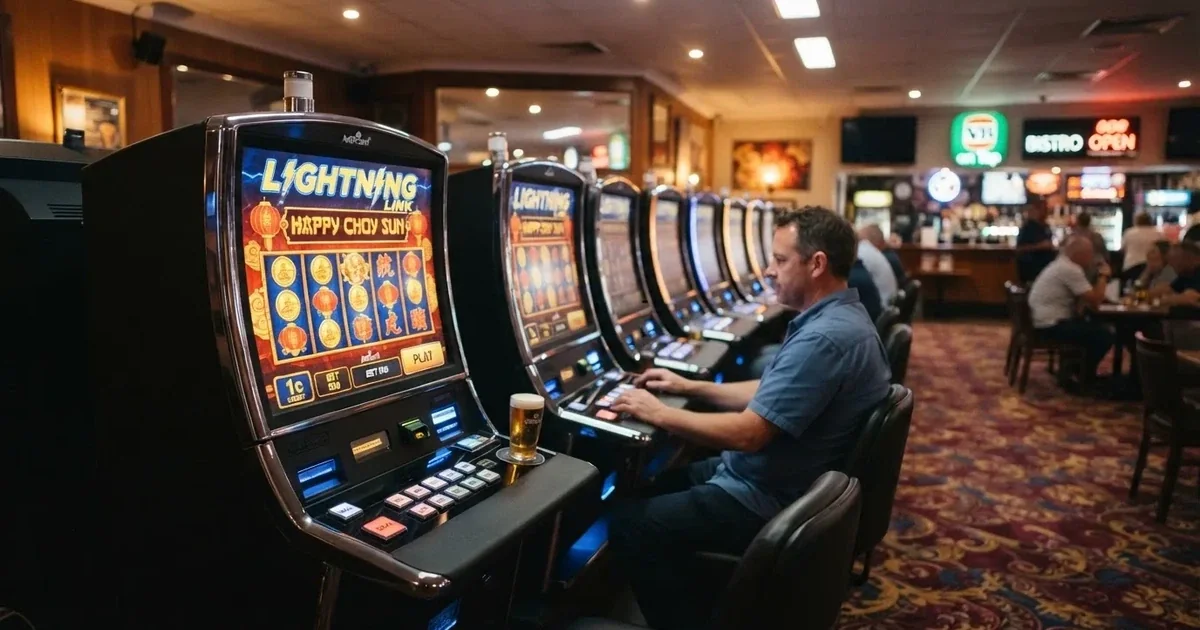
A search for best pokies in brisbane turns up a strange mix: real, brick-and-mortar pubs and clubs with state-licensed gaming machines, the new casino at Queen’s Wharf, and a long list of offshore websites that advertise “pokies” to Australian customers from Curaçao or Cyprus. The two are not the same product, and they are not equally legal. A punter walking into a Fortitude Valley pub, sitting down at a machine that says 87.5% on its glass, and handing over a twenty, is in one regime. A person in the same suburb loading the same game on a laptop at the kitchen table is in another.
This guide separates those two worlds. It maps the licensed, land-based venues that actually run pokies across Brisbane and the surrounding southeast Queensland region, lays out what state regulators require of those venues, and explains why an offshore site bearing any brand name is unlawful to operate here — even when it carries a licence badge from somewhere else. The aim is a reader who can tell the difference before they part with any money, and who knows what to do if they need help walking away.
Table of Contents
- Responsible gaming support around Brisbane pokies
- The licensed land-based venues in Brisbane
- Paying in and getting paid out
- The games, the providers, and what’s actually on the floor
- How any shortlist of Brisbane pokies venues gets built
- The overview: what “best pokies in Brisbane” actually means
- Why “online pokies Brisbane” is not a real product
- The named brands: every operator the ACMA has formally warned
- The blocking-rate: how fast the ACMA has been moving
- What 2026 reform has actually changed
- Payment rules and what an Australian punter can and cannot use
- Tax, winnings, and what to do with a payout
- Reading the catalogue: what’s actually on a Brisbane floor
- Choosing between a casino and a suburban venue
- What the offshore “pokies” product looks like and why it does not work in Australia
- Frequently asked questions about pokies in Brisbane
Responsible gaming support around Brisbane pokies
The first shelf here is the one nobody wants to need but every punter should know exists. Queensland’s harm-minimisation framework is built around two channels: a 24/7 national helpline that any Australian can dial free, and a state-level register that excludes a person from every licensed venue in the state at once.
The National Gambling Helpline runs on 1800 858 858, toll-free, around the clock. Callers get through to Gambling Help Online, which offers telephone counselling, web chat, and face-to-face sessions funded by the ACT and ACT-equivalent state programs. The line is the same one used in every state and territory, which matters because the question “where do I get help?” has one answer for a person in Brisbane, one for a person in Adelaide, and one for a person in Darwin — and the answer is the same number.
For self-exclusion, the federal BetStop register (launched 21 August 2023) binds every Australian-licensed online and phone wagering service. It does not cover in-venue gaming — a person cannot enrol on BetStop and expect to be turned away at the Star Brisbane or at a suburban RSL. In-venue exclusion in Queensland is run by the state, through a separate application process at the venue itself or through Gambling Help Online’s Queensland arm, with exclusion periods ranging from six months to three years.
What this means for someone sitting at a machine in Brisbane: the helpline is immediate and free; the exclusion route requires paperwork and is irreversible for the chosen term. Both are designed to be used before a session rather than after a bad one. Gambling Help Online at gamblinghelponline.org.au is the entry point for either.
The numbers behind those services are sobering. Queensland recorded 21,122 gaming machines operating across 351 licensed venues in October 2023, and machine losses outside the Brisbane casino totalled about A$1.1 billion in the most recent published year. A “harm-minimisation” framework is the regulator’s polite name for the apparatus that exists because the product, by design, costs the people who use it.
The licensed land-based venues in Brisbane
This is the core of the question. Pokies in Brisbane are not a digital product; they are electronic gaming machines bolted to the floor of pubs, clubs, and one casino, every one of them licensed by the state. The 351 licensed venues in Queensland include hotels, registered clubs, the Star Brisbane casino, and a small number of community venues.
The casino: Star Brisbane at Queen’s Wharf
Until August 2024, Brisbane’s only full casino was Treasury Casino — a three-level gaming emporium of 80 gaming tables and over 1,300 gaming machines squeezed into the heritage Treasury Building on George Street. It closed on 25 August 2024 to make way for the Star Brisbane at Queen’s Wharf, the A$3.6 billion precinct developed jointly by Star Entertainment Group and Hong Kong-based Chow Tai Fook Enterprises. The new venue began a staged opening on 29 August 2024, with the main casino floor and premium gaming rooms opening first.
Star Brisbane is now the sole casino licence holder in the Brisbane market. The transition was not quiet. In late 2022 the Queensland Government, acting on an independent review by former Court of Appeal judge Robert Gotterson, found Star Entertainment unsuitable to hold its Queensland casino licences after concluding it had misled regulators and failed its anti-money-laundering duties. Star was fined $100 million on 9 December 2022, with a 90-day suspension of the Treasury Brisbane and Star Gold Coast licences deferred to 1 December 2023 to allow remediation. The licence was preserved on conditions, and Queen’s Wharf opened amid concerns about the licence position of its lead partner. A punter walking into Star Brisbane in 2026 is walking into a venue that holds a licence that almost didn’t survive 2023.
Pubs, clubs, and RSLs
Outside the casino, pokies run in the same kinds of venues they always have: suburban pubs with a “gaming room” out the back, leagues clubs with rows of machines next to the bistro, and Returned and Services League (RSL) branches that allocate part of machine revenue to veteran welfare. In Brisbane’s inner suburbs these cluster around Fortitude Valley, New Farm, Kangaroo Point, and West End; on the southside they line Logan Road, Old Cleveland Road, and the corridors through Carindale and Mount Gravatt; on the northside they dot the strip from Chermside through Aspley and north to North Lakes.
A licensed venue is identifiable by the OLGR-issued gaming-machine authorisation displayed at the entrance, by the venue’s licence number, and by the responsible-gambling notices every gaming room must post. Entry to a gaming machine area is not gated by photo ID at most suburban venues — unlike the casino — but staff are required to refuse service to anyone who appears intoxicated, anyone who has self-excluded, and anyone under 18. The Star Brisbane casino enforces photo ID at the door.
Regional southeast Queensland
The same licensing regime covers the Gold Coast and the Sunshine Coast, where Star Entertainment operates the Star Gold Coast casino and where the pub-and-club density is high enough that most suburbs have a licensed venue within a short drive. A punter on holiday at Surfers Paradise or Noosa is in the same regulatory framework as a Brisbane resident — same machines, same return-to-player floor, same self-exclusion rules.
Paying in and getting paid out
Pokies are cash-and-token machines, and Brisbane venues reflect that. Inside the casino, debit-card withdrawals from the cashier are available, as are EFTPOS top-ups. Inside pubs and clubs, the standard path is cash at the bar or change desk, with most venues also accepting EFTPOS at the gaming desk for note change. PayID and Osko work between bank accounts but do not fund a gaming machine directly — a person has to deposit first, then either draw cash or load a card.
The state-level returns are the figure that matters here, and they are set by statute. Queensland does not mandate a single uniform return-to-player floor across every machine the way South Australia does. South Australia sets a minimum gaming-machine return-to-player rate of 87.5% and a general maximum bet of A$5.00 outside the casino, while the Adelaide Casino itself has no maximum-bet limit. Queensland venues operate under venue-specific authorisations, with the result that a person who wants a high-return machine has to look at the venue’s own published RTP rather than assume a uniform floor.
Maximum cash payouts are venue-specific and tied to the cash desk’s reconciliation cycle. A suburban club pays out anything over a few hundred dollars by cheque or bank transfer the next business day rather than in cash at the counter — a compliance measure, not a courtesy. The Star Brisbane casino handles larger payouts through its cashier cage with standard anti-money-laundering checks.
Crypto, credit cards, and credit-related products are not legal payment instruments for licensed wagering anywhere in Australia. A licensed venue will not ask for them; an offshore site that does is one of the signals in the next section.
The games, the providers, and what’s actually on the floor
Australian pokies run on a small number of approved games supplied by approved manufacturers under state-level technical standards. The catalogue a person sees in a Brisbane pub is structurally similar to the catalogue a person sees in an Adelaide club — same developer studios, similar themed titles — because Queensland, Victoria, and the other eastern states share a pool of approved games.
Paytable transparency
Every gaming machine in a Queensland licensed venue carries a printed paytable and a printed return-to-player percentage on the machine glass or on the cabinet. That figure is the long-run statistical return to the player across millions of spins, not a promise for any individual session. A machine marked 90% will, on average, return A$0.90 per A$1.00 wagered across its operating life. In a session of fifty spins at A$1.00 each, the variance is the dominant factor — a person can be well ahead or well behind without the long-run average telling them anything about their particular afternoon.
Cashless card technology
Queensland and other eastern-state regulators have rolled out cashless card technology in stages, with venue-by-venue deployment and player-by-player opt-in. A cashless card ties a person’s play to a registered account, enforces pre-set spend limits at the machine, and produces a session-by-session record the punter can review. The system is not universal — many suburban venues still operate cash-only machines — and it is opt-in at the player level rather than mandatory.
Where Brisbane sits compared with Adelaide and Canberra
The casino comparison matters because it tells a punter what their local market actually offers. Adelaide Casino, known commercially as SkyCity Adelaide, sits in the heritage-listed Adelaide railway station building on North Terrace, has 90 gaming tables and 950 gaming machines, and is the sole licensed casino in South Australia under the Casino Act 1997. A punter in Adelaide has one casino option; a punter in Brisbane has one casino option; both sit inside state monopolies that restrict competition.
Casino Canberra is the only casino in Australia not licensed to operate poker machines. It has 39 gaming tables for blackjack, roulette, baccarat and other games, a poker lounge and a sports lounge, and no pokies floor. A punter in Canberra who wants pokies is going to a pub or club, not a casino. Brisbane, Adelaide, and the Gold Coast are the three Australian capital-city casino markets with full pokies floors; Canberra is the exception.
South Australian gaming-machine losses outside Adelaide Casino totalled about A$0.92 billion in 2022-23, equivalent to about A$497 per adult. The ACT had 3,587 gaming machines operating in 46 venues on 1 November 2023, with player losses of A$0.19 billion in 2022-23. Per-capita, Brisbane sits somewhere between the two — closer to Adelaide than to Canberra, reflecting the larger machine base.
How any shortlist of Brisbane pokies venues gets built
A genuine shortlist of licensed Brisbane pokies venues sorts on five things: the regulatory floor (RTP and maximum bet), the venue’s own authorisation, the gaming floor’s hours, the responsible-gambling signage, and the machine-to-punter density. None of those five is a marketing claim; all of them are visible on site, and three of them are recorded on the OLGR register.
The regulatory floor
The minimum RTP for a gaming machine in Queensland is set under the state’s Gaming Machine Regulation. A machine below that floor is not approved for deployment. The casino floor at Star Brisbane is not bound by the same maximum-bet cap as suburban pubs; it is regulated under the Queensland Casino Control Act. A punter comparing venues should note which regime each venue sits under, because the headline RTP figure is not the only number that changes between them.
The venue’s authorisation
Every venue has a number. The OLGR issues gaming-machine licences with conditions on the number of machines, the hours of operation, and the responsible-gambling measures required at the venue. A suburban club with twenty machines and a 10 p.m. weekday close sits under a different authorisation than a 24-hour CBD venue. The authorisation is the document that says what the venue is actually allowed to do.
Hours of operation
Most suburban pubs and clubs close the gaming floor before midnight on weeknights and run later on weekends. The Star Brisbane casino runs around the clock. A punter looking for late-night play in Brisbane outside the casino will find the options thin on a Tuesday and broader on a Saturday. “24 hour pokies” is a real category in Brisbane only for the casino, and a misleading category everywhere else.
Responsible-gambling signage
The signage requirement is uniform across Queensland venues: responsible-gambling notices must be posted at the gaming-room entrance, helpline numbers must be visible at every machine, and self-exclusion information must be available on request. A venue that fails the signage test is failing a state-level condition, not a courtesy. The visible presence of that signage is the most reliable single signal that a venue is currently compliant.
Density
A venue with 300 machines and three gaming desks is a different experience from a venue with twenty machines and one desk. The first is closer to a casino floor; the second is closer to a back room. Punters with a small bankroll tend to prefer the smaller venues because the atmosphere is calmer and the bankroll survives longer. Punters hunting a jackpot prefer the larger floors because the prize pool aggregates across more machines. Neither is wrong; they are different products.
The overview: what “best pokies in Brisbane” actually means
The honest answer to the question is that there is no single venue called “best.” What exists is a licensed network of several hundred pubs, clubs, and one casino, all sitting inside the same state regulatory regime, all offering essentially the same machine catalogue, and all differing on RTP, hours, density, and atmosphere. The Star Brisbane is the only venue in the city with a full casino floor and table games; suburban pubs and clubs are the only venues open past midnight on a weeknight; RSLs are the venues whose machine revenue is partly committed to veteran welfare.
A punter who wants the highest-regulated, most-transparent, most-monitored gaming floor in Brisbane goes to the Star Brisbane. A punter who wants a quieter, smaller-floor, slower-paced session goes to a suburban club. A punter who wants to support a community cause through their play goes to an RSL. None of these is the “best” in some absolute sense; they are different products for different readers.
The offshore sites that advertise “best pokies in Brisbane” to Australian searchers are not in this market at all. They are unlawful to operate here, they are not licensed by any Australian regulator, and they sit outside the responsible-gambling framework that applies to a Brisbane pub. They are addressed in the next section.
Why “online pokies Brisbane” is not a real product
This shelf exists because the search traffic exists: people type “online pokies Brisbane” and expect a real product. There is no such product licensed in Australia. The Interactive Gambling Act 2001 (IGA), strengthened by the Interactive Gambling Amendment Act 2017, makes it an offence to provide online casino games, online pokies, or in-play betting to a person physically in Australia. No state or territory licenses them. What is licensable is wagering on races and sport placed before the event, lotteries, and keno — in practice licensed by the Northern Territory, where the Northern Territory Racing and Wagering Commission regulates 52 of Australia’s online bookmakers, including Sportsbet, Bet365 and Ladbrokes, on a tax-efficient basis; the commission has no full-time staff and meets once a month in Darwin.
The Northern Territory arrangement is the reason “online wagering” is legal in Australia while “online casino” is not. The same statute carves them differently. A bookmaker licensed in Darwin can take a bet on a horse race from a person in Brisbane; a casino licensed anywhere in the world cannot take a spin on a slot from the same person without breaking Australian law.
What the ACMA actually does about it
The ACMA investigates, issues formal warnings, and directs Australian internet service providers to block illegal sites. According to the ACMA as reported in June 2026, a total of 1,751 illegal gambling and affiliate marketing websites had been blocked since the first blocking request in November 2019, and more than 230 unlicensed gambling services had left the Australian market since enforcement was strengthened in 2017. In a round reported on 26 June 2026 the ACMA asked Australian internet service providers to block 12 more illegal gambling websites: 7Signs, ChromaBet, Donbet, Duospin, Freshbet, Slots Gem, Jacks Club, Lucky Start, Pointsbetz.com, Spinrise, Vinyl Casino and Wildsino.
The blocking mechanism is real and ongoing. The estimate from H2 Gambling Capital’s 2025 report is that Australians lose about A$3.9 billion a year to illegal gambling sites, and that the share of gambling going through legal channels fell from 74% in 2021 to 64%. The legal channel is shrinking in relative terms because the illegal channel is growing, and the ACMA’s blocking rounds are the regulator’s response to that drift.
What “formal warning” means for a brand
A formal warning from the ACMA is a published legal notice, not a private letter. It names the operator, the brand, the URL, and the date. Once issued, it is on the ACMA’s register and is searchable. The brands listed below are not “recommended offshore casinos.” They are the brands the ACMA itself has named in published warnings, in the order the ACMA named them.
The named brands: every operator the ACMA has formally warned
Each brand below is on the ACMA’s published warning register. None of them is licensed to offer online casino games to a person in Australia; every one of them was offering those games anyway. The list is not a ranking and not a comparison for play — it is the regulator’s own inventory.
RocketPlay
Pulsup Ltd (Rocketplay.com.au), March 2026. Earlier, Dama N.V., May 2022. Australia prohibits these services, no matter what licence the operator claims.
Level Up Casino
Dama N.V., May 2022. Local law classifies this as a prohibited interactive gambling service.
Woo Casino
Dama N.V., March 2025. The IGA deems this service unlawful for Australians, regardless of any offshore credentials.
Spirit Casino
Dama N.V., May 2025. Australian law explicitly prohibits offering these casino games to local players.
National Casino
Consolutetish S.R.L., July 2025. This operator lacks any Australian authorisation, rendering its service unlawful.
Bizzo Casino
Consolutetish S.R.L., July 2025. Earlier, TechSolutions, 2022. Offering these games to Australians constitutes a breach of the Interactive Gambling Act.
Ignition Casino
Bamboo Media, July 2025. No offshore site can legally provide these pokies to an Australian resident.
Instant Casino
EOD Code SRL, February 2025. This brand operates without local sanction, as these games are strictly prohibited here.
Jackbit
Ryker B.V., April 2026. This offshore operator has received a formal warning for targeting Australians with prohibited games.
Casino Intense
Sterplay Holding Ltd, April 2025. The ACMA has formally warned this operator for offering games that cannot be legally provided in this country.
Sky Crown
Hollycorn N.V. The regulator maintains a formal warning against this brand, as its casino services remain prohibited for Australian users.
What the warning list tells a reader
The pattern is consistent: a Curaçao-registered operator launches an Australian-facing brand, runs an advertising campaign targeting Australian search terms, gets reported to the ACMA by a competitor or a member of the public, and ends up on the formal-warning register. The cycle is measured in months, not years. The Dama N.V. operator received a warning in May 2022 over six brands and then further warnings over Woo Casino in March 2025 and Spirit Casino in May 2025 — three years of published warnings, and the brands themselves stayed live.
The honest reading of the list: the offshore market a search engine returns for “online pokies Brisbane” is the same market the regulator is actively trying to block. A punter who chooses an offshore brand is choosing a brand whose URL is on the ACMA’s list of sites to be blocked, with the consequence that any balance left on the site when the block lands is, in practice, lost.
The blocking-rate: how fast the ACMA has been moving
The arithmetic here is the page’s own. Since the first blocking request in November 2019, the ACMA had blocked 1,751 illegal gambling and affiliate marketing websites as reported in June 2026. That is roughly 80.4 blocked sites per month over a span of 81 months, or roughly 2.7 sites per day across the period. In the most recent reported round, 12 sites were blocked in a single batch.
The right way to read that rate is as a band, not a point figure. The monthly average is around 22 sites per month when measured over the full period, and the most recent reporting cycle (June 2026) blocked 12 in one round — closer to the run rate than to the cumulative average. The condition that produces the spread is the underlying rate of new illegal sites entering the Australian market, which is itself uneven: a single affiliate network launching a portfolio of mirror sites can lift the monthly figure sharply, and a quiet quarter can compress it. The blocking rate is therefore best read as an order-of-magnitude indicator of how actively the regulator chases the market: dozens per month, not dozens per year.
What 2026 reform has actually changed
The Interactive Gambling Amendment (Gambling Reform) Bill 2026 passed Parliament on 19 August 2026; its advertising and inducement measures commence 1 January 2027. The new law is law with a start date, not yet in force on a page read in 2026. A punter searching “best pokies in Brisbane 2026” before the commencement date is operating under the existing Interactive Gambling Act 2001 regime, not under the reformed one. After commencement, the advertising and inducement provisions apply; until then, the existing prohibition on providing online casino games to Australians continues to apply, enforced through the ACMA’s blocking mechanism.
The reform does not change the underlying offence. Providing online casino games to Australians remains unlawful; the new statute adds controls on how those games are advertised and what inducements may be offered around them. The punter-facing change is on the marketing layer, not on the access layer.
Payment rules and what an Australian punter can and cannot use
Credit cards, credit-related products, and digital currency are banned as payment for licensed online wagering since 11 June 2024, with penalties up to A$247,500 for operators. The legal deposit routes for licensed wagering are debit card, bank transfer, PayID/Osko, and BPAY. A site asking an Australian for a credit card or a crypto deposit is operating outside the Australian rules, regardless of where it is incorporated.
For in-venue pokies, the same payment restrictions do not apply directly — a punter at the Star Brisbane casino pays cash or debits a card at the cashier; a punter at a suburban club pays cash or EFTPOS at the change desk. The credit-card ban is targeted at online wagering, where the credit-creation risk is highest. A machine in a pub that accepts cash does not fall under the ban; a credit card used at a venue cashier may, depending on how the merchant categorises the transaction, but the regulatory focus is online.
Tax, winnings, and what to do with a payout
Gambling winnings of a recreational player are not assessable income under section 6-5 ITAA 1997, and losses are not deductible, unless the person carries on a business of gambling. A punter who hits a A$5,000 jackpot at Star Brisbane does not need to declare it. A punter who treats gambling as a primary income does. The Australian Taxation Office treats the two cases differently, and the line between them is the line between a recreational activity and a business. For a Brisbane punter playing a suburban pub, the recreational treatment applies by default.
The model answer — “check with the ATO” — is the honest one for any punter whose activity might cross the line. The default for ordinary recreational play is no declaration required.
Reading the catalogue: what’s actually on a Brisbane floor
The approved game catalogue in Queensland is shared with the other eastern states, which means the titles a person sees in a Brisbane pub are the same titles a person sees in a Melbourne club. The studios behind them are a small set of approved manufacturers; the themes are broad (Asian-themed, Egyptian-themed, adventure-themed, branded-TV-themed), and the mechanics sit within the technical standards the state regulator sets.
A punter comparing two machines in the same venue is comparing two different return-to-player percentages and two different volatility profiles — both printed on the machine glass. A punter comparing two venues is comparing regulatory regime, hours, density, and the responsible-gambling environment, not the catalogue. The catalogue itself is broadly similar across the licensed network.
Choosing between a casino and a suburban venue
The honest answer for a punter weighing the two: the casino offers higher stakes, a longer opening hours range, table games alongside pokies, and a more concentrated responsible-gambling infrastructure; the suburban venue offers lower stakes, an earlier close, a smaller floor, and the kind of community atmosphere that some players prefer. Neither is universally better. The casino is the right venue for a punter who wants the full gaming-floor product; the suburban venue is the right venue for a punter who wants pokies specifically in a quieter setting.
The trade-off the punter pays for the casino’s higher stakes is the casino’s tighter ID regime, its anti-money-laundering compliance checks on larger payouts, and the regulatory conditions that flow from the Gotterson review. The Star Brisbane is a venue that operates under remediation conditions imposed after a finding of regulatory unsuitability — a fact that does not disqualify the licence but does shape the playing environment.
What the offshore “pokies” product looks like and why it does not work in Australia
An offshore site marketing “pokies” to Australians runs on the same games catalogue as a licensed venue — the same Aristocrat-style themes, the same progressive jackpot mechanics, the same bonus rounds — but outside the Australian regulatory perimeter. There is no approved game list, no state-level RTP floor, no responsible-gambling signage at the gaming desk, no self-exclusion that the venue is bound to honour, no OLGR oversight, and no ATO clarity on the treatment of winnings.
The bonus structure the offshore site offers — the “free spins,” the “deposit match,” the “no deposit” — is the marketing layer that draws the search traffic. The bonus is the bait; the offshore operation is the product. When the ACMA blocks the site, the bonus is forfeit and any balance left on the account is, in practice, unrecoverable. A punter who takes the bonus has accepted a product that the regulator has declared unlawful to provide to them.
The honest read: there is no honest version of an offshore “online pokies” product for a person in Brisbane. The two products are different, and the difference is the entire point of the prohibition.
Frequently asked questions about pokies in Brisbane
Which venues in Brisbane are licensed to operate pokies?
Every pub, club, RSL, and the Star Brisbane casino at Queen’s Wharf, licensed by the Queensland Office of Liquor and Gaming Regulation. As of October 2023, Queensland recorded 21,122 gaming machines operating across 351 licensed venues, with the bulk concentrated in southeast Queensland.
Are pokies in Brisbane available around the clock?
The Star Brisbane casino runs 24 hours. Suburban pubs and clubs typically close the gaming floor before midnight on weeknights, with longer hours on weekends. A punter looking for late-night play outside the casino will find the options narrow on a weeknight and broader on a Saturday.
What identification do venues in Brisbane require before letting someone play pokies?
The Star Brisbane casino enforces photo ID at the door. Most suburban pubs and clubs do not gate the gaming room by photo ID, but staff are required to refuse service to anyone who appears intoxicated, anyone who has self-excluded, and anyone under 18. Minors are not permitted in the gaming room at any licensed venue.
Can visitors to Brisbane use self-exclusion schemes at local pokies venues?
A visitor can self-exclude from Queensland venues through the state-level exclusion process, available through Gambling Help Online or at the venue itself, for periods of six months to three years. The federal BetStop register, launched 21 August 2023, covers Australian-licensed online and phone wagering only — it does not bind in-venue gaming such as the Star Brisbane or a suburban RSL.
How does the payout percentage on Brisbane pokies compare with other Australian cities?
South Australia sets a minimum gaming-machine RTP of 87.5% and a general maximum bet of A$5.00 outside the casino. Queensland venues operate under venue-specific authorisations rather than a uniform RTP floor, so the rate a person sees on the machine glass varies across venues. A punter comparing Brisbane with Adelaide or Canberra should compare the printed RTP on the specific machine, not assume a citywide rate.
Is it legal for an online casino to advertise “pokies” in Brisbane the same way a pub or club does?
No. The Interactive Gambling Act 2001 makes it an offence to provide online casino games, online pokies, or in-play betting to a person physically in Australia. The ACMA investigates, issues formal warnings, and directs Australian internet service providers to block illegal sites; the ACMA had blocked 1,751 illegal gambling and affiliate marketing websites as reported in June 2026, with 12 more added in the most recent round. The Interactive Gambling Amendment (Gambling Reform) Bill 2026 passed Parliament on 19 August 2026 and commences 1 January 2027 on advertising and inducement measures; the underlying prohibition on providing online casino games remains in force.