
Microgaming casinos for Australian players: a practical guide
The shortest version: nobody operating in Australia holds a licence to offer Microgaming-powered casino games online, because the Interactive Gambling Act 2001 makes that product prohibited. The brands an Australian reader sees marketed under a Microgaming badge are run from offshore, accept Australian customers anyway, and have been the subject of formal warnings by the ACMA in pretty much every year of the last half-decade. So the honest version of this page is not a shortlist to join — it is the legal shape of the market, the ACMA’s running tally of action against it, and the lawful alternatives the law actually leaves open.

This page is current as of 28 October 2026 and checked against the ACMA’s published register of formal warnings and blocking actions.
Table of Contents
- Why Microgaming casinos cannot be licensed for Australians
- Player protection in a market that mostly isn’t licensed
- Money in, money out, and the payment-method divide
- What Microgaming-style bonuses actually cost
- The phone-screen version
- What Microgaming actually makes, and the wider catalogue
- The eleven brands the ACMA has named, side by side
- What the lawful alternatives actually look like
- The background numbers
- Frequently asked questions
Why Microgaming casinos cannot be licensed for Australians
Online casino games and online pokies sit on the prohibited list under the Interactive Gambling Act 2001 (IGA), tightened by the Interactive Gambling Amendment Act 2017. The prohibition targets the provider, not the punter: it is a criminal offence to offer these games to a person physically in Australia, and the offence is committed whether the player clicks through from Sydney or from a Bali villa. No state or territory issues a licence for online casino or pokies. What is licensable is wagering on sport and racing placed before the event, lotteries and keno, and those services are licensed in practice by the Northern Territory Racing and Wagering Commission (NTRWC), which oversees 52 of Australia’s online bookmakers — Sportsbet, Bet365, Ladbrokes among them. The commission runs on a part-time model: no full-time staff, one meeting a month in Darwin.

That asymmetry is the whole game. Microgaming’s software is a B2B product sold to operator brands; the question is never whether Microgaming itself is “banned” in Australia, and always whether the operator brand on the other end holds an Australian licence for the product it’s selling. It cannot, because that product is prohibited.
What the ACMA has actually done, in order
The Australian Communications and Media Authority investigates, issues formal warnings and asks Australian ISPs to block illegal services. A formal warning is not a fine; it is a published letter to a named operator, sitting on acma.gov.au, naming the breach and giving the operator a chance to comply before further action. Where compliance does not arrive, the ACMA moves to a blocking request, which is what an Australian customer sees as a website that simply will not load.
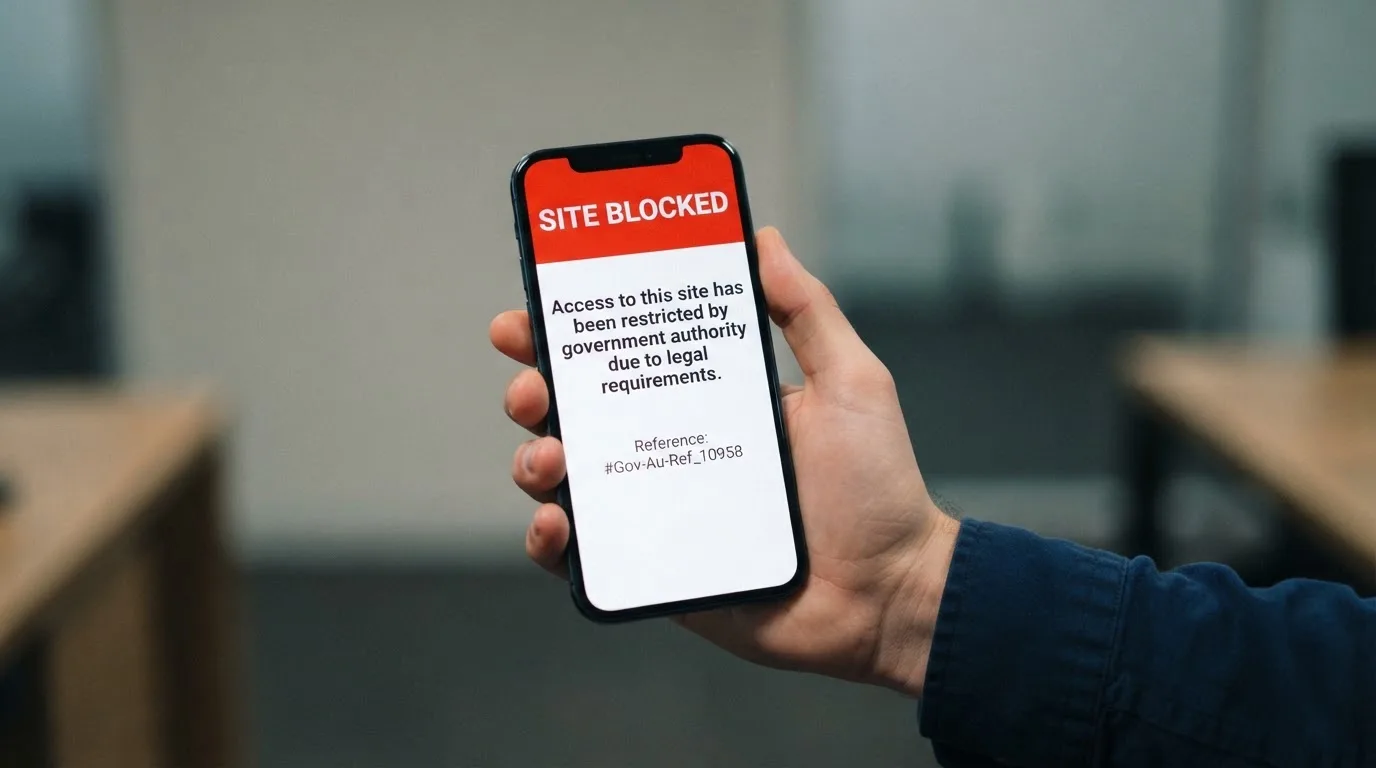
Two figures tell the cumulative story. As reported in June 2026, the ACMA had asked Australian ISPs to block 1,751 illegal gambling and affiliate-marketing websites since the first blocking request in November 2019, and more than 230 unlicensed gambling services had left the Australian market since enforcement was strengthened in 2017. The June 2026 round alone added 12 names to the blocked list — 7Signs, ChromaBet, Donbet, Duospin, Freshbet, Slots Gem, Jacks Club, Lucky Start, Pointsbetz.com, Spinrise, Vinyl Casino and Wildsino. Each of those names will be unfamiliar to most readers; the point is the cadence. A new round lands every few weeks, and the brands in it are not small fly-by-night outfits — they are the same operators that appear on affiliate review sites pitching Microgaming content to Australian sign-ups.
The cumulative block-and-leave rate is what the prescribed calculation puts a number on. The arithmetic is simple and the numbers come from the ACMA’s published record. From the first blocking request in November 2019 to the June 2026 figure of 1,751 blocked sites, the ACMA has averaged around 270 blocks a year, or roughly 22 a month — the 12-site June 2026 round was, on that pace, a quiet month. State it as a band rather than a single figure, because the ACMA reports the count only at the moment of a round; if a future round pulls a larger batch in, the rate moves.
What gets warned, what gets blocked
A formal warning is the first move and is published on the ACMA’s site, with the operator and the brand named. The pattern over 2022 to 2026 looks like this: in May 2022, Dama N.V. was warned over six brands — Bambet, Dazard, Level Up, Rocketplay, Wild Tornado and Cobra Casinos. The same operator came back for two more warnings: Woo Casino in March 2025 and Spirit Casino in May 2025. Bamboo Media drew a warning over Ignition Casino in July 2025, and Consolutetish S.R.L. drew warnings over National Casino and Bizzo Casino in the same month; Bizzo had already been the subject of a 2022 warning to TechSolutions, so it had been warned twice. EOD Code SRL picked up a warning over Instant Casino in February 2025. Sterplay Holding Ltd was warned over Casino Intense in April 2025. Ryker B.V. was warned over Jackbit and CasinOK in April 2026. Pulsup Ltd was warned over Rocketplay.com.au in March 2026. Hollycorn N.V. drew a warning covering Sky Crown and Blue Leo back in 2022.
Reading across that record, two things stand out. One is repetition — the same corporate owner can be warned under a new brand name within months. The other is overlap with the rest of this page: of the eleven brands the ACMA has acted against that the rest of this page covers, almost every one of them carries Microgaming content in its lobby. That is not a coincidence; it is a pattern.
Player protection in a market that mostly isn’t licensed
The most important thing for an Australian reader to know about protection is what BetStop actually binds. BetStop, the National Self-Exclusion Register, has been live since August 2023 and lets a person exclude themselves from every Australian-licensed online and phone wagering service with a single registration. That is meaningful: a BetStop registration is honoured by every NTRWC-licensed bookmaker and by licensed lottery operators. It is not honoured by an offshore casino running on a Curaçao licence. A self-exclusion request to BetStop does not, by itself, stop an offshore brand from accepting deposits from the same person.
So if the reader’s concern is harm minimisation, the question is which set of operators the Australian rules actually reach. Licensed wagering — sports and racing bookmakers licensed in the Northern Territory — is reachable. Offshore casino is not. That asymmetry is one reason the legal route matters even when it looks less interesting on the surface.
For anyone already feeling the strain, the National Gambling Helpline is 1800 858 858, free and 24/7, with chat available through Gambling Help Online. These are the entry points that work in Australia regardless of which site the reader has been using.
Money in, money out, and the payment-method divide
The payment-method story is where the Australian rules actually start to bite an offshore operator, and it is worth knowing because it tells a reader which sites are operating inside the rules and which are not.
From 11 June 2024, credit cards, credit-related products and digital currency are banned as a means of paying for any licensed online wagering service in Australia, with penalties of up to A$247,500 for operators that take them anyway. The lawful deposit methods for a licensed Australian wagering account are debit card, bank transfer, PayID/Osko and BPAY. A site that asks an Australian customer for a credit card number or a crypto wallet address is operating outside the Australian rules, which is one quick way to tell what kind of licence the site actually has. This is also why an offshore Microgaming casino tends to push cryptocurrency and a few e-wallets rather than PayID or BPAY: PayID is Australian real-time payments infrastructure that only connects to Australian bank accounts, and an offshore site has no business reason to support it.
Withdrawal speed is the other half. An offshore brand that accepts a PayID deposit but pays out only by international bank wire is, in practice, doing what the rules say it can do — accepting AUD without committing to a fast AUD settlement. A reader who puts A$200 in on a Tuesday and waits ten days for a wire refund has, in that time, often played through the A$200 and a good deal more. The payment-method structure is the mechanics behind the timing, not a separate problem.
What Microgaming-style bonuses actually cost
The promotional inducements attached to Microgaming content — deposit bonuses, “no deposit” bonuses, free-spin packages — are the most heavily marketed feature of these brands. The marketing line is that the offer is “free” or “extra”, with a number attached. The arithmetic underneath it is the wagering requirement, and it is the only number that decides what the offer is worth.
A deposit bonus with a wagering multiple of, say, 35× the bonus amount means the player has to wager that total before any of the bonus money becomes withdrawable. Free-spin winnings usually carry the same condition, often at a higher multiple. A “max cashout” cap — common on no-deposit bonuses — means that even after the requirement is met, only a fixed ceiling becomes withdrawable. A cap of A$100 on a no-deposit bonus that took A$1,200 of wagering to clear is the offer’s real shape: A$100 of real money after a thousand dollars of play. Where the cap is missing, the wagering requirement itself is usually higher; the two levers substitute for each other.
The honest framing is that the bonus is not “extra money” but a contract: the operator gives the player a larger bankroll to play with, in exchange for a guaranteed volume of bets the player would not otherwise have placed. Whether the contract is a good one depends on the games played and the RTP of those games — most online slots sit in the 94-97% RTP range, so on average the player loses 3-6% of every dollar wagered. Work the wagering requirement through that edge and the offer’s expected cost becomes visible. A player who reads the bonus terms before accepting is not missing out; they are reading what they have already agreed to.
For an Australian reader specifically: any “no deposit” bonus pitched in AUD is, definitionally, an offer from a site the ACMA has already noticed. No Australian-licensed wagering operator offers online casino bonuses, because they cannot offer online casino games. So a bonus email is itself a signal of where the offer is coming from.
The phone-screen version
The mobile experience for Microgaming content at an offshore brand is, mechanically, what one would expect. The provider’s catalogue is built in HTML5, which is the same technology behind the desktop instant-play client. There is no need to install anything: the games run inside the phone’s browser. The newer generation of providers — 1spin4win is a representative case, founded in 2021 and explicitly building for low-bandwidth mobile connections — ship mobile-first by design. The catalogue scale at that end is meaningful: 1spin4win’s site lists more than 190 online slots in its portfolio and more than 1,000 partnerships with casinos and aggregators.
For the reader, the relevant question is whether the mobile experience matches what the desktop version promises. There are two failure modes. The first is a site that wraps its desktop lobby in a mobile-responsive skin but leaves the actual games as low-frame-rate ports; the second is a “mobile app” offered for download that is, on inspection, a thin webview wrapper around the same browser-based lobby. Both are common at the offshore end of the market. Neither is unique to Microgaming content — these are generic complaints about how the offshore sector delivers its product — but they show up here because the marketing of these brands leans hard on the “play anywhere” line.
For licensed Australian wagering, the equivalent mobile experience is the bookmaker apps: Sportsbet, Bet365, Ladbrokes, TAB. Those are real native apps, regulated by the NTRWC, and the only legally compliant way to wager on a phone in Australia.
What Microgaming actually makes, and the wider catalogue
Microgaming is one of the oldest names in the online gambling supply chain. Martin Moshal founded the company after graduating from university in 1992, and the early Gaming Club online casino launched at casino.co.za from Durban in 1994. Wikipedia’s article on online gambling credits Microgaming — by then based on the Isle of Man — with developing the first fully functional online gambling software in partnership with CryptoLogic, which together made the first online casinos possible that year. The 1998 launch of Cash Splash, generally described as the world’s first online progressive-jackpot slot, is the catalogue’s origin point.
What Microgaming makes is the full package a B2B supplier sells to an operator brand: slot games, table games, live-dealer content, a progressive-jackpot network and the platform that ties them together. The Mega Moolah jackpot, the most-recognised single product on the network, is the most common feature on an offshore Microgaming brand’s homepage. The progressive network is one reason operators carry Microgaming content at all: a player who lands the top jackpot on a Microgaming-powered slot is reading about it on every affiliate page for a week.
The wider catalogue of providers an Australian reader will meet at the same offshore sites is broad and deliberately so. Aristocrat Leisure, the Australian gambling-machine manufacturer headquartered in North Ryde, runs its regulated online real-money gambling business through Aristocrat Interactive, formed in April 2024 from the Anaxi unit and the newly acquired NeoGames group. Aristocrat’s ticker is ALL on the ASX, it reported A$6.30 billion of revenue in 2025, and the brand is recognisably Australian in a way the offshore operators’ content catalogues are not. BGaming, run by Stable Games Ltd of Valletta, holds an MGA Critical Gaming Supply Licence (MGA/B2B/785/2020) issued on 18 March 2021 and offers more than 250 certified games. Betsoft, founded in 2006, lists more than 200 RNG games across slots, table games, video poker and specialty titles, and names compliance with Italy’s ADM and RNG certification from Quinel and Gaming Labs International. Each of these is a B2B supplier whose products the same offshore brands bundle into a single lobby under their own name.
The catalogue difference between a Microgaming-titled slot, a BGaming slot and a Betsoft slot is mostly in art direction, volatility band and RTP range; the underlying product is the same shape. A player looking at Good Girl Bad Girl 2 from Betsoft sees a published RTP of 96.22% with “Very High” volatility; The Slotfather from the same supplier sits at 95.69% RTP with “Medium” volatility. Those are the published figures from the supplier, and they are what the audit checks against.
The eleven brands the ACMA has named, side by side
The table below covers the eleven brands the ACMA has issued a formal warning against, each named in the ACMA’s publication with the operator company and the date. The list is not a ranking and not a recommendation; it is the published record, and reading it is the point.
| Brand | ACMA action and date | Operator named by the ACMA | Subject support |
|---|---|---|---|
| RocketPlay | Formal warning, March 2026 (Pulsup Ltd); previously May 2022 (Dama N.V.) | Pulsup Ltd | — |
| Level Up Casino | Formal warning, May 2022 | Dama N.V. | Listed by Wazdan as carrying its content |
| Woo Casino | Formal warning, March 2025 | Dama N.V. | — |
| Spirit Casino | Formal warning, May 2025 | Dama N.V. | — |
| National Casino | Formal warning, July 2025 | Consolutetish S.R.L. | Carries content from Betsoft, Pragmatic Play and other listed suppliers |
| Bizzo Casino | Formal warning, July 2025 (Consolutetish S.R.L.); previously 2022 (TechSolutions) | Consolutetish S.R.L. | — |
| Ignition Casino | Formal warning, July 2025 | Bamboo Media | — |
| Instant Casino | Formal warning, February 2025 | EOD Code SRL | — |
| Jackbit | Formal warning, April 2026 | Ryker B.V. | — |
| Casino Intense | Formal warning, April 2025 | Sterplay Holding Ltd | Carries content from 1spin4win and other listed suppliers |
| Sky Crown | Formal warning, September 2022 | Hollycorn N.V. | — |
Two columns needed to be dropped from the comparison because the data does not exist: a column for the operator’s stated licence jurisdiction would be repetitive (all the named operators are offshore), and a column for the brand’s age or sister-brand count would invite invented numbers. What remains is the ACMA record itself, which is what an Australian reader actually needs to see.
The shape of the table is the shape of the sector. The same operator name recurs across rows — Dama N.V. sits behind three of the eleven, and TechSolutions/Consolutetish is behind two — and the same year often turns up twice. That is what offshore rebrand activity looks like from the regulator’s side: a brand gets warned, the operator quietly re-emerges under a new name, and the ACMA catches up again within months.
RocketPlay
The ACMA warned Pulsup Ltd over Rocketplay.com.au in March 2026, with a separate earlier warning to Dama N.V. over the brand going back to May 2022. Two warnings to a single brand across roughly four years is the pattern the ACMA’s record shows when a brand has not changed its behaviour — it has changed its operator company. For a reader, the most useful fact is that RocketPlay accepts Australian sign-ups in AUD, which no Australian-licensed operator can do for casino games. The mismatch with the page’s subject is total: a reader looking for an Australian-licensed Microgaming casino will not find one here, because none exists anywhere.
Level Up Casino
Dama N.V. was warned over Level Up in May 2022, alongside five other brands in the same letter. The supplier listings for Level Up reference Wazdan content in particular, which is a different catalogue line from Microgaming — same B2B supply chain, different product. The page’s overall subject cuts against this brand for the same reason it cuts against RocketPlay, and the writeup says so: there is no Level Up Casino an Australian resident can join lawfully, and the ACMA’s letter is published evidence of that fact.
Woo Casino
The ACMA warned Dama N.V. over Woo Casino in March 2025, one of two follow-up warnings to the same operator after the 2022 round. Woo Casino was the brand name in the ACMA letter; the operator name behind it was the same Dama N.V. that ran Rocketplay in 2022. For a reader, the takeaway is that the operator-side problem is the unit the ACMA tracks, not the brand. A reader who has been told Woo Casino is a “different casino” from a Dama N.V. sister site has been told something the ACMA’s record contradicts.
Spirit Casino
Dama N.V. was warned over Spirit Casino in May 2025, two months after the Woo Casino warning. Same operator, different brand, two months apart. The reading is the same as Woo Casino: a rebrand under a new marketing name does not reset the regulatory track record.
National Casino
Consolutetish S.R.L. was warned over National Casino in July 2025. National Casino’s supplier listings name Betsoft and Pragmatic Play among its content providers — both established B2B suppliers, both with publicly stated licensing positions, neither of which alters the operator’s status under the IGA. A player on National Casino is, for the IGA’s purposes, on a site the ACMA has already told is acting unlawfully in Australia. The supplier names in the lobby do not change that.
Bizzo Casino
Consolutetish S.R.L. was warned over Bizzo Casino in July 2025, alongside the National Casino letter — same operator, same date, two brands. Bizzo had also been the subject of a 2022 warning to TechSolutions, so it has been warned twice. The repetition is unusual in the ACMA’s record and reads as a brand that has not changed course. For a reader, two warnings across three years is more pointed than one.
Ignition Casino
Bamboo Media was warned over Ignition Casino in July 2025. Ignition is one of the more recognisable offshore brands in the Australian-facing market, and the warning landed in the same month as the National Casino and Bizzo warnings — three Consolutetish/Bamboo-area brands in a single round. The cluster suggests the ACMA was working from a shared investigation rather than three separate complaints.
Instant Casino
EOD Code SRL was warned over Instant Casino in February 2025. The brand’s name is the closest the offshore sector comes to a generic category — “Instant Casino” is a positioning statement as much as a brand name — and the ACMA’s letter addresses that positioning directly.
Jackbit
Ryker B.V. was warned over Jackbit (alongside CasinOK) in April 2026. Jackbit leans hard on the cryptocurrency angle in its marketing, and that pitch is the second tell that the site is operating outside the Australian rules: licensed Australian wagering cannot legally accept crypto as a deposit method, so a site pushing crypto deposits is, by that fact alone, offside.
Casino Intense
Sterplay Holding Ltd was warned over Casino Intense in April 2025. The supplier listings for Casino Intense reference 1spin4win alongside a couple of other named providers. For the reader, the licence/operator split is the same as elsewhere on this list: the suppliers are licensed in their own jurisdictions, the operator is not licensed in Australia, and the brand is named in a published ACMA letter.
Sky Crown
Hollycorn N.V. was warned over Sky Crown (alongside Blue Leo) back in September 2022 — the oldest of the eleven entries. Sky Crown sits at the older end of the ACMA’s recent enforcement record and is a useful reference for how long a brand can stay in the Australian-facing market after a warning: four years and counting for Sky Crown. That longevity is part of why the ACMA pairs warnings with blocking requests: a warning alone, the record shows, does not move an offshore operator out of the market.
What the lawful alternatives actually look like
For an Australian reader, the lawful routes for what these offshore sites sell do not include online casino games or online pokies. The lawful routes are: licensed wagering on sport and racing through an NTRWC-licensed bookmaker, licensed lottery products, and keno. Land-based casinos in Australia offer table games and pokies, and the major operators — Crown Melbourne, The Star Sydney, Crown Perth, The Star Gold Coast, SkyCity Adelaide — run under state-based casino licences.
For Microgaming-style content specifically, land-based Australian casinos carry Aristocrat and IGT slot machines on their floors, not Microgaming. Aristocrat is the largest gambling-machine manufacturer in Australia and the second-largest slot-machine manufacturer worldwide, and its machines are the dominant product on the floors of Australian casinos. A reader who wants the experience the offshore Microgaming brands are marketing — progressive jackpot slots, themed video slots, mobile-style gameplay — gets the closest lawful version of it on the floor of a land-based Australian casino, with the difference that the product is Aristocrat’s, not Microgaming’s.
For a reader concerned about harm minimisation, the lawful path that holds together best is the BetStop route: a single BetStop registration excludes a person from every NTRWC-licensed wagering service in Australia, and the National Gambling Helpline is reachable on 1800 858 858 around the clock. Neither of those tools reaches an offshore casino. That gap is the strongest argument the law has for staying inside the licensed side of the market.
The background numbers
H2 Gambling Capital’s 2025 report puts annual losses to illegal gambling sites at roughly A$3.9 billion, with the share of gambling going through legal channels falling from 74% in 2021 to 64%. That is the closest the published record comes to a single number on the size of the offshore casino market in Australia, and it is a big number in absolute terms: A$3.9 billion a year is the budget of a mid-sized government department. The 74-to-64% slide over four years is the trend the 2026 reform bill — the Interactive Gambling Amendment (Gambling Reform) Bill 2026, passed Parliament on 19 August 2026 — is attempting to reverse. Its advertising and inducement measures commence on 1 January 2027, which means a 2026 reader is reading about law with a start date, not law in force.
For the reader, the relevant comparison is that A$3.9 billion is what Australian households are spending on offshore gambling that the law says they cannot be offered. The fact that they are spending it anyway is the policy problem the regulator is working through. The page does not resolve that policy problem. It does tell the reader what the policy is, what the regulator has actually done about it, and what the lawful alternatives are.
Frequently asked questions
What kind of games does Microgaming make?
Microgaming makes B2B online casino software — slot games, table games, live-dealer content and a progressive-jackpot network — sold under the supplier’s own name to operator brands. The company dates back to 1994, when it launched from Durban and later relocated to the Isle of Man, and it is widely credited with running the first fully functional online gambling software in partnership with CryptoLogic. Its progressive-jackpot network is the catalogue feature most Australian readers will recognise, because the headline jackpots sit on every offshore brand that carries Microgaming content.
Is Microgaming used by any casino licensed to operate in Australia?
No Australian jurisdiction licences online casino games or online pokies, so no operator brand in Australia can lawfully offer Microgaming-powered casino games to Australian residents, regardless of which licence the brand displays. The Northern Territory Racing and Wagering Commission licences online wagering on sport and racing, which is a different product. Every brand this page covers carries Microgaming content at the B2B level but operates offshore and is the subject of an ACMA formal warning.
Can Australians legally play Microgaming slots at an online casino?
The Interactive Gambling Act 2001 makes it an offence to provide online casino games to a person in Australia, so no online casino offering Microgaming slots is lawfully available to an Australian resident. The individual player is not prosecuted — the IGA targets the provider — but an offshore site offers no Australian consumer protection and no recourse if a withdrawal is refused, and the ACMA can block the site with a balance still on the account. The lawful version of the product is Aristocrat and IGT slot machines on the floor of a licensed land-based Australian casino.
Are Microgaming games available at land-based Australian casinos?
Microgaming does not supply its games to Australian land-based casinos; the floor product there is Aristocrat and IGT machines, with Aristocrat the largest gambling-machine manufacturer in Australia and the second-largest slot-machine manufacturer worldwide. Aristocrat Leisure, headquartered in North Ryde, runs its regulated online real-money gambling business through Aristocrat Interactive, formed in April 2024 from the Anaxi unit and the acquired NeoGames group, but its Australian product is on the casino floor, not online.
What should someone check before trusting a site that claims to offer Microgaming games?
The first check is whether the site is licensed by an Australian regulator for the product it is offering — no Australian jurisdiction licences online casino games, so the answer is always no, regardless of the brand. The second check is the ACMA’s published register of formal warnings, which lists every operator the ACMA has acted against, with the date and the operator company. The third is the payment method: an Australian-licensed wagering service cannot legally accept a credit card or cryptocurrency, so a site asking for either is operating outside the Australian rules. A site that fails any of those three checks is one an Australian reader should not be playing at.
Does Microgaming software run on mobile browsers?
Yes. Microgaming’s catalogue is built in HTML5, the same technology the desktop instant-play client uses, so the games run inside the phone’s browser without an install. Newer-generation suppliers in the same B2B supply chain — 1spin4win is a representative example, founded in 2021 and explicitly designing for low-bandwidth mobile connections — ship mobile-first by design. A reader comparing mobile experiences across offshore Microgaming brands should look past the marketing of “play anywhere” to whether the games run at full frame rate on the phone and whether any “mobile app” offered for download is actually a native app or a webview wrapper around the browser-based lobby.