
Pokies open near me: how Australians actually find them in 2026
Current as of 28 October 2026 and cross-checked against the Australian Communications and Media Authority’s register of blocking requests.
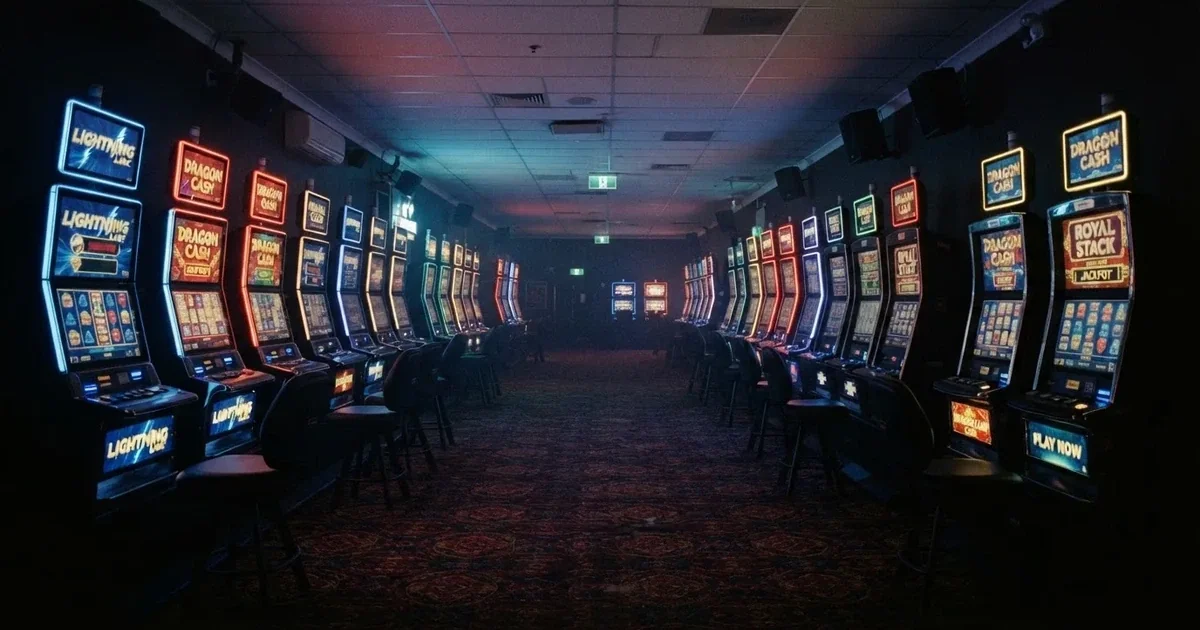
Most Australians searching for “pokies open near me” are not chasing an offshore casino. They want to know which pub, club or casino within driving distance has the machines lit up right now — and how late the venue runs. That question has a simple, lawful answer. The marketing that surrounds it does not, and this page is built to keep the two apart.
Table of Contents
- How this page is set out
- The eleven brands the ACMA has named
- The landscape before any of this
- How the ACMA’s blocking list has built up
- The land-based paths that the law actually allows
- Why the offshore shelf keeps showing up
- What this page is not for
- Keeping the search in perspective
- The trade-offs in plain view
- The bottom line
- Frequently asked questions
How this page is set out
Eleven brands sit below in the order the ACMA itself acted against them — not a ranking, not a shortlist worth chasing. They exist on this page because the regulator took the unusual step of naming them. Around that list, the rest of the article works through the question the search actually asks: where pokies are legal in Australia, what that legality leaves out, and what the offshore alternative really costs a player who tries it.
The angle here is choice — not a recommendation. Every reader of a page like this is choosing between paths, and the paths are not equivalent. A licensed venue two kilometres from home has one set of trade-offs; an offshore site reachable from a laptop has another, sharper set. Spelling those out, side by side, is the job.
The eleven brands the ACMA has named
Every brand below was the subject of a formal ACMA warning under the Interactive Gambling Act 2001 for offering prohibited online casino services to Australians. Each was named by the regulator, on a specific date, against a specific operator. None holds an Australian licence to provide online casino games, because no such licence exists to hold. The order follows the ACMA’s own publication timeline.
| Brand | ACMA action and date | Operator named by the ACMA | Subject support |
|---|---|---|---|
| RocketPlay | Formal warning, March 2026; earlier Dama N.V., May 2022 | Pulsup Ltd | — |
| Level Up Casino | Formal warning, May 2022 | Dama N.V. | listings-only — Bgaming |
| Woo Casino | Formal warning, March 2025 | Dama N.V. | — |
| Spirit Casino | Formal warning, May 2025 | Dama N.V. | — |
| National Casino | Formal warning, July 2025 | Consolutetish S.R.L. | listings-only — Wikipedia |
| Bizzo Casino | Formal warning, July 2025; earlier TechSolutions, 2022 | Consolutetish S.R.L. | — |
| Ignition Casino | Formal warning, July 2025 | Bamboo Media | — |
| Instant Casino | Formal warning, February 2025 | EOD Code SRL | — |
| Jackbit | Formal warning, April 2026 | Ryker B.V. | — |
| Casino Intense | Formal warning, April 2025 | Sterplay Holding Ltd | listings-only — ABC, ACMA, Crown Melbourne |
| Sky Crown | Formal warning, September 2022 | Hollycorn N.V. | — |
The “—” cells in the right column do not mean the brand is unpopular. They mean the research for this page did not pull an authoritative, citable subject-matter line for that brand on the specific topic of finding land-based pokies near an Australian reader. A reader sees a gap; the gap is honest.
The brands that DO carry a “listings-only” entry have a footprint in third-party directories, not a verified subject-matter offering. That is what the table shows, and nothing more.
What the table actually says
Eleven operators. Eleven formal warnings. One lawful status — every one of them prohibited from offering the services they advertise to a person in Australia. A reader looking for a “best of” list has been handed something else entirely: a list of who the regulator has moved against, in the order it moved.
The table’s other job is to surface the parent companies. Dama N.V. appears three times under different brand names — Level Up, Woo, Spirit — and once more historically for RocketPlay. Consolutetish S.R.L. runs two brands on this list. The ACMA names the operator, not just the skin. A reader looking only at brand names sees eleven businesses; a reader looking at operators sees four groups running most of them.
This is the part of the offshore market the marketing tends to flatten. A new brand name is cheap. The operator behind it often is not new at all.
The landscape before any of this
Electronic gaming machines — “pokies” — operate in every Australian state and territory, and each jurisdiction separately regulates how they are designed and run. In 2020–21 Australians bet close to A$150 billion through these machines and lost A$12.18 billion on them. The country has about 3% of the world’s pub and club poker machines with 0.3% of the global population. The machines are not a niche product; they are a deeply embedded part of the leisure economy, and the law has spent decades catching up to them.
What the law has not done, anywhere, is license the online version. No state or territory in Australia issues a licence for online casino games, online pokies or in-play betting. The Interactive Gambling Act 2001, tightened by the Interactive Gambling Amendment Act 2017, makes providing those services to a person physically in Australia an offence. The provider is the one in the frame — the individual player is not prosecuted — but the practical effect for an Australian punter is that the entire online casino shelf sits offshore.
That is why a search for “pokies open near me” returns a strange mix: real licensed venues at the top, offshore casino sites halfway down, and ACMA enforcement notices scattered through both. The two halves of the result page are not competing on equal terms. One is legal and regulated; the other is, by definition, neither.
Industry Status
| Venue Type | Licensed | Regulation |
|---|---|---|
| Pub/Club Pokies | Yes | State/Territory |
| Online Casino | No | Prohibited |
| Sports Wagering | Yes | Federal/State |
The Interactive Gambling Act 2001, as amended in 2017, is the federal instrument. State and territory regulators handle venue-level licensing — who can run a poker machine in a pub, who can run one in a casino, what hours they keep, what return-to-player floor applies. The federal law sets the outer wall; the state law fills the inside. Credit cards, credit-related products and digital currency have been banned as payment for licensed online wagering since 11 June 2024, with penalties up to A$247,500. The legal deposit routes for a licensed Australian wagering account are debit card, bank transfer, PayID/Osko and BPAY. An offshore casino accepting a credit card or a crypto deposit is, by that fact alone, outside the Australian rules.
Minimum age to gamble in Australia is 18. The minimum return-to-player on a poker machine varies by jurisdiction — 85% in NSW, the NT, Queensland and (generally) Victoria, 87% at Crown Melbourne, 87% in the ACT and Tasmania, 87.5% in South Australia, 90% in Western Australia. These are floors, not averages. The machines on the floor of a typical pub sit at or just above the floor, and the gap between the legal minimum and the actual setting is a margin the venue keeps.
What “open near me” actually means at the venue level
Opening hours are set venue by venue, not jurisdiction by jurisdiction. New South Wales pubs and clubs generally run pokies during licensed trading hours, often from mid-morning until late; some operate round the clock under club rules. Queensland and Victoria have similar patterns, with the major casino floors — Crown Melbourne, The Star Sydney, Treasury Brisbane, Crown Perth — running extended or 24-hour schedules on the main gaming floor. A reader who wants a definitive answer for a specific venue still has to check that venue: the regulator sets the ceiling, the venue sets the actual hours.
This is why “pokies open near me” is a venue question more than a law question. The federal prohibition does not touch the land-based machines. It touches only the online version, which is why the ACMA’s blocking list is the natural pivot for a page like this one.
How the ACMA’s blocking list has built up
As of the round reported on 26 June 2026, the ACMA had directed Australian ISPs to block 1,751 illegal gambling and affiliate websites since the regulator made its first blocking request in November 2019. That is six and a half years of enforcement, and the total keeps moving — the same June 2026 round added twelve more sites: 7Signs, ChromaBet, Donbet, Duospin, Freshbet, Slots Gem, Jacks Club, Lucky Start, Pointsbetz.com, Spinrise, Vinyl Casino and Wildsino.
The blocking rate, in plain language
Take the 1,751 sites blocked since November 2019 and divide by the time elapsed — roughly 80 months. The long-run rate sits around 22 sites blocked per month, with the cadence uneven: some months see a handful, some see a dozen or more in a single round. That is the page’s insight on the blocking programme. The number is not a forecast — it is a band, conditioned on the ACMA continuing to publish its findings and ISPs continuing to comply. The same source also notes more than 230 unlicensed services have left the Australian market entirely since enforcement was strengthened in 2017.
Two ways to read the same number. Optimistic reading: the system works, the offshore shelf shrinks, an Australian who tries one of the listed URLs hits a blocked page. Less comfortable reading: 1,751 is a cumulative count over years; the rate of replacement — new sites spinning up to replace the ones blocked — is what determines whether the total is a trend or a snapshot. The ACMA does not publish that replacement rate, so the comparison a reader can make is between the blocked total and the still active offshore shelf, not between the blocked total and itself.
What the warnings cover
A formal warning is not a block. It is a step before a block. The ACMA publishes the warning, names the operator and the brand, and gives the operator a chance to withdraw from the Australian market. If the service continues, the ACMA moves to the next step, which is asking ISPs to block the URL. Several of the brands on this page — Woo Casino, Spirit Casino, National Casino, Bizzo Casino, Ignition Casino, Instant Casino — have warnings on record and were added to blocking lists in the rounds that followed.
RocketPlay carries two separate warnings: an earlier one to Dama N.V. in May 2022 and a fresher one to Pulsup Ltd in March 2026. The 2026 warning names a new operator entity for a service the regulator had already moved against four years earlier. That is not a one-off: brand names change, the underlying operator shifts, and the ACMA names whoever is actually running the service at the time it acts.
The land-based paths that the law actually allows
For a reader who wants pokies open right now, the lawful paths are narrower than the offshore shelf but easier to verify.
Licensed pubs and clubs are the bulk of the offer. New South Wales alone had 87,298 gaming machines outside casinos across 2,195 venues as of June 2023, with player losses of A$8.18 billion in 2022–23. Queensland had 21,122 machines in 351 venues (October 2023); Victoria had 26,380 outside Crown Casino in 488 venues in 2021–22, sitting under a 30,000-machine statewide cap. These are the numbers behind the pub-with-pokies on the corner, and they explain why a reader in Sydney, Brisbane or Melbourne is rarely more than a short drive from a venue that has them running.
Licensed casinos are the other lawful path. Crown Melbourne, The Star Sydney, Treasury Brisbane, Crown Perth and The Star Gold Coast run the largest concentrations. Western Australia banned poker machines in pubs and clubs when Crown Perth opened in 1985 — Crown Perth’s own machine count has since grown from about 200 at opening to roughly 2,500 today, all approved by the state’s Gaming and Wagering Commission. A Perth reader who wants pokies open nearby is, in practice, choosing between Crown Perth and an online site; the rest of the WA pub landscape simply does not have them.
Registered clubs were where the machines started. Registered clubs operated Australia’s first legal poker machines from 1956, in New South Wales. Tasmania held a single-operator monopoly over the machines from 1968 until legislation passed in November 2021 ended it, moving oversight to the Tasmanian Liquor and Gaming Commission. Tasmania had also planned nation-leading mandatory pre-commitment cards, with implementation delayed into late 2025.
Picking between them
The choice between a pub or club and a casino is not really a gambling choice. It is a venue choice. A pub or club typically offers lower stakes, lower maximum bets and a smaller machine count under one roof; a casino offers higher stakes, more variants and a floor that may run 24 hours. A reader with a small budget and a taste for a single session fits the pub end; a reader chasing a specific variant or a late-night schedule fits the casino end. Both are lawful. Both are regulated. Both are within the IGA’s protected space, in a way the offshore shelf is not.
The third path — and the one a search like this surfaces most often — is the offshore casino site. That path has its own logic and its own cost, which the rest of this page works through.
Why the offshore shelf keeps showing up
If a reader is searching for pokies open near them, the search results will include offshore sites anyway. The reason is not complicated: offshore sites spend heavily on Australian-facing search advertising, and the ACMA’s blocking programme takes weeks to months to catch up with any new URL. An Australian reader who searches the term and clicks the third or fourth result will, depending on the round, sometimes hit a live site the regulator has not yet moved against.
H2 Gambling Capital’s 2025 report estimates that Australians lose about A$3.9 billion a year to illegal gambling sites. The same report puts the share of gambling going through legal channels at 64% in 2025, down from 74% in 2021. Those two figures together say the offshore shelf is not a niche. It is a multi-billion-dollar competitor to the licensed Australian wagering market, with the gap between 2021 and 2025 measurable in billions of dollars of spend that moved from the regulated side to the unregulated side.
The question a reader actually has is whether the offshore path is worth the savings it appears to offer — and the answer to that question depends on what the reader is trading away, not on the bonus headline on the landing page.
What an offshore site does not give the reader
An offshore casino is not connected to BetStop, the National Self-Exclusion Register, which has been live since August 2023 and binds only Australian-licensed online and phone wagering services. A punter who has self-excluded through BetStop can still reach an offshore site and still deposit. The site has no Australian complaints body, no Australian consumer protection, and no enforceable obligation to honour a withdrawal request. If the offshore operator decides a withdrawal is “suspicious” or a bonus term has been “abused”, the punter has no recourse in Australian law.
The site is also at the wrong end of the ACMA’s pipeline. A site that takes an Australian deposit today may be blocked tomorrow. A punter with a balance on a blocked URL has lost access to the account, the balance and any winnings tied to it — without breaking any Australian law themselves. The IGA targets the provider, not the player, which means the player is left holding the loss.
The credit card and crypto tell
From 11 June 2024, credit cards, credit-related products and digital currency have been banned as payment for licensed online wagering in Australia, with operator penalties up to A$247,500. A site asking an Australian player for a credit card deposit or a crypto transfer is, by that signal alone, not operating under Australian rules. The licensed alternatives — debit card, bank transfer, PayID/Osko, BPAY — are slower and more traceable. The offshore site is faster and less traceable, because it sits outside the regime the licensed sites are bound by.
This is one of the cleaner trade-offs the page can name. The licensed sites cost the player in convenience. The offshore sites cost the player in recourse. A reader choosing speed over protection is making a real choice with real consequences.
What this page is not for
This page is not a buyer’s guide to offshore casinos. None of the eleven brands above is recommended. Each is named because the ACMA named it first, on a specific date, against a specific operator, for a specific reason that is on the public record. A reader looking for an endorsement will not find one here; a reader looking for the regulator’s own list will.
It is also not a directory of “pokies open now” with a live feed. The numbers above are taken from regulator and research publications, not from any venue’s live trading-floor feed, and they will date. A reader who needs to know whether a specific venue has its gaming floor open at this moment should check that venue directly — its website, its phone line, or, for the casino floors, the operator’s own page.
What the page is for is the reader who wants to understand the shape of the Australian market they are about to play in. Land-based pokies are heavily regulated and heavily concentrated; the online version is prohibited entirely. The ACMA’s blocking list is the regulator’s own record of how that prohibition is being enforced, and the eleven brands on this page are the part of that record the reader is most likely to encounter in a search result.
Keeping the search in perspective
A pokies session is, by design, a product the house always wins on. The legal return-to-player floors in Australia — 85% to 90% depending on the state — are a floor on what the machine returns over its operating life, not a guarantee of any individual session. A session that ends ahead is a session the machine’s design makes uncommon, and a session that ends behind is the session the design is built around. The arithmetic does not change because the machine is in a casino, a club, a pub or — illegally — on an offshore site.
For readers who find themselves playing more than they planned, or who feel the session has stopped being a choice, the support services are:
- National Gambling Helpline: 1800 858 858 — free, 24/7.
- Gambling Help Online — chat-based, same operator, same hours.
- BetStop, the National Self-Exclusion Register — binds Australian-licensed wagering services; will not stop an offshore site.
The self-exclusion point is worth a second look. A punter who has self-excluded and then plays at an offshore site is not breaking Australian law — the law targets the provider — but they are also not getting the protection they signed up for. The offshore site is not bound by BetStop. The punter is bound by their own registration, and the offshore site does not care.
The trade-offs in plain view
A reader weighing their options now has the data in front of them, in a way the marketing page for an offshore site never quite lays out:
- Land-based licensed venue. Regulated, in scope of state law, connected to consumer protection, machine RTPs set above a legal floor, payouts handled at the venue. Cost: travel, venue hours, the venue’s own betting limits.
- Licensed Australian online wagering. Wagering on races and sport is licensable; online casino games are not. Cost: the product mix does not include what most readers searching for “pokies” actually want.
- Offshore online casino. Full product mix, available at any hour, no geographic limit. Cost: no Australian protection, no BetStop binding, balance at risk of an ACMA block, withdrawal disputes with no Australian forum, and a regulator on record against the operator.
The third path is the most heavily advertised and the least protected. The reader who picks it does so knowing the trade-off — or who should.
Where each operator sits
Eleven operators, eleven warnings, and the only thing that varies is the date and the parent company. RocketPlay sits at the freshest end of the timeline (March 2026), having been warned previously in 2022 under a different operator name. Jackbit and Casino Intense are recent (April 2026 and April 2025 respectively). Sky Crown’s warning is older (September 2022) and the ACMA has not necessarily published a follow-up. Woo Casino, Spirit Casino, National Casino, Bizzo Casino, Ignition Casino and Instant Casino cluster in the 2025 window — a year in which the regulator moved with notable speed.
A reader looking for a “best” pick from this list will not find one. The list is not built to be picked from. It is built to be read as a record.
The bottom line
For a reader in Australia who wants to play pokies right now, the lawful options are the licensed pub, club or casino within reach — and that is the answer the search itself is built around. The offshore alternatives are accessible but illegal to provide, and the regulator is on record against every brand on this page. The ACMA’s blocking rate of roughly 22 sites per month is not a victory parade; it is a reminder that the offshore shelf refreshes faster than the blocking programme can clear it, and that a reader who clicks a search result today may find a live site the regulator has not yet named.
The trade-offs are clear once they are on one page. Land-based play is regulated and constrained. Offshore play is unconstrained and unregulated. A reader who picks the second path picks it with both eyes open, or has not yet read the trade-off.
Frequently asked questions
What hours do most Australian pubs and clubs keep their pokies open?
Pokies hours are set by the venue, not by the regulator. Most pubs and clubs run machines from around 10am to midnight, with some clubs extending to 24 hours under their club licence. The major casino floors (Crown Melbourne, The Star Sydney, Crown Perth) typically run the gaming floor longer, often around the clock. There is no national “open” time — checking the specific venue is the only way to be sure.
Is there a way to check which venue currently has pokies open?
The state regulators publish venue lists and trading-hour data, and the major casino operators maintain live pages for their own floors. For a specific pub or club, the venue’s own website or phone line is the most current source. Real-time third-party “open now” data for every pub and club in Australia is not, as far as the public record shows, available in a single feed.
Are poker machines in a pub the same game as online pokies?
The mathematics is the same — reels, paylines, a return-to-player floor set by the jurisdiction. The legal status is not. A poker machine in a NSW pub is licensed under NSW law; an online pokie offered by an offshore casino is prohibited for Australians under the Interactive Gambling Act 2001. The same symbols on the same reels, in two different legal frames.
Do all pubs and clubs run pokies 24 hours?
No. The majority do not. Clubs with a 24-hour gaming licence exist in some jurisdictions — NSW is the most prominent — but the typical pub or club keeps standard trading hours, with the machines switched off when the venue closes. Crown Perth and Crown Melbourne run gaming floors around the clock; a suburban pub in Brisbane or Adelaide does not.
What ID does a venue ask for before play?
A licensed venue is required to enforce the legal minimum age of 18, and the standard ask is a photo ID — driver’s licence, passport, or the state-issued proof-of-age card. The machine is not the gate; the venue’s staff is. Some venues require registration at the loyalty club or at the cashier before the machine accepts play above a certain threshold, depending on the state. Offshore sites have no equivalent gate, which is part of why the ACMA’s blocking list targets them.