
Booongo-Powered Online Casinos in Australia: The Landscape Behind the Search
The phrase “Booongo casino” travels a long way before it reaches an Australian punter. It starts in the studios where slot machines are designed, passes through aggregators and licensing shells in places like Curaçao, surfaces on offshore marketing pages, and arrives here, in a market where none of it is licensed to operate. This page is a map of that path, drawn from the public record rather than from the marketing that brought you to it. The map’s central feature is a legal wall, and the whole landscape sits on the other side of it.
Currency stamp: data current as of 28 October 2026 · checked against the Australian Communications and Media Authority’s published formal-warning register and blocking-round notices.
Table of Contents
- How Online Casino Gambling Is Regulated in Australia
- What Responsible Gambling Looks Like in an Off-Shore-Side Landscape
- Payments and Payout Speed: Why This Shelf Reads Thin
- Bonuses and Free Spins: How the Maths Quietly Disinflates the Marketing
- Mobile and App: How the Studio’s Content Reaches a Phone
- What a Booongo Slot Looks Like on a Paytable
- Eleven Operators and the ACMA Record: A Ranking Without a Recommendation
- The Bigger Picture: Studios, Aggregators and Where Booongo Fits
- Where That Leaves a Reader Comparing Options
- Frequently Asked Questions About Booongo in Australia
How Online Casino Gambling Is Regulated in Australia
Australia’s online casino market is not a market at all in the legal sense. The Interactive Gambling Act 2001, tightened by the Interactive Gambling Amendment Act 2017, makes it an offence to provide online casino games, online pokies or in-play betting to anyone physically in Australia. No state or territory issues a licence for those products, and no operator can lawfully offer them here. What is licensed, and licensed only in the Northern Territory in practice, is wagering on racing and sport placed before the event, lotteries and keno.

That division is the reason a search for “Booongo casino Australia” returns what it does. The studios design slot content. Aggregators repackage it for hundreds of offshore operators. Those operators run the games from outside Australia under Curaçao or other non-Australian licences, and they market themselves to anyone whose IP address suggests Australia is a viable target. The ACMA’s job is to make that marketing, and the access that follows it, as difficult as possible. The enforcement record is the public face of that work, and it is the only field where research gives a hard count.
| Enforcement Tool | Purpose | Frequency |
|---|---|---|
| Formal Warning | Notify operator of IGA breach | Ongoing |
| Blocking Request | Restrict access to illegal sites | Periodic rounds |
Two enforcement tools do most of the work. The first is the formal warning: a published notice naming the operator behind a brand, citing the Interactive Gambling Act 2001, and giving the operator a chance to stop before further action. The second is the blocking request: the ACMA asks Australian internet service providers to make the domain unreachable for customers on Australian networks. By June 2026, 1,751 illegal gambling and affiliate marketing websites had been blocked since the first blocking request in November 2019, and more than 230 unlicensed services had left the Australian market since 2017 enforcement was strengthened. A single June 2026 round asked ISPs to block 12 more: 7Signs, ChromaBet, Donbet, Duospin, Freshbet, Slots Gem, Jacks Club, Lucky Start, Pointsbetz, Spinrise, Vinyl Casino and Wildsino.
What the law targets is the provider, not the player. The Australian who reaches an offshore site from a home connection has committed no offence. What that player loses is the entire layer of consumer protection that a licensed product carries: no Australian complaints body, no recourse if a withdrawal is refused, no BetStop registration applies, and a balance can be stranded the day the ACMA blocks the domain. The Northern Territory Racing and Wagering Commission, which regulates 52 of Australia’s online bookmakers including Sportsbet, Bet365 and Ladbrokes, has no jurisdiction over any of those offshore products, and meets once a month in Darwin with no full-time staff.
A 2025 estimate from H2 Gambling Capital put Australian losses to illegal gambling sites at about A$3.9 billion a year, with the share of gambling going through legal channels falling from 74% in 2021 to 64%. Those figures describe the scale of the gap between what is licensed and what Australians actually spend on. They do not soften the legal line. The line is the line.
A bill passed Parliament on 19 August 2026, the Interactive Gambling Amendment (Gambling Reform) Bill 2026, whose advertising and inducement measures commence 1 January 2027. That is law with a start date, not yet in force. Any page that treats it as already biting in 2026 is overstating the present.
The payment side of the wall
A second wall sits inside the first. Since 11 June 2024, credit cards, credit-related products and digital currency are banned as payment for any licensed online wagering service in Australia, with penalties for operators of up to A$247,500. The legal deposit routes are debit card, bank transfer, PayID/Osko and BPAY. Any site asking an Australian punter for a credit card or a crypto deposit is, by definition, not operating under Australian rules. That signal alone tells you which side of the wall a site is on, before you read a single term.
What Responsible Gambling Looks Like in an Off-Shore-Side Landscape
The responsible-gambling tools that Australian regulators built work for Australian-licensed products. BetStop, the National Self-Exclusion Register, has been live since August 2023 and binds every Australian-licensed online and phone wagering service. It does not bind an offshore casino. Self-excluding through BetStop will not stop an offshore account from accepting deposits or, more importantly, will not stop an offshore account from marketing back to you. That is a hard limit of the system, not a flaw you can route around.
The help line itself works regardless of where the gambling happens. Gambling Help Online, reached on 1800 858 858, runs free and confidentially around the clock, with a chat option. The service treats compulsion as a problem of the person, not of the platform, and it does not require the platform to be Australian. If a Booongo slot at 2 a.m. is starting to feel like a need rather than a choice, the call is the same call.
For a reader weighing offshore options, the responsible-gambling question has a different shape. BetStop cannot help. The site’s own deposit limits and timeouts are enforced by the site’s own goodwill. Account closure on request is the only consumer-protection lever the player holds, and only because the operator chooses to honour it. That is the floor of the comparison, not a feature to score on.
Payments and Payout Speed: Why This Shelf Reads Thin
There is no Australian-licensed Booongo casino to bank into or out of. Every deposit is a deposit to an offshore operator, and every payout is a payout from one. The information that follows is therefore background, not a buyer’s guide.
Most offshore operators in this segment accept a mix of card payments, e-wallets and crypto. Card payments tend to be the most familiar to an Australian user, and also the most exposed: card-issuer chargeback rights do not transfer cleanly across jurisdictions, and the operator’s stated processing time is whatever the operator’s terms say it is. Crypto deposits, where accepted, settle quickly because the network settles quickly; the same property makes them unsuitable for a licensed Australian product, which is why they are banned on the legal side of the wall. E-wallets sit between the two: faster than a bank transfer, slower than crypto, with their own KYC friction.
Payout speed, on the offshore side, runs from a few hours for crypto to several business days for a bank transfer once a withdrawal is approved. The phrase that matters in any terms page is not the headline speed but the verification step that gates it: a first withdrawal will usually trigger a document check, and that check is the delay most players actually feel. Research carries no figure specific to any Booongo-partnering brand on this point, so the comparison belongs to the reader’s own due diligence, not to this page.
For an Australian punter, the cleaner question is whether the chosen deposit route survives the jurisdiction test. A deposit made by credit card or in digital currency to an offshore casino is, on the Australian side, money paid into an illegal service. The payment itself is not prosecuted, but it is the kind of action that licensed products explicitly prohibit, and the protection a chargeback would normally offer is weaker than it looks once the merchant is offshore.
Bonuses and Free Spins: How the Maths Quietly Disinflates the Marketing
The marketing copy that names Booongo is built around welcome packages, deposit-match percentages and free-spin bundles. The marketing is not the product. The product is the terms page underneath, and a few numbers carry most of the truth.
A deposit-match bonus pays the player a percentage of the deposit as bonus money, with a wagering multiple that says how many times the bonus must be turned over before it can be withdrawn. A 100% match up to A$500 with a 40x wagering multiple on the bonus means A$500 of bonus funds must be turned over A$20,000 before withdrawal. A free-spin bundle pays a fixed number of spins at a fixed stake, with winnings paid either as bonus money (subject to its own wagering multiple) or, less often, as cash. Each of those words does work, and the work is at the casino’s end.
A second set of terms limits what a cleared bonus can actually be worth. A maximum cashout cap on free-spin winnings can sit at five times the spin value, or less. A game-weighting table can exclude the very slots the welcome package seemed to promote. A minimum deposit to qualify can sit above what the headline banner implied. A time limit on the wagering requirement — say, seven days from credit — is the silent killer of any bonus whose turnover is hard to clear on the games the weighting table allows.
The expected-loss calculation behind any of these offers is the page’s own arithmetic, and it is what deflates the marketing word. Take a bonus of A$100 with a 40x wagering multiple, played at A$1 per spin on a slot with a published return to player of 96%. The required turnover is A$100 × 40 = A$4,000. At A$1 per spin that is 4,000 spins. At five seconds per spin that is 20,000 seconds, or about 5.6 hours of continuous play. The expected loss over that turnover, at the stated RTP, is A$4,000 × (1 − 0.96) = A$160. The bonus pays A$100. The net expected cost to the player is A$60 over the time it takes to clear it.
That is one worked example. Every bonus on the market is a different input into the same formula, and the bonus that reads biggest on the banner is rarely the bonus that costs least to clear. A smaller bonus with a lower multiple and a higher RTP can come out cheaper than a larger bonus with a higher multiple, and the difference is in the math, not the marketing. For Booongo-powered offers specifically, the studio’s RTP figures for individual titles are the figure that drives the comparison, and research does not supply a single RTP covering the full portfolio. The comparison belongs to the reader’s own look at the games page.
What the “free” in free spins really costs
Free spins are not free in the bank-account sense. They are a stake the operator pays on the player’s behalf, with the winnings either credited as bonus money or as cash depending on the terms. Where the winnings are bonus money, they inherit the bonus’s wagering multiple, and the headline number of spins does not predict the headline number of dollars at the end of the wagering window. Where the winnings are cash, the cap on withdrawable winnings is the ceiling, and the operator’s terms state it.
A bonus that takes longer to clear is not a better bonus. It is a bonus whose expected loss is larger by virtue of the turnover it requires, and whose time cost is larger by virtue of the spins that turnover takes. The arithmetic the operator does not print is the arithmetic the player should do.
Mobile and App: How the Studio’s Content Reaches a Phone
Booongo’s slot portfolio, now operating under the 3 Oaks Gaming brand for regulated markets, is built in HTML5. That is the technical reason a Booongo slot opens in a mobile browser without a separate download, on either iOS or Android. The aggregator and the operator decide how the game is wrapped — sometimes as a downloadable app, more often as a mobile-responsive site that loads the same games in a smaller window. The studio’s role stops at the file that ships; the player’s experience starts where the operator’s mobile build begins.
For an Australian punter, that distinction matters in two ways. First, no app available in the Australian App Store or Google Play store is going to be an Australian-licensed casino app for casino or pokies content. Any app that surfaces itself for that purpose is operating offshore, and the same legal wall that applies to the desktop site applies to the app. Second, the mobile experience is where most of the play happens anyway, which means the responsible-gambling tooling — deposit limits, timeouts, session reminders — needs to be reachable from the same screen as the reels. On a licensed product, that is a regulatory requirement. On an offshore product, it is whatever the operator has built.
A mobile experience that buries the deposit-limit toggle three menus deep is not a defect unique to one studio or one operator; it is the genre. The 3 Oaks Gaming recognition notice from the Malta Gaming Authority, dated 4 August 2025, lets the studio offer titles such as Sun of Egypt 4, Coin UP: Lightning and 3 Hot Chillies to MGA-licensed operators, following earlier market approvals in the UK, Portugal and Romania. The recognition is for the studio, not for any Australian-facing site, and it does not change what an Australian player can lawfully play.
What a Booongo Slot Looks Like on a Paytable
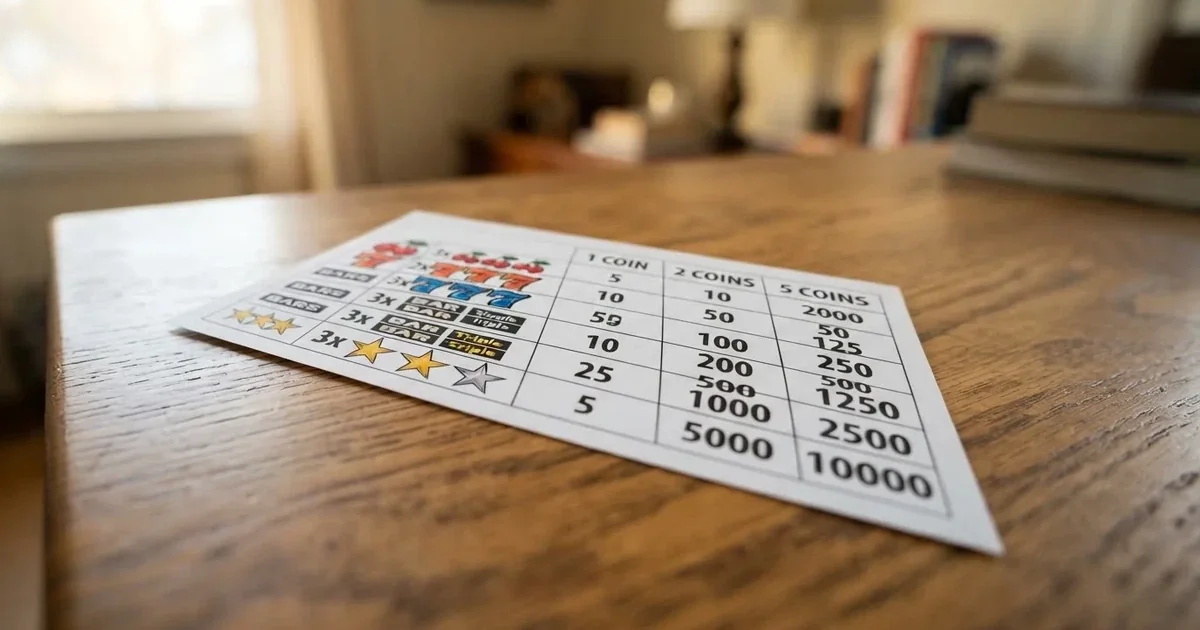
A paytable is the contract between the slot and the player. It lists every symbol, the value of every winning combination, the rules for any bonus feature, and the lines on which a win is paid. Booongo’s catalogue, since the 2021 restructuring into 3 Oaks Gaming, leans on hold-and-win mechanics, Egyptian and mythological themes, and a multiplier ladder that climbs during the bonus round. The visible mechanics are not the only mechanics. Behind the paytable sit two numbers that decide what the slot pays back over time: the return to player (RTP) and the volatility class.
RTP is the percentage of all wagered money a slot returns to players over a very large number of spins. A 96% RTP slot returns A$96 for every A$100 wagered across millions of spins, on average. The figure is published per title and varies; the average across a healthy portfolio sits in the mid-90s, with some titles higher and some lower. Volatility is the distribution of those returns: a high-volatility slot pays less often and pays larger amounts when it does, a low-volatility slot pays more often and pays smaller amounts. A bankroll that can absorb a hundred dead spins behaves differently from a bankroll that cannot, and the volatility class decides which player the slot suits.
A handful of comparable studios illustrate the spread. Betsoft’s Good Girl Bad Girl 2 carries a published RTP of 96.22% with “Very High” volatility and a 15.59% hit rate, played on 5 reels and 20 paylines. The Slotfather, live since December 2012, carries 95.69% with “Medium” volatility and an 8.17% hit rate, on 5 reels and 30 paylines. BGaming, the brand that debuted in 2018 after the team’s earlier work since 2012, runs a portfolio of more than 250 certified games. Each studio presents its own catalogue at its own RTP and volatility distribution, and the headline game count is not the headline RTP.
What an Australian player does with these numbers is constrained by what an Australian player can lawfully play. The paytable still tells the truth about the game. The game just is not on a lawful Australian site.
Eleven Operators and the ACMA Record: A Ranking Without a Recommendation
The eleven brands below are not a recommended shortlist. They are operators the ACMA itself has named in formal warnings, published on the ACMA register, for offering prohibited online casino services to people in Australia. They are the operators a search for “Booongo casino Australia” most reliably surfaces, and the reason this page names them at all is to attach the public record to the names the marketing uses. A reader who arrived here looking for a place to play should leave having read the table, not having picked a row.
The blocking-rate calculation, run against the ACMA’s published record, comes out as follows. As of June 2026, the ACMA’s running total of blocked sites is 1,751, and the first blocking request was made in November 2019. That is roughly 80 months of enforcement, or about 22 blocked sites per month on average — a band whose width depends on which months the ACMA reports a round and which it does not. The figure is not a forecast, and it does not predict which of the eleven brands below will be added to the next round; it is the rate at which the ACMA has been turning formal warnings into blocks, and it is the rate a reader can reasonably expect to continue.
| Operator | ACMA action and date | Operator named by the ACMA | Booongo / 3 Oaks Gaming support |
|---|---|---|---|
| RocketPlay | Formal warning, March 2026 | Pulsup Ltd (Rocketplay); earlier Dama N.V., May 2022 | — |
| Level Up Casino | Formal warning, May 2022 | Dama N.V. | Wazdan listings only |
| Woo Casino | Formal warning, March 2025 | Dama N.V. | — |
| Spirit Casino | Formal warning, May 2025 | Dama N.V. | — |
| National Casino | Formal warning, July 2025 | Consolutetish S.R.L. | Betsoft, Pragmatic Play listings only |
| Bizzo Casino | Formal warning, July 2025; earlier 2022 warning to TechSolutions | Consolutetish S.R.L. (2025); TechSolutions (CY) Group Ltd and TechSolutions Group N.V. (2022) | — |
| Ignition Casino | Formal warning, July 2025 | Bamboo Media | — |
| Instant Casino | Formal warning, February 2025 | EOD Code SRL | — |
| Jackbit | Formal warning, April 2026 | Ryker B.V. | — |
| Casino Intense | Formal warning, April 2025 | Sterplay Holding Ltd | 1spin4win, 3 Oaks Gaming listings only |
| Sky Crown | Formal warning (PDF, September 2022) | Hollycorn N.V. | — |
The table’s third column names the company the ACMA identified in its formal warning, which is rarely the same as the consumer-facing brand. The ACMA names operators, not banners. The fourth column records what third-party sources say about Booongo or 3 Oaks Gaming content at each brand: a dash means no source consulted carries that link, and a “listings only” tag means the link is asserted by those listings and not by the studio. The studio’s UK Gambling Commission licence, granted on 9 February 2024 under number 063055-R-338209-005 and held by Green Rock Ltd from Douglas, Isle of Man, is for the studio; it does not extend to any of the eleven brands above.
Reading the table the way the ACMA writes it
A formal warning is a published document on acma.gov.au. It names the operator behind a brand, the section of the Interactive Gambling Act 2001 the operator is alleged to have breached, and the date of issue. It is not a prosecution, and it does not name individuals. What it does is put the operator on the public record, and once on the record, the next blocking round is the natural next step.
The April 2026 warning to Ryker B.V. over Jackbit and CasinOK is the most recent in the table. The March 2026 warning to Pulsup Ltd over Rocketplay is the next most recent, and it lands on a brand that had already been warned in May 2022 under Dama N.V. — a recurrence the ACMA’s record keeps careful track of. Woo Casino and Spirit Casino, both Dama N.V. brands, picked up warnings in March and May 2025. National Casino and Bizzo Casino were both warned in July 2025 under Consolutetish S.R.L., with Bizzo already on the register from 2022 under TechSolutions (CY) Group Limited and TechSolutions Group N.V.
The pattern is that brands move between operators. The legal entity behind the brand changes; the brand name on the marketing stays. A reader who finds a familiar logo on a new corporate parent is not looking at a different company; they are looking at the same banner through a different corporate window.
The Bigger Picture: Studios, Aggregators and Where Booongo Fits
Booongo is not an operator. It is a slot studio, founded in the early 2010s and reorganised in 2021 into the regulated-market brand 3 Oaks Gaming. The 3 Oaks restructure kept the Booongo name as a sub-brand for some markets and aligned the rest of the portfolio under 3 Oaks for licensing purposes. The UK Gambling Commission certified more than 50 of 3 Oaks Gaming’s slot titles following the February 2024 licence, including 3 Pots of Egypt, Storm of Olympus, 777 Fruity Classic and Hawaii Riches. The Malta Gaming Authority recognition notice of 4 August 2025 added titles such as Sun of Egypt 4, Coin UP: Lightning and 3 Hot Chillies to the list of games available to MGA-licensed operators, after earlier approvals in the UK, Portugal and Romania.
The studio’s content reaches players through aggregators, who package hundreds of studios’ games into a single platform integration for an operator. An offshore casino running a hundred studios does not licence those studios one by one; it licences an aggregator, and the aggregator brings the studios with it. That is why a single offshore brand can carry Booongo, Betsoft, BGaming, Wazdan and Pragmatic Play content in one lobby without naming any of them in its own corporate filings.
Comparable studios illustrate the shape of the market the studio operates in. Betsoft, founded in 2006, carries a catalogue of more than 200 RNG games spanning slots, table games, video poker and specialty titles, with RNG certification from Quinel and Gaming Labs International and partnerships with more than 500 operators across regulated markets in Europe, Scandinavia, Latin America and Africa. BGaming’s team has worked on games since 2012 and the brand debuted in 2018, operating under Stable Games Ltd of Valletta, Malta, holding an MGA Critical Gaming Supply Licence (MGA/B2B/785/2020) for Type 1 B2B gaming services issued on 18 March 2021. 1spin4win, founded in 2021 by a group of professionals with 15 years of iGaming experience, reports more than 190 online slots, more than 1,000 partnerships with casinos and aggregators, and total bet sum growth of 46% in the first half of 2025 compared with the first half of 2024, with games built in HTML5 for low-bandwidth connections from a Curaçao headquarters.
Aristocrat Leisure, for contrast, is an Australian gambling machine manufacturer with headquarters in North Ryde, marketing and development offices in South Africa, Russia and the United States, and 2025 revenue of A$6.30 billion on 7,400 employees. Its online arms are Product Madness (social games) and Aristocrat Interactive, the latter formed in April 2024 by combining the Anaxi unit with the NeoGames group acquired for roughly US$1 billion. Aristocrat is the largest gambling-machine manufacturer in Australia and the second-largest slot-machine manufacturer worldwide behind International Game Technology. None of that makes Aristocrat an Australian-licensed online casino; it makes Aristocrat a publicly listed Australian gambling-machine company whose online products run on licensed platforms in other jurisdictions. The names are different and so are the legal positions.
Where the marketing word meets the regulator’s word
Offshore marketing leans on the studio’s regulated licences to imply that the operator carrying the studio is itself regulated. The implication does not hold. The UK Gambling Commission licence belongs to 3 Oaks Gaming as a B2B supplier; it does not extend to any operator that integrates 3 Oaks content, and it does not put that operator within the UK regulator’s consumer-protection regime. The MGA recognition notice belongs to 3 Oaks as a recognised supplier; it does not extend to MGA-licensed operators that carry 3 Oaks content for their own players, and it does not put those operators within the MGA’s jurisdiction over their Australian players either.
The plain reading is the right reading. The studio is regulated where it is regulated. The operator is regulated where the operator is licensed. Neither statement says anything about the other, and neither statement covers an Australian player.
Where That Leaves a Reader Comparing Options
The shape of the comparison is the shape of the legal wall, and a reader who arrived looking for a ranked list of casinos is now looking at a ranked list of formal warnings. The comparison itself has not gone away; the basis of it has changed. Where two offshore brands offer similar bonus packages, similar payout speeds and similar mobile builds, the differentiator that matters to an Australian player is whether the operator’s name is already on the ACMA register, how recently it was added, and how many times it has moved between corporate parents.
BetStop is the tool that works for Australian-licensed wagering, and an offshore casino does not connect to it. The 1800 858 858 helpline works regardless. The A$3.9 billion a year going to illegal sites is the scale of the gap that the licensed market has not closed, and the ACMA’s blocking rate of roughly 22 sites per month over 80 months is the pace at which the regulator is closing what it can.
For a reader whose interest is in the studio’s content rather than in a place to play, the practical move is to wait for an Australian-licensed product carrying Booongo or 3 Oaks content, which does not exist at present. For a reader whose interest is in a regulated slot experience that includes titles from comparable studios, the licensed wagering operators carry a different product mix under a different regulatory frame, and the comparison that page would run is not this page’s comparison.
The arithmetic behind any bonus the marketing copy names is the same arithmetic on every site: bonus × multiple ÷ stake gives spins, spins × 5 seconds ÷ 3600 gives hours, turnover × (1 − RTP) gives expected loss. None of those numbers make the bonus a good deal on its own; they make the bonus legible, and a legible bonus is a smaller bonus in the wallet than a glossy one. The marketing word is not the product, and the regulator’s word is the only word that runs to the end.
Frequently Asked Questions About Booongo in Australia
Is Booongo itself an online casino, or a studio that supplies games to casinos?
Booongo is a slot studio, not an operator. The studio was reorganised in 2021 into the regulated-market brand 3 Oaks Gaming, which holds a UK Gambling Commission remote operating licence granted on 9 February 2024 under number 063055-R-338209-005, held through Green Rock Ltd of Douglas, Isle of Man. Studios design games; operators run casinos; the two are different businesses with different licences.
Can Booongo titles be played for real money at any casino licensed in Australia?
No. The Interactive Gambling Act 2001, as strengthened by the 2017 amendments, prohibits online casino games and online pokies for anyone in Australia, and no state or territory issues a licence for them. The Northern Territory Racing and Wagering Commission regulates 52 online bookmakers for wagering, racing and sport — not casino games. Any site offering Booongo titles to an Australian player is operating offshore, outside the Australian licence frame.
How does a typical Booongo slot paytable differ from other studios’ games?
A paytable lists the value of every symbol, the rules of any bonus feature, and the lines on which a win is paid. Booongo’s catalogue, run under the 3 Oaks Gaming brand for regulated markets, leans on hold-and-win mechanics, Egyptian and mythological themes, and a multiplier ladder during the bonus round. Comparable studios run their own shapes: Betsoft publishes a 96.22% RTP with Very High volatility on Good Girl Bad Girl 2, and 95.69% with Medium volatility on The Slotfather. The visible mechanics differ; the underlying contract — RTP, volatility, hit rate — is the contract every paytable is built on.
Does Booongo run its own casino, or only license its games to other casinos?
Booongo only licences its games to other operators. The studio’s content reaches players through aggregators who package it with hundreds of other studios into a single platform integration, which is why an offshore casino can carry Booongo, Betsoft, BGaming, Wazdan and Pragmatic Play content in one lobby without naming any of them in its own corporate filings. The studio’s Malta Gaming Authority recognition notice of 4 August 2025 lets it offer titles such as Sun of Egypt 4, Coin UP: Lightning and 3 Hot Chillies to MGA-licensed operators, after earlier approvals in the UK, Portugal and Romania.
Why do offshore casinos promote Booongo as a selling point to Australian visitors?
Because the studio carries regulatory recognition in markets offshore operators like to advertise — a UK Gambling Commission licence from February 2024, an MGA recognition notice from August 2025, and approvals in Portugal and Romania — which gives marketing copy the words “regulated studio” to lean on. The recognition covers the studio, not the operator, and it does not extend to any Australian player on any offshore platform. The signal is real but does not transfer.
Is it legal for a site to offer Booongo games for real money to people in Australia?
No. The Interactive Gambling Act 2001 makes it an offence for a provider to offer online casino games or online pokies to a person in Australia, and the ACMA enforces the prohibition by issuing formal warnings and asking ISPs to block illegal sites. As of June 2026, 1,751 illegal gambling and affiliate marketing websites had been blocked since the first blocking request in November 2019. The Australian player is not the target of prosecution, but the player has no Australian consumer protection, no complaints body and no BetStop coverage on an offshore site, and a balance can be stranded when the next blocking round lands.