
best progressive jackpot slots 2026 — mechanics, offshore sites, and the Australian line
The progressive jackpot is the one feature in slot design that genuinely defies the house edge: a single spin can return more than the machine has paid out in its life. What makes that possible is also what makes the marketing around it worth a second look. A progressive pool grows by skimming a slice of every losing wager and feeding it into a shared prize that resets only when someone wins. The mechanic has been around since 1986, and the modern version of it has paid out record sums that no fixed-jackpot game can match. The Australian twist in 2026 is that the offshore sites doing most of the advertising cannot legally offer the product to anyone in this country, while the licensed venues that can offer slot machines tend not to feature the wide-area progressive at all. Sorting those two worlds apart is what this page is for.
Current as of 28 October 2026 — verified against the ACMA register of formal warnings and the register of blocking requests.
Table of Contents
- How the ranking is put together
- ### Record Online Slot Wins
- Paytables and the wide-area progressive
- What is licensed in Australia, and what is not
- The ACMA’s enforcement record
- Player protection, regardless of where the play happens
- The eleven brands the ACMA has acted against
- How fast the ACMA is blocking sites
- What a record payout is worth
- What a player in Australia actually has access to
- What this page does not cover
- Where to get help
- Frequently asked questions
How the ranking is put together
Any shortlist of progressive jackpot slots has to decide what it is comparing first. A list of games is one kind of comparison; a list of sites is another; a list that mixes both usually ends up comparing one Megabucks-style title against an offshore casino’s welcome package, which is not a comparison anyone can act on. This page keeps the two apart. The game-level discussion sits in its own section, and the operator-level discussion covers eleven brands the ACMA itself has acted against, in the order they appear in that register. The game discussion leans on how the pool is funded, what kind of trigger sets it off, and how the return-to-player (RTP) shifts when a slice of every wager goes into a shared pot. The operator discussion does not produce a winner, because the regulator has already done that work.

Three ideas carry through both. One: a progressive slot is a game of variance, not a game of return, and the headline prize is the long tail of a distribution most players will never land on. Two: every figure a slot operator publishes about a jackpot — the seed value, the average payout, the “must-hit-by” ceiling — sits inside a system the operator also controls, and the only independently audited number on the page is the historical record. Three: in Australia, the legal status of the site determines everything else, because a payout refused by an offshore operator is a payout with no Australian complaints body behind it.
### Record Online Slot Wins
| Game | Record Amount | Date Won | Venue / Network |
|---|---|---|---|
| Absolootly Mad: Mega Moolah | €19,430,723.60 | 27 April 2021 | Napoleon Sports & Casino |
| Mega Moolah | £11.5 million | 2026 | Games Global network |
| Mega Moolah | £13.5 million | 2026 | Games Global network |
The mechanics of a rising prize pool
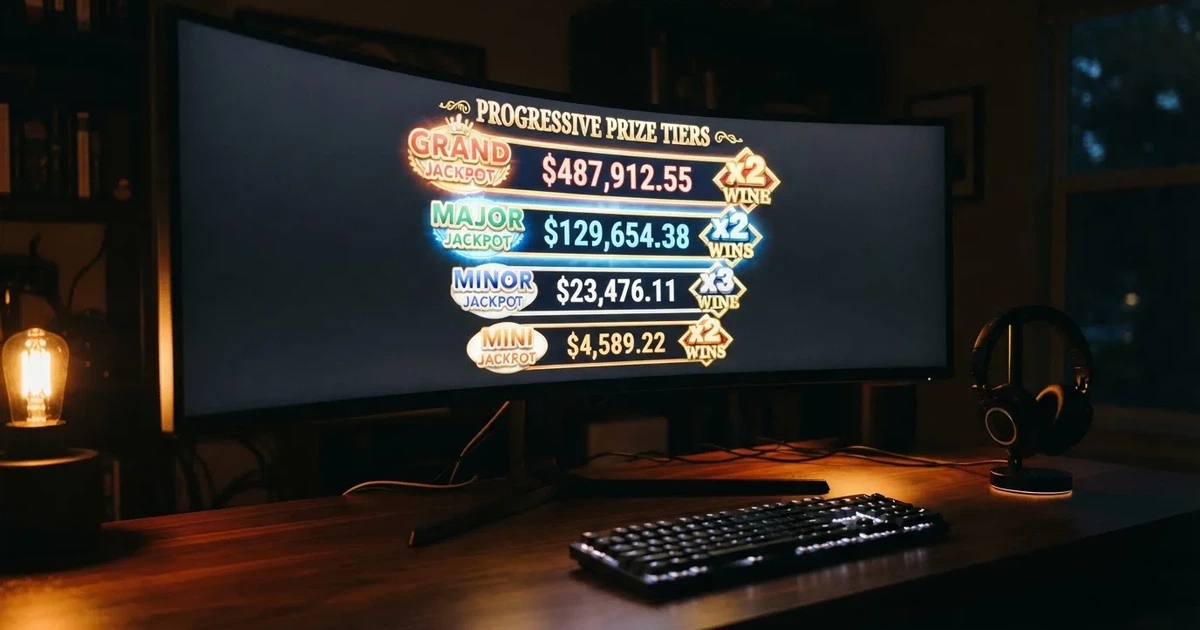
A progressive jackpot works by taking a small percentage of every wager — typically a few tenths of a percent — and diverting it from the game’s ordinary return to a separate pool. That pool climbs with every spin that does not win it, and resets to a preset minimum the moment the conditions for winning are met. The slice diverted is what the marketing copy calls the “contribution rate,” and it is the lever the operator pulls when it sets the headline prize higher or lower. The RTP of the base game — the return on every spin that is not the jackpot — is correspondingly lower than it would be on a fixed-jackpot game of the same theme, because the contribution has to come from somewhere, and it comes out of the player’s ordinary returns.
The pool itself can be standalone, local, or wide-area. A standalone progressive lives inside one machine and one venue, and the pool is small because it is fed by a single set of wagers. A local progressive links machines inside one casino, and the pool is larger because more spins feed it. A wide-area progressive links machines across many venues — sometimes across many countries — and the pool is the one that makes the news because it can climb into eight figures. The wider the link, the larger the pool, the lower the probability of any single spin hitting it.
The trigger varies by design. The classical version requires a specific combination of symbols on a payline. The must-hit-by variant sets a hidden ceiling at the moment the previous jackpot is won — the system picks a number within a preset range, say $1,000 to $3,000, and the moment a random number generator passes that number, the next qualifying spin pays it out. There is no symbol combination to chase; there is only the ceiling the system has already chosen.
The first Megabucks progressive, made by International Game Technology, paid out its inaugural jackpot of $4,988,842.17 on 1 February 1987, and the format has been climbing ever since. The current record for an online progressive slot stands at €19,430,723.60, won on 27 April 2021 by a player in Belgium at Napoleon Sports & Casino on Microgaming’s Absolootly Mad: Mega Moolah. Games Global, the business that took over Microgaming’s distribution, has since announced further Mega Moolah wins of £11.5 million and £13.5 million, and the wider Mega Moolah series remains the most-cited example of the genre.
Paytables and the wide-area progressive
The wide-area progressive is what the offshore sites are selling, and the paytable is where the design shows through. A paytable lists what every symbol combination pays, what the bonus features cost to enter, and — for a progressive — what the seed value is, what the trigger is, and how the contribution is split between the base game and the pool. A reader who compares two Mega Moolah variants will see the same theme, the same wild symbol, the same bonus wheel, and a different progressive seed. The base game RTP tends to sit in the low- to mid-90s, several percentage points below what a non-progressive game of similar quality returns, and the difference is the contribution to the pool. The pool makes up for the lower base RTP in expectation only when the prize climbs far enough — and the climb is the long tail.
That long tail is also what the marketing copy most often flattens. A seed of $1 million and a current pool of $5 million are different numbers: the seed is what the pool resets to after a win, and the current pool is what is on offer now. A site quoting one and not the other is quoting half the picture. The full picture is the pool’s expected growth curve between wins — how fast it rises in absolute dollars per million spins — and that curve is rarely published.
What is licensed in Australia, and what is not
Australia’s gambling law draws a sharp line at the type of product, not at the brand. Under the Interactive Gambling Act 2001, strengthened by the Interactive Gambling Amendment Act 2017, it is an offence to provide online casino games, online pokies or in-play betting to a person in Australia. No state or territory licenses them. What is licensed is wagering on races and sport placed before the event, lotteries and keno — in practice licensed by the Northern Territory. The Northern Territory Racing and Wagering Commission regulates 52 of Australia’s online bookmakers, including Sportsbet, Bet365 and Ladbrokes, and the commission has no full-time staff and meets once a month in Darwin.
The slot machine, as a product, exists onshore only in licensed venues — clubs, hotels and the two state casinos (Crown Melbourne and Crown Perth). The product those venues offer is the poker machine, the Australian pokies machine. The machines have a return-to-player set by the state regulator, and the return is published. A progressive jackpot can in principle be configured on a pokies machine, but the wide-area version is not the format the Australian venues tend to run; the bulk of the market is fixed-jackpot or standalone progressive, with relatively modest pools by international comparison.
What the offshore sites are selling is something else: an online casino product, hosted overseas, advertised to Australian players, with a progressive slot library drawn from international studios. The product is prohibited. The site, even if it carries a Curaçao or Anjouan licence, is offering a prohibited service to anyone it accepts from Australia. The licence it displays is a licence to operate in its own jurisdiction, not a permission to sell to Australians.
The ACMA’s enforcement record
The Australian Communications and Media Authority (ACMA) handles enforcement on the provider side. The individual player is not prosecuted, but the site can be investigated, issued a formal warning, and directed to Australian internet service providers for blocking. As of June 2026, the ACMA’s cumulative count was 1,751 illegal gambling and affiliate marketing websites blocked since the first blocking request in November 2019, and more than 230 unlicensed gambling services had left the Australian market since enforcement was strengthened in 2017.
In the round reported on 26 June 2026, the ACMA asked ISPs to block twelve more sites: 7Signs, ChromaBet, Donbet, Duospin, Freshbet, Slots Gem, Jacks Club, Lucky Start, Pointsbetz, Spinrise, Vinyl Casino and Wildsino. The list is a snapshot of the current enforcement wave, and a reader comparing options today will see it shrink as new sites are added and old ones are taken offline.
The formal warnings the ACMA has published on its own register tell a similar story at the brand level. In March 2026, the ACMA issued a formal warning to Pulsup Ltd over Rocketplay. In May 2022, the ACMA issued a formal warning to Dama N.V. covering six brands: Bambet, Dazard, Level Up, Rocketplay, Wild Tornado and Cobra Casinos. The ACMA issued further formal warnings to Dama N.V. over Woo Casino in March 2025 and Spirit Casino in May 2025. In July 2025, formal warnings went to Bamboo Media over Ignition Casino and to Consolutetish S.R.L. over National Casino and Bizzo Casino — the latter having already been the subject of a 2022 formal warning to TechSolutions (CY) Group Limited and TechSolutions Group N.V. In February 2025, the ACMA warned EOD Code SRL over Instant Casino. In April 2026, the ACMA warned Ryker B.V. over Jackbit and CasinOK. In April 2025, the ACMA warned Sterplay Holding Ltd over Casino Intense. The ACMA also issued a formal warning to Hollycorn N.V. over its Sky Crown and Blue Leo casino services, published in September 2022.
The pace is steady. Two or three new formal warnings a quarter is the working rate, and they tend to cluster around the same handful of operator groups — Dama N.V. has now appeared across at least three separate warnings, and TechSolutions has appeared across two.
Player protection, regardless of where the play happens
Two pieces of player protection sit on top of this picture, and they reach the reader regardless of which side of the line they play on.
The first is BetStop, the National Self-Exclusion Register, which has been live since August 2023. It binds every Australian-licensed online and phone wagering service — every bookmaker licensed by the Northern Territory or a state regulator — to honour a registered player’s request to be excluded. An offshore casino is not connected to BetStop, which means a self-exclusion request does not travel to the site the reader might actually be playing on. The exclusion is real on the licensed side and partial on the offshore side.
The second is the National Gambling Helpline on 1800 858 858, free, available 24 hours a day, with chat at Gambling Help Online. The service is not a regulator and does not enforce; it is a counselling line. It is reachable from any phone in Australia, no matter where the gambling took place, and it is the single piece of the picture that does not require the reader to be playing on a licensed site to be of use.
The 2026 reform: the Interactive Gambling Amendment (Gambling Reform) Bill 2026 passed Parliament on 19 August 2026, and its advertising and inducement measures commence on 1 January 2027. The bill is law with a future start date, and a 2026 reader sees it as a coming change rather than a current rule.
On payments: credit cards, credit-related products and digital currency have been banned as payment for licensed online wagering since 11 June 2024. Penalties for operators who breach that rule run up to A$247,500. The legal deposit routes for licensed wagering are debit card, bank transfer, PayID/Osko and BPAY. An offshore site asking an Australian for a credit card or a crypto deposit is operating outside the Australian rules, and the deposit method is itself a signal about which side of the line the site is on.
On tax: gambling winnings of a recreational player are not assessable income under section 6-5 of the ITAA 1997, and losses are not deductible, unless the person carries on a business of gambling. The position is a model only, and the Australian Taxation Office is the body to confirm it for any individual situation.
The eleven brands the ACMA has acted against
The eleven brands below are not a shortlist to play at. They appear because the ACMA itself has published a formal warning over each one for offering prohibited online casino services to people in Australia, and the order follows the register rather than any ranking this page is constructing. The table below carries the ACMA action, the date, the operator named in the warning, and what the page can say about progressive jackpot support from other sources. The product itself — the online casino progressive slot — is prohibited in Australia whatever licence the site displays, and no entry in the table changes that.
| Brand | ACMA action and date | Operator named by the ACMA | Subject support |
|---|---|---|---|
| RocketPlay | Formal warning, March 2026; earlier Dama N.V., May 2022 | Pulsup Ltd (Rocketplay); earlier Dama N.V. | — |
| Level Up Casino | Formal warning, May 2022 | Dama N.V. | listings only (BGaming) |
| Woo Casino | Formal warning, March 2025 | Dama N.V. | — |
| Spirit Casino | Formal warning, May 2025 | Dama N.V. | — |
| National Casino | Formal warning, July 2025 | Consolutetish S.R.L. | listings only (en.wikipedia.org) |
| Bizzo Casino | Formal warning, July 2025; earlier TechSolutions, 2022 | Consolutetish S.R.L.; earlier TechSolutions (CY) Group Limited and TechSolutions Group N.V. | — |
| Ignition Casino | Formal warning, July 2025 | Bamboo Media | — |
| Instant Casino | Formal warning, February 2025 | EOD Code SRL | — |
| Jackbit | Formal warning, April 2026 | Ryker B.V. (Jackbit and CasinOK) | — |
| Casino Intense | Formal warning, April 2025 | Sterplay Holding Ltd | listings only (ABC, acma.gov.au, Crown Melbourne) |
| Sky Crown | Formal warning, September 2022 | Hollycorn N.V. (Sky Crown and Blue Leo) | — |
Two of the eleven — Level Up Casino, National Casino and Casino Intense — turn up in third-party listings that name them in connection with progressive slot content, but those listings are not the ACMA’s own and they do not constitute an endorsement of the product. The remaining eight have no listing this page can point to that speaks to progressive jackpot support specifically. A reader who wants progressive slot content from any of the eleven will find it advertised on the site itself; what they will not find is a clean line between the marketing claim and an Australian right of complaint.
RocketPlay
Pulsup Ltd took a formal warning in March 2026 over the Australian-facing Rocketplay, and the same brand had earlier drawn a warning to Dama N.V. in May 2022 — the same operator group that covers another five of the eleven brands on this page. Two warnings across the same brand, four years apart, is the working pattern: the brand gets a formal warning, the operator group changes, the brand reappears under new corporate ownership. The product the site advertises is the international progressive slot library, and no Australian regulator oversees it. A reader who has a balance with the operator when a blocking request lands has no Australian complaints body to approach, because the site is not licensed here.
Level Up Casino
The Dama N.V. warning of May 2022 covered six brands at once, and Level Up Casino was one of them. Third-party listings on BGaming name Level Up among operators carrying BGaming’s progressive catalogue. The listing is not the ACMA’s, and the product is the same prohibited one. A reader who knows the brand from those listings is still dealing with an operator the ACMA has already acted against, and any progressive slot they play on the site sits outside Australian consumer protection.
Woo Casino
Dama N.V. picked up a second formal warning in March 2025, this one over Woo Casino. The pattern is the same as for Level Up: a brand under a familiar operator group, a product the ACMA has already told the operator to stop offering to Australians, and no listing on this page that says anything further about progressive slot support. The relevant question for a reader is whether Woo’s payout terms or its progressive catalogue would change the picture — and the answer on both fronts is that the picture is set by the prohibition, not by the brand.
Spirit Casino
Spirit Casino picked up its formal warning in May 2025, again under Dama N.V. — the third warning the operator group has drawn in this list alone, counting the May 2022 batch. The brand sits in the same family as RocketPlay, Level Up, Woo and others, and the relevant question is the same one. The marketing around a progressive slot on the site does not move the product across the line.
National Casino
Consolutetish S.R.L. drew a formal warning in July 2025 covering National Casino and Bizzo Casino together. Third-party listings on Wikipedia name National Casino among operators carrying progressive slot content. A reader who finds the brand through those listings is finding it because the listings exist, not because any Australian regulator has signed off on it.
Bizzo Casino
The July 2025 warning is Consolutetish S.R.L.’s first, but Bizzo Casino had already been the subject of a 2022 formal warning to TechSolutions (CY) Group Limited and TechSolutions Group N.V. Two warnings across two different operator groups is the same shape as the RocketPlay story — a brand that persists through corporate reshuffling, and an Australian enforcement record that tracks each new owner as it appears.
Ignition Casino
Bamboo Media took a formal warning in July 2025 over Ignition Casino. The brand has a long international history in the offshore casino space, and the formal warning is the first time it has appeared on the ACMA’s register under this operator. The product is the same prohibited one.
Instant Casino
EOD Code SRL drew a formal warning in February 2025 over Instant Casino. The brand is one of the more heavily advertised in the offshore progressive slot space, and the warning landed during a wave the ACMA was running through several instant-withdrawal-style brands. A reader who has used the site before the warning will find the site either still online or blocked depending on the ISP, and either way the balance question is the same one — no Australian recourse.
Jackbit
Ryker B.V. took a formal warning in April 2026 covering both Jackbit and CasinOK. The April 2026 date is recent, and the formal warning was issued in the same quarter as the blocking round the ACMA published in June 2026. A reader landing on Jackbit today is landing on a brand the ACMA has told the operator to stop offering to Australians.
Casino Intense
Sterplay Holding Ltd took a formal warning in April 2025 over Casino Intense. Third-party listings from the ABC, the ACMA’s own register and Crown Melbourne’s site name Casino Intense in passing — none of which constitutes an endorsement of the product. The relevant fact is the same one as the other ten: the site is offering a prohibited service.
Sky Crown
Hollycorn N.V. took a formal warning in September 2022 covering both Sky Crown and Blue Leo. The 2022 warning is the oldest in this list, and Sky Crown is the brand that has had the longest time to either comply or relaunch under new ownership. The product remains prohibited.
How fast the ACMA is blocking sites
The blocking rate provides valuable context for the reader, and it is worth examining because the question it answers — how quickly does a brand become unreachable from Australia — is the question the page’s subject keeps turning over.
The ACMA’s cumulative count at the end of June 2026 was 1,751 websites blocked, with the first blocking request issued in November 2019. From November 2019 to June 2026 is roughly 79 months. Across that span, the working rate is somewhere between 22 and 23 sites blocked per month, with the rate higher in the years since 2023 as the ACMA increased its enforcement bandwidth. The June 2026 round alone added 12 sites, which is just over half the long-run monthly rate in a single action.
The right way to read the number is as a band rather than a single figure. The long-run rate of 22 to 23 sites per month holds across the full enforcement window, with the rate clustered higher in recent years. The June 2026 round landed at roughly 12 sites in one announcement — consistent with the long-run rate on a busy week and well above it on a quiet one. A reader who wants a working number for “how long until an offshore site I’ve heard about becomes harder to reach from Australia” should treat the long-run rate as a floor, with the recent rate as the working assumption. The ACMA’s own register of formal warnings is the upstream signal: a brand usually gets a warning months before it ends up on a blocking list, and the gap is the window in which the site is still reachable.
What a record payout is worth
The record figures attached to progressive slots tend to get recycled without their conditions. The €19.4 million Absolootly Mad: Mega Moolah win of April 2021 was paid by an online casino licensed in Belgium. The Games Global announcements of £11.5 million and £13.5 million Mega Moolah wins since 2021 are paid by the same network, and the network is hosted across many jurisdictions — not in Australia. The history is real; the implication is not that the next big win will land at an Australian-facing site, because the Australian-facing sites are not the ones hosting the wide-area Mega Moolah network.
A record payout is verified in two ways: by the operator publishing it under its own licence conditions, and by independent media confirming the amount and the date. The Microgaming/Games Global wins are independently reported by European trade outlets. A record claimed by an offshore operator with no verifiable licence should be treated as marketing copy, not as fact, and the ACMA’s enforcement record is the cleanest indication of which operators in this list are the ones to be most cautious about.
What a player in Australia actually has access to
Putting the pieces together, the picture for a reader in Australia in 2026 looks like this. Online casino games and online pokies — including the wide-area progressive slots the offshore sites advertise — are prohibited from being offered to people in Australia. The licensed Australian wagering market offers sports and race betting, lotteries and keno, and the slot machines that exist onshore are in clubs, hotels and the state casinos. The progressive slot as a product is essentially an offshore product for the Australian reader, and the offshore sites that advertise it are the ones the ACMA is blocking and warning on an ongoing basis.
A reader who wants to play progressive jackpot slots today is, in practice, choosing between not playing and playing on a site the regulator has acted against. The cost of that choice is the absence of an Australian complaints body behind any withdrawal dispute, and the operational reality that a blocking request can land with a balance still on the account. The legitimate side of the offer — the wide-area progressive with a real seed and a real growth curve — does not have an Australian onshore equivalent at the international scale.
What this page does not cover
This page does not list every offshore operator the ACMA has acted against; the formal warning register runs to many more than eleven brands, and the full register is the ACMA’s own publication. It does not produce a betting recommendation, because the subject of the page is the product rather than the place to play it. It does not quote bonus terms, because the only sources for those were affiliate marketing pages and the operator’s own promotional material, and the ACMA’s enforcement record is the only independently audited figure on the operator side. It does not give a tax ruling, because the position is a model only and the ATO is the body to confirm.
Where to get help
For a reader who wants to play less or stop, the National Gambling Helpline is 1800 858 858, free, 24 hours a day, with chat at Gambling Help Online. BetStop, the National Self-Exclusion Register, has been live since August 2023 and binds every Australian-licensed wagering service to honour a registered exclusion. The exclusion does not extend to offshore sites. The 2026 reform bill has passed Parliament but its advertising and inducement measures do not commence until 1 January 2027.
Frequently asked questions
How does a progressive jackpot slot’s prize pool actually grow between wins?
The pool grows by skimming a small percentage — typically a few tenths of a percent — of every wager and feeding it into a shared prize. Each spin that does not win the prize adds to the pool, and the moment the conditions for winning are met the pool resets to a preset seed value. The contribution rate is set by the operator, and the wider the network the faster the pool climbs.
What’s the difference between a standalone jackpot and a network-wide progressive jackpot?
A standalone jackpot is fed by wagers from a single machine in a single venue, and the pool is small. A local progressive links machines inside one casino, and the pool is larger. A wide-area progressive links machines across many venues — sometimes across many countries — and the pool is the one that can climb into eight figures, because the contribution base is much larger.
Do licensed Australian pokies venues offer progressive jackpot machines?
The licensed venues in Australia — clubs, hotels and the state casinos — offer poker machines, and a progressive jackpot can in principle be configured on one, but the wide-area international progressive is not the format the venues tend to run. The bulk of the Australian onshore market is fixed-jackpot or standalone progressive, with relatively modest pools by international comparison.
Why do progressive jackpot slots typically have a lower base return-to-player than fixed-jackpot games?
The base game RTP is lower because the contribution to the progressive pool is taken out of the ordinary return. A non-progressive slot of the same theme returns more on ordinary spins because none of the wager is diverted to a separate prize. The progressive slot makes up the difference in expectation only when the prize climbs far enough that the long-tail probability produces a meaningful expected value.
How is a record progressive jackpot payout verified?
A record payout is verified by the operator publishing it under the conditions of its licence, and by independent trade media confirming the amount and the date. The current online slot record — €19,430,723.60, won on 27 April 2021 by a player in Belgium at Napoleon Sports & Casino on Absolootly Mad: Mega Moolah — has been reported by European trade outlets including European Gaming and Gaming Intelligence. A record claimed by an offshore operator with no verifiable licence is marketing copy rather than fact.