
Best high volatility slots Australia 2026: how the market really sits
The phrase “best high volatility slots Australia 2026” promises a shortlist of online casinos where a punter can chase long-shot reels from inside the country. That shortlist does not exist, and pretending otherwise is the first lie the marketing pages sell. The Interactive Gambling Act 2001, strengthened in 2017, makes it an offence to provide online casino games to anyone in Australia; no state or territory issues a licence for the product. The Australian Communications and Media Authority enforces that prohibition, and the comparison a reader is really after is not which offshore brand offers the most volatile reels — it is whether anything legitimate is on offer, and what the safer choices look like when the offshore ones are ruled out.
Current as of 28 October 2026 · Verified against the ACMA register and the Interactive Gambling Act 2001.
Table of Contents
- Eleven brands the ACMA has warned — and why the comparison ends there
- What high volatility actually means at the reels
- The Australian legal frame
- How the ACMA enforces the prohibition
- What an Australian reader actually has access to
- Player protection and BetStop
- Specific high volatility titles and where they live
- Tax framing for the recreational player
- How each operator in the table sits against the law
- What the comparison actually leaves a reader with
- Frequently asked questions
Eleven brands the ACMA has warned — and why the comparison ends there
The closest thing to a “best of” list for this subject in Australia is the ACMA’s own enforcement record. Every brand in this section sits on that record because the regulator issued a formal warning over it for offering prohibited interactive gambling services to Australians. The order below follows the ACMA’s most recent action against each operator, beginning with the freshest entries. None of these sites is legal for an Australian to play at on a casino product, and none of them is a recommendation. Reading them as a ranked shortlist is exactly the mistake the page exists to prevent.
| Brand | ACMA action and date | Operator named by the ACMA | Subject support |
|---|---|---|---|
| RocketPlay | Formal warning, March 2026; earlier action against its Dama N.V. operating company, May 2022 | Pulsup Ltd (RocketPlay) | — |
| Jackbit | Formal warning, April 2026 | Ryker B.V. | — |
| Sky Crown | Formal warning, September 2022 | Hollycorn N.V. | — |
| Casino Intense | Formal warning, April 2025 | Sterplay Holding Ltd | listings only |
| Instant Casino | Formal warning, February 2025 | EOD Code SRL | — |
| National Casino | Formal warning, July 2025 | Consolutetish S.R.L. | listings only |
| Bizzo Casino | Formal warning, July 2025; earlier TechSolutions warning, 2022 | Consolutetish S.R.L. | — |
| Ignition Casino | Formal warning, July 2025 | Bamboo Media | — |
| Spirit Casino | Formal warning, May 2025 | Dama N.V. | — |
| Woo Casino | Formal warning, March 2025 | Dama N.V. | — |
| Level Up Casino | Formal warning, May 2022 | Dama N.V. | listings only |
“Listings only” means the brand appears in third-party catalogue pages but no source confirms that high volatility slots, or any specific category of slot, is actually carried by that operator. Several brands carry no third-party attestation at all, and on this subject that silence is the honest answer. The comparison itself is not between products — it is between entries on a regulator’s list. Anyone choosing between these names is choosing between different shades of prohibited.
What high volatility actually means at the reels
A high volatility slot is a machine whose payouts cluster: long stretches of small or empty rounds, then the occasional round that returns several times the stake or triggers a bonus feature with a multiplier at the top end. The maths is a longer-tailed distribution of outcomes than a low volatility game, where wins arrive more often and the ceiling is lower. A session on a high volatility title is, by design, more about surviving the quiet stretches than catching the bright ones.

Charles Fey’s late-19th-century Liberty Bell machine, with five symbols across three reels, offered roughly a thousand possible combinations and paid the top prize of ten nickels for three bells in a row. Modern video slots can run five or more reels with fifty or more symbols per reel, producing odds as high as 300 million to one against the top combination. That gap between the mechanical era and the present is what “volatility” now describes — a distribution of outcomes so wide that the average return only resolves across millions of spins, and a single session is closer to a coin flip on whether the player catches anything notable.
The mechanics the marketing leans on are real but loaded. A 96% return-to-player figure is an average across the full cycle, not a session promise, and the house always retains its edge across that cycle. A player sitting down for an hour sees a small slice of the distribution, and on a high volatility title that slice is more likely than not to come from the lower end. The “huge win potential” copy on the splash screen is a description of the top end of the distribution, not the slice the reader is going to occupy.
The Australian legal frame
The Interactive Gambling Act 2001, as amended by the Interactive Gambling Amendment Act 2017, prohibits the supply of online casino games — slots, table games, live dealer products — to a person physically in Australia. The law targets the provider, not the player. No Australian jurisdiction, state or territory, issues a licence for an online casino product, so any site offering one to an Australian reader is operating outside the regime whatever offshore licence it displays.
What is licensable, and runs through licensed Australian channels, is wagering on racing and sport placed before the event, plus lotteries and keno. The Northern Territory Racing and Wagering Commission regulates 52 of Australia’s online bookmakers, including Sportsbet, Bet365 and Ladbrokes, for tax reasons; the commission has no full-time staff and meets once a month in Darwin. The product mix that commission licenses is wagering, not casino — a betting account at a Territory-licensed bookmaker does not become a route into a prohibited slots product.
The Interactive Gambling Amendment (Gambling Reform) Bill 2026 passed Parliament on 19 August 2026. Its advertising and inducement measures commence 1 January 2027, which means a page read in 2026 is looking at law with a start date rather than law in force. The substantive prohibition on supply has been on the books since 2017 and is what every entry in the table above runs against.
How the ACMA enforces the prohibition
Enforcement runs through formal warnings, directions to internet service providers to block sites, and referrals for civil penalty proceedings. According to the ACMA as reported in June 2026, a total of 1,751 illegal gambling and affiliate marketing websites had been blocked since the first blocking request in November 2019, and more than 230 unlicensed gambling services had left the Australian market since enforcement was strengthened in 2017. In the round reported on 26 June 2026, the ACMA asked Australian ISPs to block 12 further sites: 7Signs, ChromaBet, Donbet, Duospin, Freshbet, Slots Gem, Jacks Club, Lucky Start, Pointsbetz.com, Spinrise, Vinyl Casino and Wildsino.
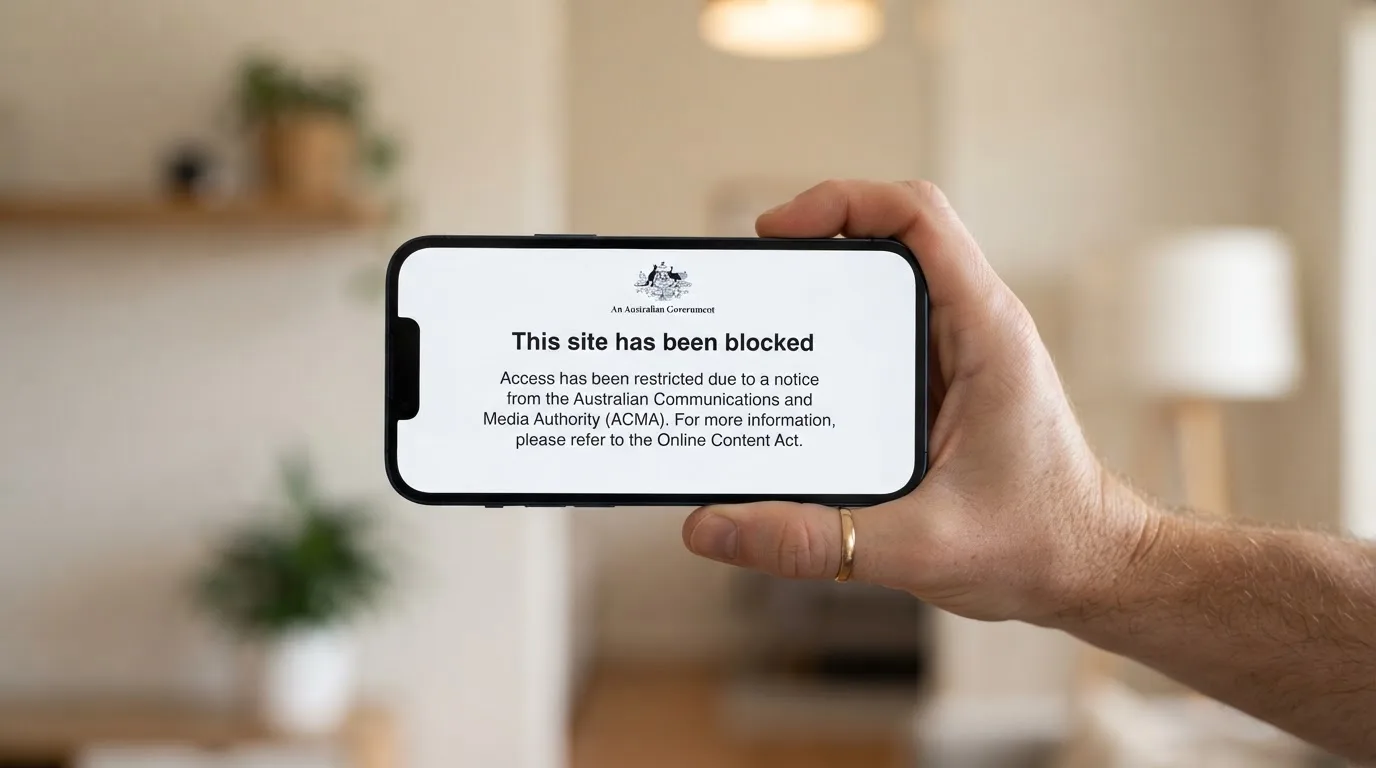
The arithmetic on blocking rate sits inside this record. From November 2019 to June 2026 is roughly 79 months; 1,751 blocked sites across that window works out to a band of roughly 20 to 25 blocks per month on average, with the actual monthly pace varying as the ACMA issues fresh rounds. The page does not read this as a single fixed rate — it reads as an ongoing rhythm in which the regulator adds new entries faster than providers rotate out of the list. For a reader weighing offshore options, that pace is the only honest “trust” metric available: the regulator is not catching up, it is running ahead.
H2 Gambling Capital’s 2025 report estimates that Australians lose about A$3.9 billion a year to illegal gambling sites, and that the share of gambling going through legal channels fell from 74% in 2021 to 64%. The figure is an estimate, not a measured total, but the direction is the part that matters — the illegal share is widening even as the blocking pace holds steady. A market that size, on the wrong side of the law, is the reason the ACMA publishes a formal-warning register at all.
The warnings the table above lists are not the full set. The ACMA’s action against Dama N.V. alone covers six brands: Bambet, Dazard, Level Up, Rocketplay, Wild Tornado and Cobra Casinos, warned in May 2022, with further warnings over Woo Casino in March 2025 and Spirit Casino in May 2025. The April 2026 warning to Ryker B.V. covered Jackbit and CasinOK. The July 2025 warning to Consolutetish S.R.L. covered National Casino and Bizzo Casino, the latter already the subject of a 2022 formal warning to TechSolutions (CY) Group Limited and TechSolutions Group N.V. The point of naming the operating company rather than only the brand is that the same operator can rebrand while keeping the same record against it.
What an Australian reader actually has access to
Three routes sit inside the law, and each one shapes what “high volatility” means in practice.
The first route is licensed wagering on racing and sport, placed before the event through a Territory-licensed bookmaker or a state-licensed equivalent. The product is fixed-odds betting, not slots, so “high volatility” here describes the odds-on longshots rather than reel variance. A multi-leg accumulator at long combined odds is the wagering analogue of a high volatility slot session — quiet most of the time, the occasional payout at multiples of the stake, and the same average-return framing. The credit-card and crypto ban that came in on 11 June 2024 governs this route: the lawful deposit methods for a licensed wagering account are debit card, bank transfer, PayID, Osko and BPAY, with penalties up to $247,500 for operators that breach the rule.
The second route is licensed pokies venues and land-based casinos. Pokies-style slot machines outside casinos numbered 87,298 in New South Wales as of June 2023, 26,380 in Victoria in 2021-22, 21,122 in Queensland in October 2023, 11,672 in South Australia in September 2023, and 3,587 in the ACT in November 2023. By 2010 Australia operated an estimated 97,103 gaming machines outside casinos, a per-capita rate about five times that of the United States. Inside those venues the volatility distribution is what the operator programs into the machine, the same envelope as an offshore video slot but with a venue-level regulator and an on-site complaints path that an offshore site does not offer. New South Wales legalised slot machines in 1956; the category has been on Australian pub and club floors for nearly seventy years.
The third route is self-exclusion, which is the subject of the next section. A reader who has already moved past the product question is reading about it for a reason.
Player protection and BetStop
BetStop, the National Self-Exclusion Register, has been live since August 2023 and binds Australian-licensed online and phone wagering services. A person who registers is excluded from every participating Australian-licensed operator for the period they choose. The mechanism is real for the wagering product and the licensed Australian channel; it does not reach an offshore casino. The register covers what the law covers, and an offshore site sits outside the law.
The National Gambling Helpline on 1800 858 858 is free, available 24/7 and connects to chat support at Gambling Help Online. The two services are the ones the page points to whenever the question turns from product choice to player wellbeing. The minimum age for any Australian gambling product is 18.
On the offshore side, the absence of consumer protection is the point. An offshore casino gives no Australian complaints body, no local recourse if a withdrawal is refused, and no guarantee that a balance survives a blocking round. The same blocking rounds that removed 1,751 sites between November 2019 and June 2026 are the rounds that strand funds. The reader who has chosen an offshore product has also chosen the absence of the protections that follow a licensed product.
Specific high volatility titles and where they live
The high volatility slot as a category has no catalogue on the Australian side. What it has is a long offshore tail, and the catalogue pages that list titles are not the operators themselves — they are aggregator pages, developer sites and review platforms. A handful of high volatility slots recur across those listings; none of them is licensed for Australian play, and any site offering them to an Australian reader is on the ACMA’s list or heading to it.
The gameplay detail that defines a high volatility title is the bonus feature structure. Free-spin rounds with progressive multipliers, “hold and win” mechanics where special symbols lock in place across re-spins, and pick-style bonus games with a small number of high-value outcomes are the three envelopes most often labelled “high volatility” in third-party catalogue pages. The volatility label is set by the developer and reflects the distribution of outcomes, not the size of the maximum advertised prize; a 5,000x advertised top prize on a low volatility title is marketing language, not a distribution claim.
Bally’s 1963 Money Honey was the first slot machine with a bottomless hopper and automatic payout of up to 500 coins without an attendant; the first video slot followed in 1976 from Fortune Coin Co. in Kearny Mesa, California. The category has been iterating for sixty years, and the high volatility envelope is the current end of that iteration — wider distributions, longer quiet stretches, brighter advertised peaks. None of that history changes the legal frame for an Australian reader, but it explains why the marketing around high volatility slots leans so hard on the top-end numbers and so lightly on the average.
For comparison, table games on the licensed side have their own volatility profiles that a high volatility slot player might find familiar. Baccarat’s Banker bet carries a house edge of 1.06%, the Player bet 1.24% and the Tie 14.36%. Blackjack with optimal strategy sits around 0.28% under liberal Las Vegas Strip rules and 0.43% under Atlantic City rules. Craps’ Pass/Come bet is 1.41%, Don’t Pass/Don’t Come 1.36%, and Any Craps 11.11%. None of those numbers is a volatility claim, but the house edges are the same kind of average-over-many-rounds framing that an RTP figure is, and they show how thin the house margin is on the regulated side compared with the marketing language a high volatility splash screen leans on.
State-level approval of casino table games is part of the regulatory frame. Under section 66 of the NSW Casino Control Act 1992, a casino operator must not permit a game to be played unless the game and its rules are approved by the regulator, and the operator must make a copy of the approved rules available to patrons on request. In Victoria, the Casino Control Act 1991 requires the Victorian Gambling and Casino Control Commission to approve any rules for table games and any change to those rules before they are introduced at the Melbourne casino; that commission replaced the VCGLR as Victoria’s casino regulator on 1 July 2022. Crown Melbourne’s approved baccarat variants — Traditional Baccarat, Crown Baccarat and 2 to 1 Baccarat — are the current output of that approval process, with a parallel log of approved changes to blackjack variants including the renaming of the “Perfect Pairs” side bet to “Crown Pairs” on 23 December 2024 and the introduction of a “Free Bet” option with a new “Pot of Gold” side bet on 25 March 2024.
Tax framing for the recreational player
Gambling winnings of a recreational Australian player are not assessable income under section 6-5 of the ITAA 1997, and losses are not deductible. The line shifts only where the ATO accepts that a person carries on a business of gambling, which is a higher bar than a regular punter clears. The framing matters less than it sounds for most readers, who are recreational players by definition. The page records it because it is part of the full picture, not because it changes the product choice.
How each operator in the table sits against the law
The eleven brands in the table are not a ranking and not a recommendation. They are the brands the ACMA has acted against, and the order follows the regulator’s most recent action.
RocketPlay sits at the top of the table because the ACMA warned Pulsup Ltd over Rocketplay.com.au in March 2026. The same brand was caught earlier when Dama N.V., then its operating company, was warned in May 2022. A site that has been warned twice is a site that has been told the same thing twice; reading the warning as a single event misses the repetition.
Jackbit is the second entry on a fresh April 2026 warning to Ryker B.V., which also covered CasinOK. The ACMA’s April 2026 actions sit alongside the March 2026 warning to Pulsup Ltd as the regulator’s most recent activity in the casino space.
Sky Crown is the longest-standing entry, on a September 2022 formal warning to Hollycorn N.V. that also covered Blue Leo. The brand has had four years to change its approach; the ACMA’s continued attention is the data point that matters.
Casino Intense was warned in April 2025 over Sterplay Holding Ltd. Its third-party catalogue pages list it among operators with a pokies product; that listing is what the table records, not an attestation that the brand carries any specific high volatility title.
Instant Casino was warned in February 2025 over EOD Code SRL. The “instant” in the name is a marketing word rather than a regulatory fact; the ACMA’s record on the operator is the regulatory fact.
National Casino was warned in July 2025 over Consolutetish S.R.L. Its third-party catalogue listings are the only subject-attestation the table records.
Bizzo Casino carries the same July 2025 warning through Consolutetish S.R.L. and a separate 2022 warning to TechSolutions (CY) Group Limited and TechSolutions Group N.V. Two warnings across two operators is the ACMA’s clearest signal that the brand persists on the prohibited side of the line.
Ignition Casino was warned in July 2025 over Bamboo Media. The brand’s third-party presence is narrower than some of the others on the table, and the page records the operator’s name without claiming anything about its catalogue.
Spirit Casino and Woo Casino both sit under Dama N.V., warned in May 2025 and March 2025 respectively. Dama N.V. is the most-warned operator on the ACMA’s casino-side record: six brands in May 2022, then Woo Casino and Spirit Casino in 2025, and the earlier 2022 action against the same operating company behind RocketPlay. The pattern is one operator running multiple brands rather than eleven separate companies.
Level Up Casino was warned in May 2022 over Dama N.V., alongside the five other Dama brands on the same letter. Its third-party catalogue listing is the only subject-attestation the table records.
The verdict on every entry is the same: an offshore casino offering a casino product to an Australian reader is operating outside the Interactive Gambling Act 2001, and the ACMA’s record on it is the data point. No entry is a safer choice than any other on the legal question; the variation across the table is in which operator has been caught most recently and most often, not in whether any of them is permissible.
What the comparison actually leaves a reader with
A reader who arrived looking for the best high volatility slots in Australia for 2026 leaves the page holding three things rather than a ranked shortlist. The first is the legal frame: online casino games are prohibited, the prohibition is enforced, and the enforcement record is published. The second is the licensed product mix: wagering through a Territory-licensed bookmaker for the racing and sport product, pokies-style machines at licensed venues and land-based casinos, and lotteries and keno through licensed channels. The third is the player-protection layer: BetStop for self-exclusion, the National Gambling Helpline on 1800 858 858, and Gambling Help Online for chat support.
The offshore brands in the table are not in that comparison. They are the ACMA’s record, not the reader’s options. A reader who is weighing an offshore site against the licensed channels has the answer before they open the comparison: the licensed channels are lawful, the offshore channels are not, and the ACMA’s monthly blocking pace is the pace at which the offshore channels disappear.
Frequently asked questions
What does high volatility mean for a slot machine?
High volatility describes a payout distribution where small or empty rounds dominate most sessions and the rare large payouts sit at the far end of the range. The advertised maximum win is a property of the distribution’s tail, not a guarantee any session will reach it. Average return across the full cycle is the figure the math holds to, and the house retains its edge across that cycle whatever the volatility label.
How do swings on a high volatility slot compare with a steadier one?
A low volatility slot returns small wins more often with a lower ceiling; a high volatility slot returns them less often with a higher ceiling. The two distributions share the same average return over a long cycle — the difference is in how that average breaks down across a typical session. A player who plays one hour sees a smaller slice of a high volatility distribution than a low volatility one, and the slice is more likely to come from the lower end.
Is it legal to play high volatility slots at an online casino from Australia?
No. The Interactive Gambling Act 2001 prohibits the supply of online casino games, including slots, to a person in Australia, and no Australian jurisdiction issues a licence for the product. The law targets the provider rather than the player, but an offshore site gives no Australian consumer protection, no local complaints body and no guarantee a balance survives a blocking round.
Are high volatility pokies-style machines common in Australian pubs and clubs?
Pokies-style machines outside Australian casinos numbered 87,298 in New South Wales as of June 2023, with 26,380 in Victoria in 2021-22, 21,122 in Queensland in October 2023, 11,672 in South Australia in September 2023 and 3,587 in the ACT in November 2023. The category is widespread on Australian pub and club floors, and the volatility distribution on those machines is set by the venue-level regulator.
New South Wales alone had over 87,000 pokies-style machines outside casinos as of mid-2023 — how does that compare with other states?
The 87,298 figure for New South Wales as of June 2023 is the largest of the state counts available, with Victoria at 26,380 in 2021-22, Queensland at 21,122 in October 2023, South Australia at 11,672 in September 2023 and the ACT at 3,587 in November 2023. New South Wales has roughly three times the next state’s count and roughly twenty-four times the ACT’s, a per-capita density that has been part of the policy conversation in Australia since the category was legalised in 1956.
Why might a high volatility slot suit a player with a bigger bankroll?
A high volatility slot returns the same average over a long cycle but concentrates returns into a small number of large outcomes, so surviving the quiet stretches takes a bankroll large enough to absorb them. A player with a smaller bankroll is more likely to exhaust it before the distribution delivers a top-end outcome, which is the practical reason high volatility titles are usually pitched at players who can absorb longer downswings. The math does not promise any session will land the top end, and the house edge applies across the full cycle whatever the bankroll size.