Best 7-Reel Slots Australia: What the Format Is and Where It Actually Lives
 Available in US
The search for a “7-reel slot” runs straight into a wall, and the wall is not the format itself. Australia does not license online casino games or online pokies under the Interactive Gambling Act 2001, and no state or territory issues a licence for them either. The 7-reel layout, a curiosity in the broader slot catalogue, has a clean presence on physical club floors across the country and a much murkier one online. Anyone typing this query is, in practice, trying to understand a piece of gaming history and a marketing term at the same time.
Currency and licence register data checked as of 23 September 2026 against the ACMA’s published blocking totals and the regulator’s formal warning register.
Table of Contents
- How Bonuses Frame 7-Reel Slots — and Why the Frame Doesn’t Hold in Australia
- 7-Reel Slots as a Game Format — How the Grid Reads
- Top 11 Brands the ACMA Has Acted Against — A Comparison That Isn’t a Recommendation
- The Australian Landscape for Online Slots — What the Reader Is Actually Searching Within
- Legality and Regulation — How the IGA Works Against the Sites a Reader Will Find
- Responsible Gaming — What Help Looks Like
- How Fast the ACMA Moves — The Blocking Rate
- Reading the ACMA’s Formal Warning Register — What the Brands on This Page Mean
- What a Fair Comparison of These Brands Would Weigh — And Why It Cannot Be Done
- Frequently Asked Questions
How Bonuses Frame 7-Reel Slots — and Why the Frame Doesn’t Hold in Australia
What a “7-reel bonus” actually describes
A 7-reel slot is mechanically a seven-column grid, distinct from the standard five-by-three video slot that fills most modern lobbies. Each spin generates combinations across more columns, which by itself expands the combinatorial space considerably: a five-reel video slot with 50 symbols per reel can carry combinations in the hundreds of millions, and a seven-reel format pushes that envelope further still. The bonus framing — “7-reel bonus slots”, “free 7-reel bonus slots online” and the like — refers to a title that layers free-spin rounds, pick-em games or multiplier ladders on top of that expanded grid.

The terminology is loose. A “7-reel bonus slot” can mean a game that genuinely runs seven columns, or a five-reel video slot with a bonus feature. In marketing copy the two are often blurred. For a player the practical question is the same either way: how many combinations exist, what the return-to-player figure is, and what the bonus feature actually contributes to the expected payout.
Why the offer doesn’t translate to Australian players
Australia’s regime sits in a different category from markets where bonus comparison is the central reader question. The Interactive Gambling Act 2001, strengthened by the Interactive Gambling Amendment Act 2017, makes it an offence to provide online casino games or online pokies to a person physically in Australia. Wagering on races and sport placed before the event, lotteries and keno remain licensable — in practice licensed by the Northern Territory — but casino-style slots do not.
So the “best bonus for a 7-reel slot” question, the one that animates a great deal of the search-volume vocabulary around this format, has no Australian answer. The offers described on offshore sites — deposit matches, free-spin packages, no-deposit trial balances — are attached to services the ACMA treats as prohibited. They cannot be advertised to Australians and they cannot be claimed under Australian consumer law.
Reading bonus terms as background, not as action
What this page can do for a reader is describe the shape of such offers: a deposit match multiplied by a wagering factor, a cap on how much of the bonus can be withdrawn, a list of games that contribute less than full weight toward clearing the requirement. The maths is the same wherever the offer sits. The geography is what changes the answer. Treat any offer attached to a brand on this page as background reading only — none of the brands listed here are licensed to take Australian players.
7-Reel Slots as a Game Format — How the Grid Reads
The history of the expanding reel
Charles Fey of San Francisco developed the first automatic slot machine in the late 19th century, a three-reel machine with five symbols (horseshoes, diamonds, spades, hearts and the Liberty Bell), where three bells in a row paid the top prize of ten nickels. Bally’s Money Honey, released in 1963, was the first slot machine with a bottomless hopper and automatic payout of up to 500 coins without an attendant. The first video slot machine was developed in 1976 by Fortune Coin Co. in Kearny Mesa, California. New South Wales legalised slot machines in 1956.
Seven-reel machines sit in that lineage as an outlier rather than a mainstream format. The same combinatorial engine that powers modern five-reel video slots — each reel as a strip of 50 or more virtual symbols, the outcome drawn from a random number generator — applies equally to a seven-column grid. The reel count is a stylistic choice layered on the same arithmetic.
What a paytable actually shows
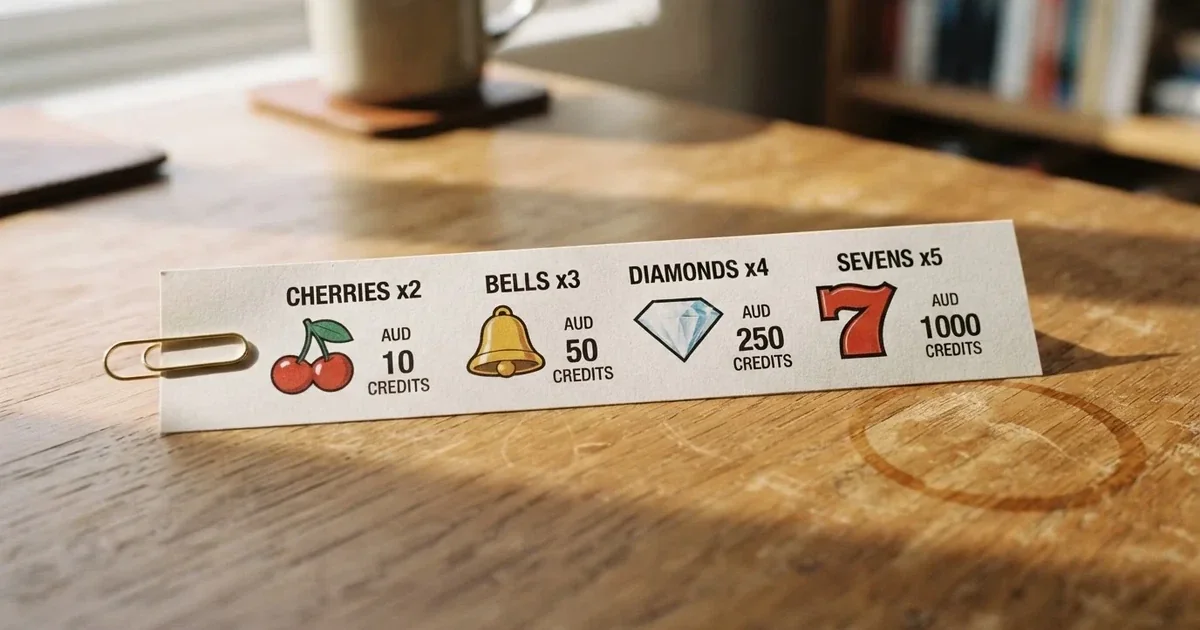
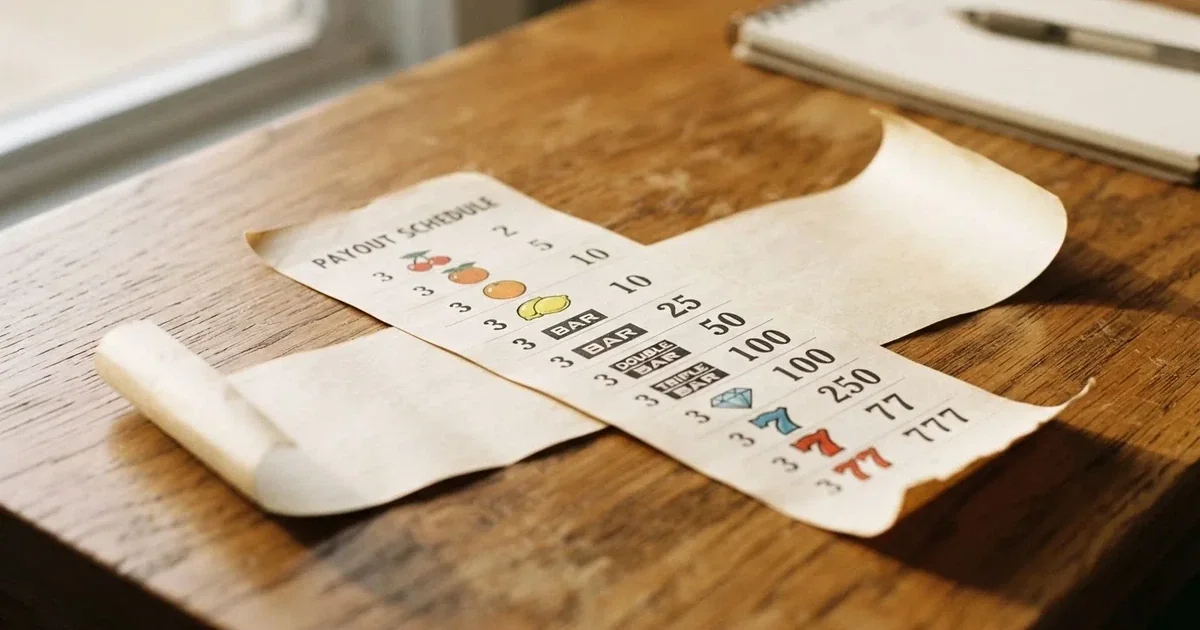
A paytable lists each symbol, the value of matching combinations and any scatter, wild or bonus-trigger conditions. On a seven-reel layout the table typically shows line pays across seven columns rather than five, and the multiplier for full-column matches scales accordingly. Modern video slot machines can use five or more reels with 50 or more symbols per reel, producing odds as high as 300 million to one against a top combination, compared with a classic mechanical three-reel machine with about 10 symbols per reel offering roughly 1,000 possible combinations.
A reader working through a paytable for the first time should read the highest-paying combination first, then the scatter rules, then the wild substitution behaviour, then the bonus-trigger symbols. The order matters because the top combination is what the random number generator is least likely to produce; the scatter and bonus triggers are what you’ll see often enough to matter.
Provider patterns and game families
7-reel releases tend to come from smaller studios and from providers treating the format as a niche novelty. The provider landscape is fragmentary: a handful of studios have released genuine seven-column games, while the larger catalogue of titles tagged “7-reel” in marketing are five-reel video slots with bonus features that mention the number. The listings that place 7-reel slots into a particular provider’s range are not the operator’s own claim and should be read as catalogue placements rather than as studio-confirmed grid counts.
Top 11 Brands the ACMA Has Acted Against — A Comparison That Isn’t a Recommendation
How the set is assembled
The eleven brands below are not a ranking and not a recommendation. Each one has been the subject of a formal warning from the ACMA under the Interactive Gambling Act 2001 for offering prohibited online casino services to Australians. The reason they appear on this page is that any reader searching for “best 7-reel slots” in Australia is, in practice, being pointed at this set of offshore sites — and a fair account of where the search leads has to name what it leads to. The blocking rate section later on this page quantifies how fast the regulator moves against these brands.
The comparison at a glance
| Brand | ACMA action and date | Operator named by the ACMA | Subject support (7-reel listings) |
|---|---|---|---|
| RocketPlay | March 2026 | Pulsup Ltd | — |
| Level Up Casino | May 2022 | Dama N.V. | listings only |
| Woo Casino | March 2025 | Dama N.V. | — |
| Spirit Casino | May 2025 | Dama N.V. | — |
| National Casino | July 2025 | Consolutetish S.R.L. | listings only |
| Bizzo Casino | July 2025 (earlier 2022) | Consolutetish S.R.L.; TechSolutions earlier | — |
| Ignition Casino | July 2025 | Bamboo Media | — |
| Instant Casino | February 2025 | EOD Code SRL | — |
| Jackbit | April 2026 | Ryker B.V. | — |
| Casino Intense | April 2025 | Sterplay Holding Ltd | listings only |
| Sky Crown | September 2022 | Hollycorn N.V. | — |
The em-dash in the right-hand column is honest: for most of these brands the page cannot confirm that a seven-reel title appears in their catalogue, and it does not pretend otherwise. Where a third-party listing has placed a seven-reel title against the brand, that is what “listings only” records — a catalogue placement, not a studio-confirmed grid count.
Why some operators recur
The same operating-company names repeat because the brands are operated in clusters. Dama N.V. carries six names that the ACMA has acted against, and Consolutetish S.R.L. carries another two. A formal warning is published against the operator, not the brand skin — a fact that matters when reading the ACMA’s own register, and that does not change the underlying offer being prohibited. Two of the eleven (Bizzo Casino and Sky Crown) carry earlier warnings in addition to the most recent one.
The Australian Landscape for Online Slots — What the Reader Is Actually Searching Within
The shape of the legal market
The legal online gambling market in Australia is wagering, not casino gaming. Sportsbet, Bet365 and Ladbrokes are licensed in the Northern Territory through the Northern Territory Racing and Wagering Commission — 52 online bookmakers in all — for tax reasons; the commission has no full-time staff and meets once a month in Darwin. Lotteries and keno fall under state and territory regimes. Casino-style games, including slot machines and table games in their online form, sit outside the licensable frame.
New South Wales legalised slot machines in 1956, and by 2010 Australia operated an estimated 97,103 gaming machines outside casinos, a per-capita rate about five times that of the United States. The latest counts outside casinos put pokie-style machines at 87,298 in New South Wales as of June 2023, 26,380 in Victoria across 2021–22, 21,122 in Queensland as of October 2023, 11,672 in South Australia as of September 2023 and 3,587 in the ACT as of November 2023.
| State/Territory | Pokie-style machines (outside casinos) |
|---|---|
| New South Wales | 87,298 (June 2023) |
| Victoria | 26,380 (2021–22) |
| Queensland | 21,122 (October 2023) |
| South Australia | 11,672 (September 2023) |
| ACT | 3,587 (November 2023) |
That density of physical machines is the reason a reader searching “7-reel slots Australia” finds a great deal of marketing copy: the format’s reputation is anchored in a country with more poker-style machines per capita than almost any other.
What fills the gap when readers search offshore
Australia’s illegal gambling market is large enough to attract sustained enforcement. H2 Gambling Capital’s 2025 report estimates that Australians lose about A$3.9 billion a year to illegal gambling sites, and that the share of gambling going through legal channels fell from 74% in 2021 to 64%. The 2025 figure covers all illegal gambling — sports, casino, poker, lottery — but the casino segment is the largest single draw, and it is the segment the ACMA’s blocking actions target.
The offshore sites the reader meets in a normal search engine are the same brands the ACMA names in formal warnings, the same brands whose blocking requests it files with ISPs, and the same brands whose payment rails fall outside the Australian rules. None of them offer the player any of the consumer protections an Australian-licensed wagering service is required to carry: no dispute resolution through a domestic body, no guarantee of payout if the operator disputes a withdrawal, and no connection to BetStop, the National Self-Exclusion Register.
Reading the market in 2026
The Interactive Gambling Amendment (Gambling Reform) Bill 2026 passed Parliament on 19 August 2026, with its advertising and inducement measures commencing on 1 January 2027 — law with a start date, not yet in force on a page published in this calendar year. The legal framework the reader meets today is the post-2017 IGA, not the post-2027 reforms.
Legality and Regulation — How the IGA Works Against the Sites a Reader Will Find
What the Interactive Gambling Act 2001 actually prohibits
The IGA prohibits the provision of online casino games, online pokies and in-play betting to a person physically in Australia. The offence sits with the provider, not the individual player — a player who opens an account with an offshore site does not face prosecution under the IGA. What the player does face is the absence of every protection an Australian licence would normally attach.
In the United States, state regulation sets minimum slot machine payout percentages that vary by jurisdiction: Nevada requires at least 75%, Mississippi at least 80%, and New Jersey at least 83%. Australia has no equivalent floor for the offshore segment because that segment is not regulated. The minimums quoted above are useful only as a comparison point — what a regulated market looks like in dollar terms.
What the ACMA does
The ACMA investigates, issues formal warnings and directs internet service providers to block illegal sites. A formal warning is the regulator’s first formal step and is published on the ACMA website. A blocking request is the more serious tool: it asks Australian ISPs to make the named site unreachable from Australian IP addresses, and it has been used more than 1,700 times since November 2019.
A reader should note the rhythm. A formal warning in one year is followed by a blocking request in a later year for many of the same brands. The brands in the table above span every step of that progression — some carry only a formal warning, some have already been the subject of blocking requests, some have changed skin and re-appeared under a different operator name.
What the reader loses by playing offshore
The consumer protections an Australian-licensed wagering service is required to carry do not extend to offshore casino sites. There is no complaints body to escalate a disputed withdrawal to. There is no requirement that the operator segregate player funds. There is no legal recourse if the operator refuses to pay out — the matter sits outside Australian jurisdiction entirely. And a site blocked by the ACMA can vanish overnight with a balance still on it.
Payment rails — another layer of the prohibition
Credit cards, credit-related products and digital currency are banned as payment for licensed online wagering in Australia since 11 June 2024, with penalties up to $247,500 for operators who breach. The legal deposit routes for licensed wagering are debit card, bank transfer, PayID/Osko and BPAY. A site asking an Australian for a credit card or a crypto deposit is, by definition, operating outside the Australian rules — even if it advertises a Curacao or other offshore licence. A licence displayed by an offshore site does not change the Australian characterisation of the service.

Responsible Gaming — What Help Looks Like
The Australian help lines
If play starts to feel compulsive or stressful, free confidential help is available around the clock. The National Gambling Helpline is 1800 858 858, free, 24/7. Chat support is available through Gambling Help Online. These services are funded to operate across every state and territory and they do not require the caller to identify themselves.
BetStop and what it binds
BetStop, the National Self-Exclusion Register, has been live since August 2023. It binds Australian-licensed online and phone wagering services — an offshore casino is not connected to it. A person who registers with BetStop cannot open new accounts with Australian-licensed bookmakers and cannot log into existing ones for the duration of the exclusion period. A person who wants to extend the same exclusion to an offshore casino site has to do so with each operator individually, and the offshore operator has no obligation to honour the request.
This is the practical limit of the Australian regime for someone playing offshore: the help lines are universal, but the exclusion register is bounded by licence type, and the offshore segment is outside that boundary.
A reader already thinking about a session
A person who has typed this search and is now reading this page because they are weighing up an offer should consider what BetStop does and does not cover. A person who has already registered with BetStop and is looking for a way around it will not find one in the Australian-licensed market. The offshore segment is not a route around the exclusion — it is, at best, an unregulated version of the same risk.
How Fast the ACMA Moves — The Blocking Rate
What the calculation shows
According to the ACMA as reported in June 2026, a total of 1,751 illegal gambling and affiliate marketing websites had been blocked since the first blocking request in November 2019, and more than 230 unlicensed gambling services had left the Australian market since enforcement was strengthened in 2017. The arithmetic belongs to the page rather than to the regulator’s narrative: across roughly 6.5 years from November 2019 to June 2026, the running total sits at 1,751 blocked sites.
The blocking rate works out to somewhere between 250 and 275 sites blocked per year on average over that period, with the most recent rounds running faster than the early ones. In a single round reported on 26 June 2026 the ACMA asked Australian ISPs to block 12 more illegal gambling websites: 7Signs, ChromaBet, Donbet, Duospin, Freshbet, Slots Gem, Jacks Club, Lucky Start, Pointsbetz, Spinrise, Vinyl Casino and Wildsino. Twelve sites in one round is a meaningful acceleration on the long-run average.
Why the rate matters for the reader
A reader looking at a brand on the comparison table above is looking at a brand the regulator has already moved against. The blocking-rate figure tells them how quickly the same fate reaches new entrants. The arc is steady: an average of a site every working day for more than six years, with the recent rounds running faster. A site that is up today can be blocked next month, and a balance sitting on it when the block lands is gone in any practical sense.
The reader who has already deposited
The blocking arithmetic does not retrieve lost funds. A blocked site is unreachable, not refundable. The 230 services that have left the Australian market since 2017 did not, in the main, settle player balances before closing. The protection available is upstream: not playing at all, or sticking to the Australian-licensed segment where the rules apply.
Reading the ACMA’s Formal Warning Register — What the Brands on This Page Mean
Why the same operators appear under multiple brand names
The brands on the comparison table are not always independent businesses. Dama N.V. carries six names the ACMA has warned; Consolutetish S.R.L. carries two of the eleven on this page alone. Hollycorn N.V. carries two. When the ACMA issues a formal warning it names the operator, not the brand skin, because the operator is the legal entity that holds the licence and the obligation. A reader who recognises a brand from prior search results may be looking at a brand whose operator has already been told once — and the warning that names the operator covers every brand that operator runs.
What the brand table cannot show
A brand-by-brand table cannot show what each site actually offers in its lobby. The seven-reel question is largely orthogonal to the brand catalogue: most of the brands in the table are large multi-provider casinos, and whether a specific seven-reel title appears in their catalogue is a question for the live lobby, not the warning register. The “subject support” column in the comparison table records what third-party listings have placed against each brand, not what the brand itself confirms.
The brands that recur across years
Two of the eleven carry earlier warnings in addition to the most recent one. Bizzo Casino was warned in 2022 over TechSolutions (CY) Group Limited and TechSolutions Group N.V., then again in July 2025 over Consolutetish S.R.L. Sky Crown was warned in September 2022 over Hollycorn N.V., and that warning also named Blue Leo. A second warning is rarely a second look — it is the regulator noting that the operator has not changed its posture after the first one.
What a Fair Comparison of These Brands Would Weigh — And Why It Cannot Be Done
The comparison this page cannot make
A “best 7-reel slots Australia” ranking in any other market would weigh payout percentages, withdrawal times, bonus terms, game catalogue depth and customer support quality. None of those comparisons can be made honestly for this set of brands. Each one is operating outside Australian law, and each one falls outside the jurisdiction an Australian consumer would rely on if something went wrong.
A comparison that ignored the legal frame and ranked the brands on their casino-floor qualities would also be misleading, because the reader is in Australia and the legal frame applies. The honest answer to “which of these is best” is “none, because none of them are licensed to take Australian players.” The comparison table on this page is therefore the only kind of comparison an honest reader can use: who the ACMA has acted against, when, and which operator name sits behind the brand skin.
What the reader should do with this page
The reader’s practical choices, after reading this page, sit in two camps. The first camp is the Australian-licensed wagering market — sports and racing, lotteries, keno — where the consumer protections apply and the rules are enforceable. The second camp is not playing at all. There is no third camp of “playing offshore but safely.” The offshore segment is, by definition, the segment where the protections do not apply.
A note on the format itself
7-reel slots are a real game format with a real history and a real combinatorial signature. The format is interesting on its own terms — more columns, different paytable logic, different hit profile — and a reader who wants to understand slot design will find the format worth reading about. What the format is not, in Australia, is a category of legally available online play.
Frequently Asked Questions
What makes a 7-reel slot different from a standard five-reel video slot?
A 7-reel slot uses seven columns rather than the standard five, which expands the combinatorial space considerably. Each column still carries a strip of symbols, the outcome is still drawn from a random number generator, and the paytable structure is the same in principle — but the larger grid produces longer odds against the top combinations and a different hit frequency on the smaller pays.
Can 7-reel slot machines be found in licensed Australian pubs and clubs?
Australia has one of the highest densities of poker-style machines outside casinos in the world — 87,298 in New South Wales alone as of June 2023. Whether any of those machines run a seven-reel layout rather than the standard three or five depends on the venue and the state. The bulk of the installed base is five-reel video, with three-reel mechanical machines largely retired.
Do 7-reel slots typically pay out differently than newer five-reel formats?
Payout percentage is set by the game’s design and the regulator’s rules, not by the reel count. A 7-reel game can carry a higher or lower return-to-player than a 5-reel game from the same provider. The reel count affects the hit frequency and the distribution of symbol combinations, not the long-run return on its own.
Is a 7-reel slot online the same game as a 7-reel machine on a casino floor?
In principle yes — both draw outcomes from a random number generator against the same paytable. In practice, online and physical versions of a slot title can carry different payout percentages even when the artwork and feature set are identical. Australia does not license online casino games, so any “7-reel slot online” is necessarily an offshore product.
Are 7-reel slots for real money available legally from an Australian-based site?
No. The Interactive Gambling Act 2001, strengthened by the Interactive Gambling Amendment Act 2017, makes it an offence to provide online casino games or online pokies to a person in Australia, and no state or territory issues a licence for them. Real-money 7-reel play exists only on offshore sites that are operating outside Australian law.
Is reel count still a useful way to compare volatility between older and newer slots?
Reel count affects volatility because the combinatorial space changes, but it is one input among several. Modern five-reel video slots with 50 or more symbols per reel carry combinations in the hundreds of millions and can be more or less volatile than a seven-reel game with fewer symbols per reel. Volatility is better read from the game’s own published profile than inferred from the reel count.
Published by the Casino Safety Info team.