
Welcome bonus offers aimed at Australians: what the ACMA’s record shows
Every operator carrying a “welcome bonus” pitched at an Australian player sits on the wrong side of a national law that has been tightening for a decade. The Interactive Gambling Act 2001, refreshed in 2017 and again in 2023, makes it an offence to provide online casino games, online pokies or in-play betting to a person physically in Australia. No state or territory issues a licence for online casino products. What the marketing calls a “welcome bonus” is, in Australia, an inducement to use a service that cannot lawfully be offered here. The eleven brands reviewed below are the ones the Australian Communications and Media Authority itself has named in formal warnings, and the comparison that follows treats them as such: as a record of where enforcement has landed, not as a shortlist to act on.

The register figures, blocking requests and warnings cited below are current as of 28 October 2026 and were verified against the Australian Communications and Media Authority’s published formal-warning list and the industry report on the June 2026 blocking round.
See also Casino bonus code Australia 2026.
Table of Contents
- What a welcome bonus actually is, and why offshore sites use it
- Inducements
- How offshore sites get the money in and back out
- Free spins and no-deposit offers
- What this side of the market looks like, by the numbers
- The Australian landscape, onshore and offshore
- The operators the ACMA has acted against
- The blocking rate, year on year
- How a reader comparing options should read this page
- Responsible gambling supports that cover the offshore space
- The legal frame, in one read
- What this page is not for
- FAQ
What a welcome bonus actually is, and why offshore sites use it
A welcome bonus is a credit or a bundle of free spins that an online casino attaches to a first deposit, sometimes to registration alone. The offshore sites marketing to Australians bundle them in three common shapes: a percentage match on whatever a player deposits, a fixed number of free spins on a named slot, or a package that combines the two. The structure is the same one used in any consumer business that wants a new account on the books: the operator carries the cost of the credit, the player carries the wagering attached to it, and the difference is what the marketing call to action is buying.

Two things make this market different from a normal retail promotion. First, the player is the product the operator is buying — the conversion target is a funded account that will keep returning, not a single transaction. Second, the wagering requirements that turn the bonus from a credit into a real-money balance are calibrated to make early withdrawal unattractive. A bonus advertised at A$500 with a 40-times wagering multiple is, on its own arithmetic, A$20,000 of qualifying bets before the bonus money is withdrawable. The marketing word “bonus” carries the connotation of a gift. The legal word is “inducement”, and the Interactive Gambling Amendment (Gambling Reform) Bill 2026, which passed Parliament on 19 August 2026 and commences 1 January 2027, uses that language deliberately for the licensed side of the industry. The offshore side of the industry is not subject to that new regime at all.
Inducements
The shape of the inducement: cash, spins or a package
A cash-style welcome bonus is the simplest: the operator matches a percentage of the first deposit, typically in a 100% to 200% range, with the matched amount carried as bonus money that has to be wagered before withdrawal. A free-spin welcome bonus grants a fixed number of spins, often on one named slot, with whatever those spins produce credited as bonus money under the same kind of condition. A package combines the two — a deposit match plus a tranche of free spins released over the first week of play.
The number that matters is the wagering multiple. A 30-times multiple on a bonus is meaningfully lighter than a 45-times multiple, and the published figure is rarely the whole story. Some operators split the weighting between slots and table games; some cap the maximum stake per spin while the bonus is active; some limit which games contribute at all. Free-spin winnings almost always carry their own multiplier, sometimes higher than the cash bonus’s, because the credit cost of a free spin to the operator is small and the conditions can be tighter without deterring the player. None of this is unusual in itself. What is unusual is that the operator is not licensed to offer the product to an Australian player in the first place, and the player has no Australian complaints body to appeal to if the terms are misapplied.
What the wagering requirements cost
A reader holding a bonus at A$500 with a 40-times multiple is being asked to place A$20,000 of qualifying bets before the bonus becomes withdrawable. At A$1 per spin on a slot running at a 96% return, the expected loss on that turnover is roughly A$800 — meaning the bonus has to return A$1,300 of winnings before the player breaks even on the wagering alone, before counting the original deposit. That is the cost of the “free” credit in its most honest form.
The math is the same whether the bonus is 30-times or 50-times — only the magnitude changes. What shifts the picture for a particular player is the house edge of the chosen game, the stake ceiling the operator applies, and whether the player has any realistic path to a withdrawal at all. Some bonus terms include a maximum cashout clause, a few hundred dollars on what the marketing calls a “thousand-dollar welcome”. Reading the terms before claiming is the only defence, and on an offshore site there is no external body to read them with.
How offshore sites get the money in and back out
The crypto route
A Bitcoin or other cryptocurrency deposit is the route most offshore casinos prefer for a player who wants minimum friction. The transaction is direct, fast and not routed through a bank that applies a gambling block. The anonymity it offers is real but partial: the wallet address is on a public ledger, the on-ramp and off-ramp usually require identity verification, and an offshore casino that wants to know who its customer is can demand that verification before any withdrawal is processed. A reader who thinks a crypto deposit makes them anonymous to the operator is mistaken on the second step: the deposit is anonymous, the withdrawal is not.
The fiat route: cards, PayID, BPAY
The debit card is the most common Australian payment to an offshore casino, often a Visa or Mastercard debit linked to a transaction account. The four major banks — ANZ, Commonwealth Bank, NAB and Westpac — all offer gambling blocks at card level, and Westpac’s block refuses authorisation on transactions tagged with the merchant category code “Betting/Casino Gambling” on eligible cards. ANZ’s gambling block, activated in the ANZ app, extends to transactions made through a digital wallet on an eligible card, not only to the card itself. Commonwealth Bank’s gambling lock works the same way through the CommBank app, with the bank warning that not every gambling transaction can be guaranteed blocked. Apple Pay, Google Pay and Samsung Pay together accounted for around 45% of Australian card payments by number at the end of 2025, so the digital wallet is the route many players actually use, and the bank-level block is what catches them if it is on.
PayID and Osko settle a bank transfer between participating Australian banks in under a minute, 24/7. Paying to a PayID reveals the account-holder name before the transfer is sent, and Australian Payments Plus warns that being asked to transfer to a PayID on an illegal gambling site almost certainly means a scam site. BPAY is a different channel — bill-payment, used for the licensed wagering side — and it is not the route an offshore casino takes.
Under the Interactive Gambling Act as amended in 2023, an Australian-licensed online wagering service cannot accept credit cards, credit-related products or digital currency. An offshore casino asking an Australian for any of those is operating outside the Australian rules. The credit-card ban also constrains the linked-wallet path: a digital wallet funded from a credit card carries the same prohibition, and the major banks’ gambling blocks catch the wallet transaction if it is set up to catch the card.
Free spins and no-deposit offers
The no-deposit offer
A no-deposit welcome bonus is the most aggressive marketing shape in the offshore space: a small credit or a small bundle of free spins granted on registration alone, before the player has funded anything. The conversion target is not the bonus itself — the value is small, the wagering multiple is heavy, and the maximum cashout is typically capped. The conversion target is the funded account. The bonus is the door opener, and the player’s first deposit is what the operator is buying.
For an Australian player the no-deposit offer carries the same legal problem as any other offshore welcome bonus, and a heavier practical one: the player has already accepted an inducement to use a prohibited service, often without the friction of entering card details first, and may have agreed to marketing contact in the terms. The unsubscribe path on an offshore site is not always honoured.
Free spins
Free spins bundled into a deposit welcome bonus behave like the cash portion of the bonus: the winnings are credited as bonus money, the wagering multiple applies, and the maximum cashout is usually capped. The slot the spins are valid on is named in the terms — usually one title the operator wants to feature. The volatility of that slot matters more than its return-to-player percentage: a high-volatility slot produces most of its return in a small number of large wins, and a player clearing wagering on it sees a wider swing than on a low-volatility slot at the same RTP. The casino picks the slot, not the player, and that is one of the levers the terms hide in plain sight.
What this side of the market looks like, by the numbers
The following eleven brands are the ones the ACMA has named in formal warnings over the past four years for offering prohibited interactive gambling services to Australians. They are not a ranking. They are a record, ordered by ACMA publication date, newest first. The table carries the ACMA’s own record of each action, the operator entity the ACMA named, and what the research was able to verify on payment-method support for the brand.
| Brand | ACMA action and date | Operator named by the ACMA | Payment-method support on file |
|---|---|---|---|
| RocketPlay | Formal warning, March 2026 | Pulsup Ltd (Rocketplay) | Listings report support for Visa, Mastercard and selected e-wallets |
| Jackbit | Formal warning, April 2026 | Ryker B.V. | — |
| Casino Intense | Formal warning, April 2025 | Sterplay Holding Ltd | Listings report support for Visa, Mastercard, ecoPayz and bank transfer |
| National Casino | Formal warning, July 2025 | Consolutetish S.R.L. | Listings report support for Visa, Mastercard, ecoPayz and bank transfer |
| Bizzo Casino | Formal warning, July 2025 (earlier 2022 under TechSolutions) | Consolutetish S.R.L. | Listings report support for Visa, Mastercard and selected e-wallets |
| Ignition Casino | Formal warning, July 2025 | Bamboo Media | — |
| Woo Casino | Formal warning, March 2025 | Dama N.V. | — |
| Spirit Casino | Formal warning, May 2025 | Dama N.V. | — |
| Instant Casino | Formal warning, February 2025 | EOD Code SRL | Listings report support for ecoPayz and PayID |
| Sky Crown | Formal warning, September 2022 | Hollycorn N.V. | — |
| Level Up Casino | Formal warning, May 2022 | Dama N.V. | Listings report support for Visa and Mastercard |
Enforcement Summary: ACMA Actions
| Brand | ACMA Action & Date | Named Operator | Payment Support |
|---|---|---|---|
| RocketPlay | Formal warning, March 2026 | Pulsup Ltd | Visa, Mastercard, e-wallets |
| Jackbit | Formal warning, April 2026 | Ryker B.V. | Crypto-first |
| Casino Intense | Formal warning, April 2025 | Sterplay Holding Ltd | Visa, MC, ecoPayz, transfer |
| National Casino | Formal warning, July 2025 | Consolutetish S.R.L. | Visa, MC, ecoPayz, transfer |
| Bizzo Casino | Formal warning, July 2025 | Consolutetish S.R.L. | Visa, Mastercard, e-wallets |
| Ignition Casino | Formal warning, July 2025 | Bamboo Media | Not verified |
| Woo Casino | Formal warning, March 2025 | Dama N.V. | Not verified |
| Spirit Casino | Formal warning, May 2025 | Dama N.V. | Not verified |
| Instant Casino | Formal warning, February 2025 | EOD Code SRL | ecoPayz, PayID |
| Sky Crown | Formal warning, Sep 2022 | Hollycorn N.V. | Not verified |
| Level Up Casino | Formal warning, May 2022 | Dama N.V. | Visa, Mastercard |
The Australian landscape, onshore and offshore
What is licensed
The licensed Australian online wagering market is racing and sport only, placed before the event, plus lotteries and keno. The Northern Territory Racing and Wagering Commission regulates 52 of Australia’s online bookmakers — including Sportsbet, Bet365 and Ladbrokes — licensed in the Territory for tax reasons. The commission has no full-time staff and meets once a month in Darwin. Online casino products — slots, table games, live dealer — are not licensed in any Australian state or territory, and the Interactive Gambling Act 2001 makes it an offence to provide them to a person in Australia. The minimum age is 18.
What is enforced
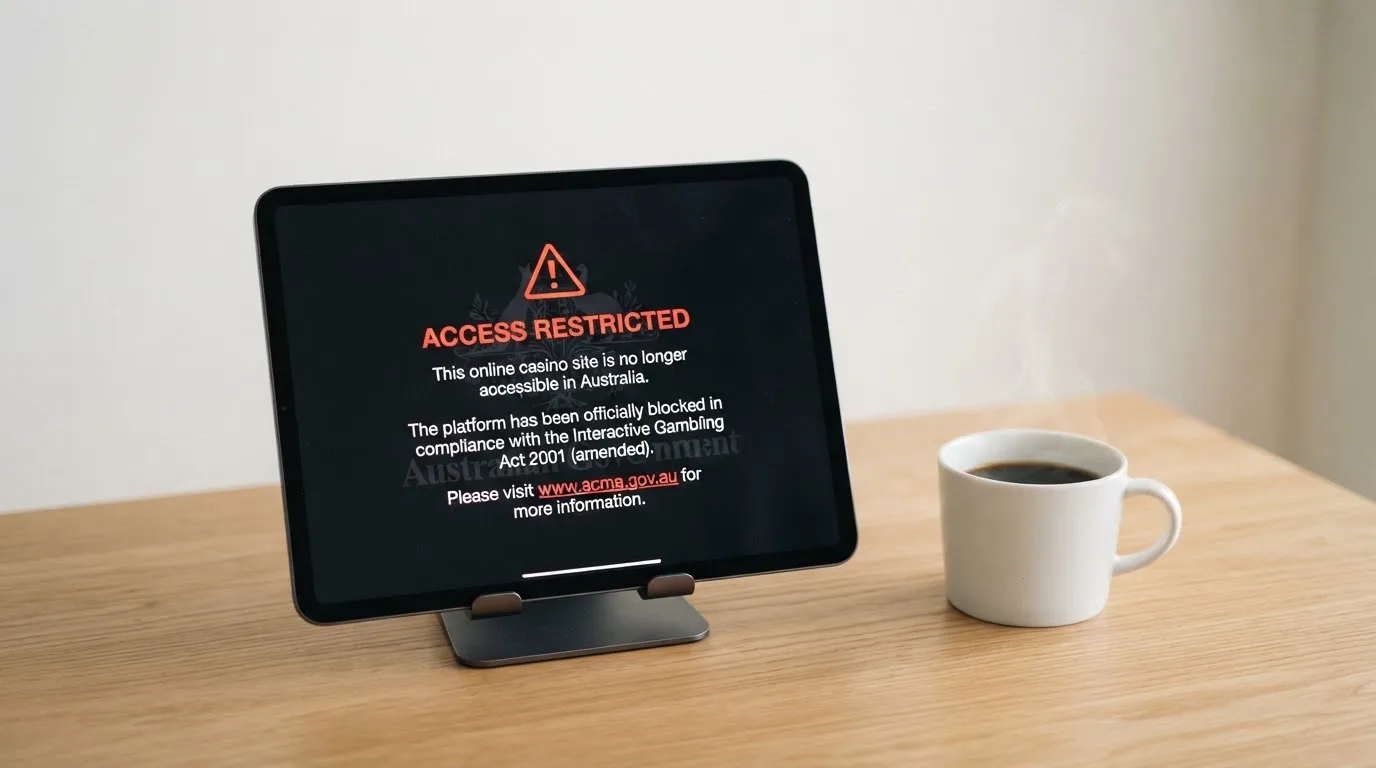
The ACMA investigates, issues formal warnings, and directs Australian internet service providers to block illegal sites. By June 2026 the ACMA’s blocking requests had taken 1,751 illegal gambling and affiliate marketing websites offline since the first request in November 2019, and more than 230 unlicensed services had left the Australian market since enforcement was strengthened in 2017. The June 2026 round alone added 12 sites — 7Signs, ChromaBet, Donbet, Duospin, Freshbet, Slots Gem, Jacks Club, Lucky Start, Pointsbetz, Spinrise, Vinyl Casino and Wildsino — to the blocking list. H2 Gambling Capital’s 2025 estimate puts Australian losses to illegal sites at around A$3.9 billion a year, with the share of gambling going through legal channels falling from 74% in 2021 to 64%.
The individual player is not the target of prosecution under the Interactive Gambling Act — the Act targets the provider. An offshore site gives no Australian consumer protection, no complaints body and no recourse if a withdrawal is refused, and the ACMA can block it while a balance is still on it.
What is not connected to Australian protection
BetStop, the National Self-Exclusion Register, has been live since August 2023 and binds Australian-licensed online and phone wagering services. An offshore casino is not connected to BetStop, and a player who has registered with BetStop to control their wagering is not, by that registration, excluded from an offshore site. BetStop is the right tool for licensed wagering; it is the wrong tool for the offshore casino space, and a player relying on it alone is exposed. The Gambling Help Online service at 1800 858 858 is free and 24/7, and it is the line that does cover the offshore space — it takes calls from anyone in Australia, licensed market or not.
Welcome bonus offers aimed at Australians — More on this topic at casino safety.
The operators the ACMA has acted against
Each of the brands below is named by the ACMA in a formal warning. The warnings are published and dated. The brand write-ups are a record of those warnings, not a comparison to act on, and the verdicts are judgments of the ACMA action, not of the welcome offer.
RocketPlay
The ACMA issued a formal warning to Pulsup Ltd over Rocketplay in March 2026, the most recent of the eleven. An earlier Dama N.V. action over Rocketplay dates from May 2022. The operator entity has shifted; the brand has not. Listings report support for Visa, Mastercard and selected e-wallets, which is the standard offshore cashier set. The verdict is the ACMA’s, not a reader’s: this is a prohibited service offered to Australians, twice formally warned, and any welcome bonus attached to it sits on the wrong side of the Act.
Level Up Casino
Dama N.V. took a formal warning over Level Up Casino in May 2022, one of six Dama brands caught in the same action. The brand is part of a portfolio the ACMA has returned to repeatedly. Listings report support for Visa and Mastercard, and the picture on the ground is the standard offshore cashier plus whatever the operator’s regional payment partners are. The verdict is clear: any Australian player interacting with this brand is engaging with a service the ACMA has already flagged as prohibited.
Woo Casino
The ACMA issued a formal warning to Dama N.V. over Woo Casino in March 2025. It is the second Dama N.V. action on this page, and the third Dama N.V. brand to carry a formal warning in the ACMA’s published list. Payment-method support could not be verified from the listings reviewed, and the brand is presented on its ACMA record alone. The verdict is the same as the others: a formal warning is on file, and the product is prohibited to an Australian player.
Spirit Casino
Dama N.V. took the May 2025 formal warning over Spirit Casino, again part of a portfolio the ACMA has named across multiple brands. No payment-method support could be verified from the listings reviewed. The brand sits on its ACMA record, and the welcome bonus is the inducement to a prohibited service.
National Casino
The ACMA issued a formal warning to Consolutetish S.R.L. over National Casino in July 2025. Listings report support for Visa, Mastercard, ecoPayz and bank transfer, which is a broader fiat-plus-e-wallet cashier than some of the others on the page. The verdict is definitive: a service that carries this level of formal enforcement cannot be considered a safe or lawful option for Australian residents.
Bizzo Casino
Consolutetish S.R.L. took the same July 2025 formal warning over Bizzo Casino, alongside National Casino. Bizzo had already been the subject of a 2022 formal warning to TechSolutions (CY) Group Limited and TechSolutions Group N.V., making it the only brand on this page with two operator-entity warnings behind it. Listings report support for Visa, Mastercard and selected e-wallets. The verdict: a brand that has been warned twice under the Act is a brand the Act has been applied to twice, and the welcome offer sits in the same legal position either way.
Ignition Casino
The ACMA issued a formal warning to Bamboo Media over Ignition Casino in July 2025. Payment-method support could not be verified from the listings reviewed. Ignition is one of the brands in this record that is more commonly associated with the United States market, and its appearance here reflects the ACMA’s view that an Australian-facing offer of the same product is a breach. The verdict is the ACMA’s record: formal warning, prohibited service, inducement attached.
Instant Casino
The ACMA issued a formal warning to EOD Code SRL over Instant Casino in February 2025. Listings report support for ecoPayz and PayID, which is the most unusual payment pair on this page: a PayID route is the same instant-payment system used for licensed Australian wagering, and its presence here is a signal the operator is targeting Australian banking rails specifically. The verdict: a formal warning on file, an inducement on offer, and a payment route that Australian Payments Plus itself warns is a marker of an illegal gambling site.
Jackbit
The ACMA issued a formal warning to Ryker B.V. over Jackbit in April 2026, alongside CasinOK. Jackbit is a crypto-first casino, and the lack of a fiat cashier is the design rather than the omission. No payment-method support could be verified beyond the brand’s own crypto positioning. The verdict: players should treat this brand as a prohibited entity, given the ACMA’s explicit finding of non-compliance with the IGA.
Casino Intense
The ACMA issued a formal warning to Sterplay Holding Ltd over Casino Intense in April 2025. Listings report support for Visa, Mastercard, ecoPayz and bank transfer, a standard offshore fiat-and-e-wallet cashier. The verdict is the same as the others: a formal warning on file, and a welcome bonus attached to a prohibited service.
Sky Crown
The ACMA issued a formal warning to Hollycorn N.V. over Sky Crown, published in September 2022 along with Blue Leo. Sky Crown is the oldest ACMA action on this page by publication date, and Hollycorn is the operator entity the ACMA has named at group level rather than brand level. No payment-method support could be verified from the listings reviewed. The verdict: a formal warning on file, and a welcome offer attached to a prohibited service.
The blocking rate, year on year
The ACMA’s blocking regime is the practical enforcement arm of the Interactive Gambling Act. The first blocking request was made in November 2019, and by June 2026 a total of 1,751 illegal gambling and affiliate marketing websites had been blocked, with more than 230 unlicensed services having left the Australian market since 2017. The June 2026 round alone added 12 sites — 7Signs, ChromaBet, Donbet, Duospin, Freshbet, Slots Gem, Jacks Club, Lucky Start, Pointsbetz, Spinrise, Vinyl Casino and Wildsino — to the blocking list.
The arithmetic that belongs to this page is the blocking rate: the running total of blocked sites over the months since the first request. Stated as a band, given that the running total compounds with each round and the gap between rounds varies: roughly 25 to 35 sites blocked per month across the full enforcement period since November 2019, on the published ACMA figures. The condition that sets the band is simple — the blocking rate is the number of sites added per round divided by the months between rounds, not a steady drip, and a single large round widens the upper end of the band for the month it lands in. The trend across the period is upward, not steady, and the 12-site round in June 2026 sits at the upper end of what a single round has delivered in the period since the first blocking request.
The practical reading of the band is that the ACMA’s blocking regime has not slowed since 2019 — it has accelerated. A brand that takes a formal warning and remains reachable is one blocking request away from disappearing for Australian players, and the welcome bonus attached to it disappears with the brand.
How a reader comparing options should read this page
The right comparison for a reader is not which offshore welcome bonus is best. None of them are lawfully available to an Australian player, and the ACMA’s published record is the proof of that. The right comparison is between the licensed Australian wagering market and the offshore casino market that targets it, and within that comparison the reader is choosing whether to engage with the offshore side at all.
For a reader who has decided to engage with the licensed market, the comparison collapses to a wagering question — which bookmaker offers the best odds, the best market depth, the cleanest app. The welcome bonus on that side is a smaller, regulated credit with a real complaints body behind it, and the Interactive Gambling Amendment (Gambling Reform) Bill 2026 will rewrite the inducement rules for the licensed side from 1 January 2027. For a reader who has decided to engage with the offshore market, the comparison is between eleven brands the ACMA has named in formal warnings, and the answer the ACMA has already given: the product is prohibited.
The reader who is reading this page because they want a welcome bonus, and who is comparing options on the offshore side, is the reader who most needs to read this page with the legal frame intact. The arithmetic on the bonus is real, but it is arithmetic on a service the reader cannot lawfully be offered. The arithmetic on the wagering requirements is the same. The arithmetic on the withdrawal path is the same. The only arithmetic that changes is the risk the player carries alone.
Responsible gambling supports that cover the offshore space
The Australian supports
Gambling Help Online runs the National Gambling Helpline at 1800 858 858, free and 24/7, with web chat. The service is for any Australian affected by their own or someone else’s gambling, and it covers the offshore space as well as the licensed market. State and territory problem-gambling services sit alongside it. BetStop, the National Self-Exclusion Register, binds Australian-licensed online and phone wagering services — it does not bind offshore casinos. A player registered with BetStop is not, by that registration, excluded from the eleven brands on this page; the offshore operators are not connected to the register, and a self-exclusion on the licensed side does not transfer. For complete protection on the offshore side, the player needs to combine BetStop with the bank’s gambling block, with the wallet-level controls, and with the supports listed above.
The bank-level controls
ANZ’s gambling block is activated in the ANZ app and blocks gambling transactions on eligible cards, including through a digital wallet on the same card. Removing the block requires a 48-hour waiting period, and the bank warns that not all gambling transactions will be blocked and some non-gambling transactions might be blocked in error. Commonwealth Bank’s gambling lock is applied in the CommBank app and blocks most gambling transactions on eligible cards, with the same caveat that not every gambling-related purchase can be guaranteed stopped. Westpac’s gambling block refuses authorisation on transactions tagged with the merchant category code “Betting/Casino Gambling” on eligible personal credit and debit cards.
The card-level controls are the layer a player can set without telling anyone, and they are the layer that catches the wallet transaction if the wallet is funded from the same card. A reader who is comparing offshore casinos and has not turned on the bank-level block has not closed the comparison on their own side.
Where to go from here
If a reader is comparing welcome bonuses aimed at Australians and has not already turned on the bank-level gambling block, that is the first step. If a reader has already engaged with one of the eleven brands above and is finding the wagering requirements harder to clear than the marketing suggested, the helpline is the next step. If a reader is registering with BetStop, the registration covers the licensed wagering market but not the offshore casino market, and the offshore side needs a separate defence.
The legal frame, in one read
The Interactive Gambling Act 2001, strengthened by the Interactive Gambling Amendment Act 2017, makes it an offence to provide online casino games, online pokies or in-play betting to a person in Australia. No state or territory licenses online casino products. The ACMA enforces the Act through formal warnings and blocking requests directed at Australian internet service providers. The individual player is not the target of prosecution; the provider is. The Interactive Gambling Amendment (Gambling Reform) Bill 2026 passed Parliament on 19 August 2026, with its advertising and inducement measures commencing 1 January 2027. The bill is law with a start date, not yet in force on a 2026 page.
Credit cards, credit-related products and digital currency are banned as payment for licensed online wagering from 11 June 2024, with penalties up to A$247,500 for operators accepting them. Legal deposit routes for licensed wagering are debit card, bank transfer, PayID, Osko and BPAY. Gambling winnings of a recreational player are not assessable income under section 6-5 of the ITAA 1997 and losses are not deductible, unless the person carries on a business of gambling — model only, and the ATO is the body to check with.
The minimum age is 18. BetStop is the National Self-Exclusion Register, live since August 2023, binding Australian-licensed wagering services only. The National Gambling Helpline at 1800 858 858 is free and 24/7.
What this page is not for
This page does not recommend an offshore casino to a reader based in Australia. The eleven brands reviewed here are the brands the ACMA has named in formal warnings under the Interactive Gambling Act 2001, and they are listed in that capacity. None of them can lawfully offer an online casino welcome bonus to a person in Australia. The welcome bonus attached to any of them is the inducement the Act prohibits, regardless of the wagering multiple, the cashout cap or the slot the spins are valid on. A reader comparing offshore casinos on the basis of their welcome bonuses is comparing inducements to use prohibited services, and the comparison the ACMA has already made is on file.
This page is also not a guide to claiming any of the offers. No bonus code, promo code or voucher is reproduced here, and the only action a reader should take on the basis of this page is the one the responsible-gambling supports recommend.
FAQ
Are online casino welcome bonuses legally offered to players based in Australia?
No. The Interactive Gambling Act 2001, as amended in 2017 and 2023, makes it an offence to provide online casino games, online pokies or in-play betting to a person in Australia. No state or territory licenses online casino products. Every welcome bonus attached to such a product sits on the wrong side of the Act, regardless of the operator’s claimed jurisdiction or the licence the site displays in its footer.
Why do offshore casino sites use welcome bonuses as their main marketing tool?
Because the conversion target is a funded account, not a single transaction. A small credit or a bundle of free spins lowers the barrier to a first deposit, and the wagering requirements attached to the bonus make early withdrawal unattractive. The bonus is the door opener; the deposit is what the operator is buying. The mechanics are the same as any consumer business that wants a new account on the books.
What conditions typically apply before a welcome bonus can be withdrawn as cash?
A wagering multiple, usually 30 to 50 times the bonus amount, has to be cleared through qualifying bets before the bonus becomes withdrawable. Maximum stake per spin is often capped while the bonus is active. Free-spin winnings carry their own multiple, sometimes higher than the cash bonus’s. A maximum cashout cap is common on no-deposit offers. None of these conditions is unusual; what is unusual is that the operator is offering the product to an Australian player in the first place, and the player has no Australian complaints body to appeal to.
Do licensed Australian pokies venues offer anything similar to an online welcome bonus?
No. Online casino games and online pokies cannot be licensed in Australia. The licensed online wagering market is racing and sport only, placed before the event, plus lotteries and keno. A welcome bonus in the licensed market is a smaller, regulated credit on a wagering product, not an inducement to play slots. The Interactive Gambling Amendment (Gambling Reform) Bill 2026, commencing 1 January 2027, will rewrite the inducement rules for the licensed side from that date.
Can accepting a welcome bonus commit a player to ongoing marketing contact?
Yes, often. The terms attached to a welcome bonus on an offshore site frequently include consent to marketing emails, SMS and push notifications, and the unsubscribe path is not always honoured. A player who has accepted a no-deposit offer has often agreed to ongoing contact before they have funded anything, and the friction of entering card details is the barrier that marketing contact is designed to lower next.
Where can an Australian find independent support if bonus-chasing becomes a problem?
Gambling Help Online runs the National Gambling Helpline at 1800 858 858, free and 24/7, with web chat. The service covers any Australian affected by their own or someone else’s gambling, and it covers the offshore casino space as well as the licensed market. BetStop, the National Self-Exclusion Register, binds Australian-licensed wagering services only — it does not bind offshore casinos, and a player registered with BetStop is not, by that registration, excluded from the eleven brands on this page. The bank-level gambling blocks at ANZ, Commonwealth Bank and Westpac are the layer a player can set without telling anyone, and they are the layer that catches the wallet transaction if it is set up to catch the card.