
Real money pokies apps on Android for Australian players: the choice the law has actually left on the table
The Google Play Store will not hand an Australian a real money pokies app. Neither will Apple. The product those storefronts refuse to host is the same one hundreds of offshore sites are quite happy to push through sideloaded APKs, Telegram links, and web pages that dress themselves up as mobile apps. This page is about the gap between those two markets — the one Google enforces, and the one the Australian Communications and Media Authority has been chipping away at since the Interactive Gambling Amendment Act 2017 strengthened the regulator’s hand.

The reading on the law is straightforward and it does not bend. Online casino games and online pokies cannot be licensed anywhere in Australia. Wagering on races and sport, lotteries and keno can; everything else offered on a phone as a real-money “pokies app” sits outside the regime the states and territories recognise. That means there is no Australian regulator an Android punter can complain to when an offshore balance disappears, no local body that will chase a refused withdrawal, and no obligation on the operator to honour any advertisement it has run. The eleven brands covered below are listed for one reason only — each has had a formal warning issued over it by the ACMA, and each is therefore a useful exhibit of the offshore market the prohibition was written against.
Data current as of 28 October 2026, cross-checked against the Australian Communications and Media Authority’s formal warning register and the most recent published blocking round.
Table of Contents
- Landsca
- The legal ground an Australian is actually standing on
- The arithmetic the regulator’s file actually shows
- What an offshore real money pokies app typically asks an Android phone for
- The responsibility side of the page
- What the eleven brands actually offer, and what the ACMA file actually says about each
- The wider market the ACMA’s blocking file describes
- Picking an option from what is on the table
- Frequently asked questions
Landsca
The comparison below is not a ranking and not a recommendation. The brands vary wildly in age, in operator, in the country their licence (where any exists) was issued under, and in how long ago the regulator here moved against them. What they share is a single characteristic: every one of them was offering, or being marketed to Australians as offering, real money casino games — including online pokies — over the internet. Each one was the subject of a formal warning from the ACMA under the Interactive Gambling Act 2001 at the date in the table.
| Brand | ACMA action and date | Operator named by the ACMA | Pokies/app support |
|---|---|---|---|
| RocketPlay | Formal warning — March 2026 (also Dama N.V., May 2022) | Pulsup Ltd; earlier Dama N.V. | — |
| Level Up Casino | Formal warning — May 2022 | Dama N.V. | BGaming listings |
| Woo Casino | Formal warning — March 2025 | Dama N.V. | — |
| Spirit Casino | Formal warning — May 2025 | Dama N.V. | — |
| National Casino | Formal warning — July 2025 | Consolutetish S.R.L. | Wikipedia listing |
| Bizzo Casino | Formal warning — July 2025 (also TechSolutions, 2022) | Consolutetish S.R.L.; earlier TechSolutions (CY) Group | — |
| Ignition Casino | Formal warning — July 2025 | Bamboo Media | — |
| Instant Casino | Formal warning — February 2025 | EOD Code SRL | — |
| Jackbit | Formal warning — April 2026 | Ryker B.V. (also CasinOK) | — |
| Casino Intense | Formal warning — April 2025 | Sterplay Holding Ltd | ABC, ACMA, and Crown Melbourne listings |
| Sky Crown | Formal warning — September 2022 | Hollycorn N.V. (also Blue Leo) | — |
Regulatory Status of Wagering
| Service Type | Regulator | Licensed in Australia? |
|---|---|---|
| Online sports betting | Northern Territory Racing and Wagering Commission | Yes |
| Online casino | None | No |
| Online pokies | None | No |
| Lotteries and Keno | State regulators | Yes |
Regulatory Context for Licensed Wagering
| Service Type | Regulator | Licensed in Australia? |
|---|---|---|
| Online sports betting | Northern Territory Racing and Wagering Commission | Yes |
| Online casino | None | No |
| Online pokies | None | No |
| Lotteries and Keno | State regulators | Yes |
Two operators recur on the register. Dama N.V. — the holder of the earlier 2022 warnings for RocketPlay, Level Up, Woo, Spirit and others — is the most iterated name in the ACMA’s recent file, which is itself part of the story: the same Curaçao vehicle has been re-skinned under fresh consumer-facing brands faster than the regulator’s warning cycle catches up. Consolutetish S.R.L. is the second repeat operator in the set, named for both National Casino and Bizzo in a single 2025 round. TechSolutions had been warned over Bizzo in 2022; that the same product resurfaced under a different corporate wrapper three years later is the practical shape of the offshore market.
What the ACMA’s blocking rounds add to the picture
A formal warning is the regulator’s middle gear. The first round of public action is usually a written direction telling the operator that the service is prohibited, and the IGA carries civil penalties for non-compliance. The next gear is the blocking request: the ACMA asks Australian internet service providers to make the offending domains unreachable from this country. Both ends of that cycle have moved in the most recent reporting period.
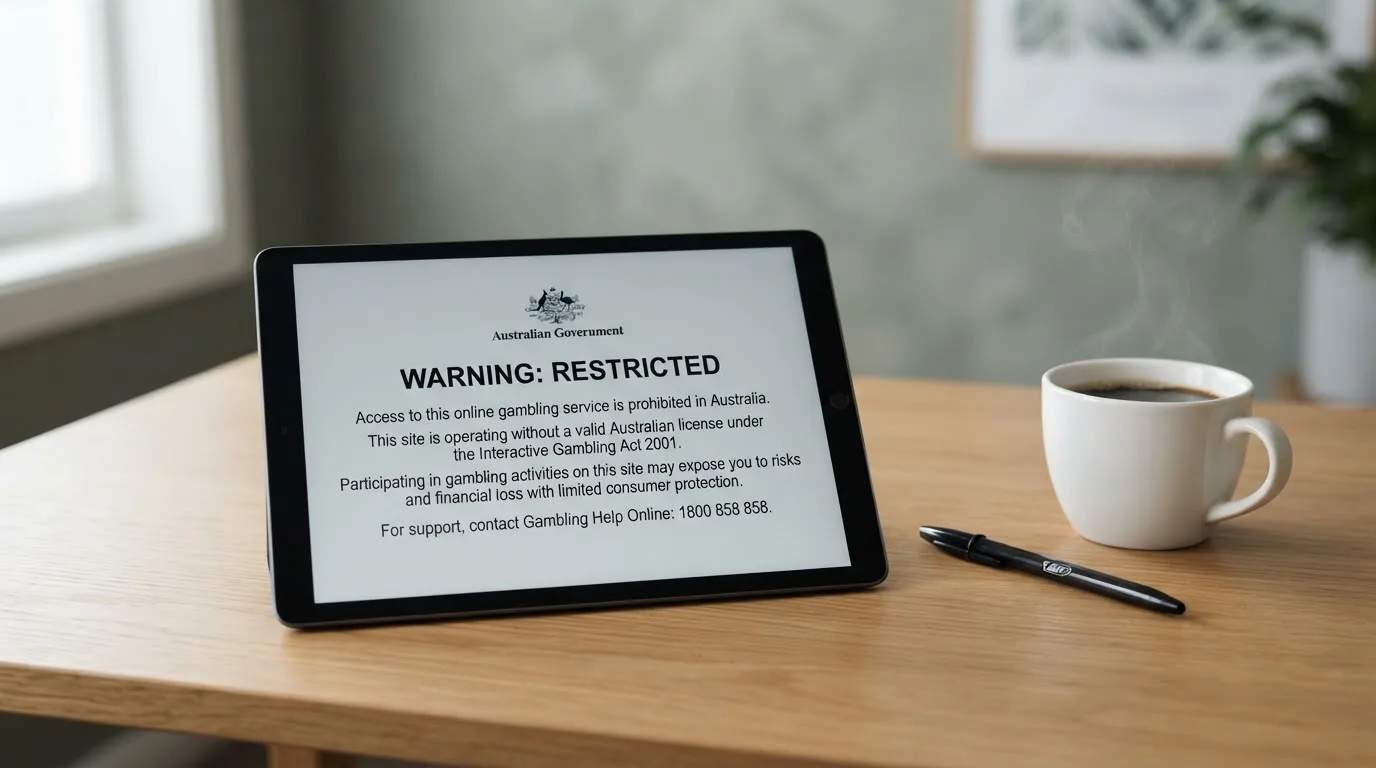
By June 2026 the cumulative tally stood at 1,751 illegal gambling and affiliate marketing websites blocked since the first blocking request went out in November 2019, with more than 230 unlicensed services having withdrawn from the Australian market entirely since 2017. The most recent round, also reported in June 2026, asked ISPs to block twelve more domains in a single pass: 7Signs, ChromaBet, Donbet, Duospin, Freshbet, Slots Gem, Jacks Club, Lucky Start, Pointsbetz, Spinrise, Vinyl Casino and Wildsino. None of those names sits on the comparison table above — they are the next wave rather than the legacy one — but they tell the reader how active the cutting edge of enforcement is.
A blocked site still has the balances Australians deposited before the block. That is the consequence that does not show up in a press release: an APK installed on a phone is not a deposit the regulator protects, and the consumer-protection machinery Australians rely on for licensed wagering simply does not exist on the offshore side of the line.
See also Real Money Pokies Australia App in 2026.
The legal ground an Australian is actually standing on
The Interactive Gambling Act 2001 was the original instrument; the Interactive Gambling Amendment Act 2017 is what made it bite. The amended Act makes it an offence to provide online casino games, online pokies or in-play betting to a person physically in Australia. The prohibition is on the provider — the offshore operator — not on the individual punter, who is not prosecuted for opening the app. But the practical effect on the punter is the whole point: there is no Australian licence being advertised by any brand in the comparison above, because none can be issued.
What can be licensed is wagering on races and sport placed before the event, lotteries and keno. The bulk of that licensed online activity is regulated by the Northern Territory Racing and Wagering Commission, which oversees 52 of Australia’s online bookmakers — Sportsbet, Bet365 and Ladbrokes among them — and which has no full-time staff, meeting once a month in Darwin. The reason is largely tax: Northern Territory licensing has historically been cheaper for the operators, and the arrangement has survived multiple federal reviews. None of those bookmakers offers an online pokie, which is the point.
The next instrument the punter will meet is the ACMA itself. The Authority investigates complaints, issues formal warnings, and directs ISPs to block illegal domains. It is not the punter’s complaint handler — that role belongs to gambling.help or to the National Gambling Helpline on 1800 858 858 — and offshore disputes are not within its remit.
The third instrument is the Interactive Gambling Amendment (Gambling Reform) Bill 2026, which passed Parliament on 19 August 2026. Its advertising and inducement measures commence on 1 January 2027. For a 2026 reader that is law enacted but not yet in force, and any operator pushing inducements in the meantime is operating in the window the new rules will close. The page reads as if the reform had not yet landed because, for 2026, it had not yet commenced.
Payments: what an Australian can hand over to a licensed operator, and what an offshore app quietly asks for
The legal deposit routes for licensed online wagering are debit card, bank transfer, PayID and Osko (the near-instant overlay on Australia’s New Payments Platform) and BPAY. Credit cards, credit-related products and digital currency have been banned as payment for licensed online wagering since 11 June 2024; penalties for an operator accepting them run to A$247,500. The rule is part of the licensed-wagering regime, not the prohibition, which means an offshore pokie app is not bound by it. The practical tell: a site asking an Australian punter for a credit card or for a crypto deposit is advertising the fact that it sits outside the licensed regime. There is no other reason an app would prefer it.
What happens to balances once a site is blocked
A blocked domain does not refund the balances it held. The April 2026 warning over Jackbit and CasinOK is the most recent example in the file: the formal warning was issued to Ryker B.V. on those two brands in the same letter. By the time the next round of blocking requests is processed, the customers behind those balances have no Australian complaints route, no Australian ombudsman, no Australian small-claims body with jurisdiction over an entity registered in Curaçao. The balance is a figure on an offshore screen, not a debt enforceable under Australian consumer law.
That is the single sharpest reason the comparison above is not framed as a ranking. A ranking implies the customer can collect on it.
The arithmetic the regulator’s file actually shows
The blocking figure is the easiest to compute. The first ACMA blocking request went out in November 2019, and by June 2026 the cumulative count of blocked illegal gambling and affiliate marketing websites stood at 1,751. That is 1,751 domains across roughly eighty months, or an average of around twenty-two per month — with the headline figure reported by iGaming Business noting that 230-odd services have withdrawn from the Australian market entirely since 2017 rather than face a block. The exact rate varies sharply round by round: the June 2026 round alone cleared twelve sites. State the result as a band: between the first request in November 2019 and June 2026, the ACMA’s blocking programme has cleared 1,751 sites at a sustained pace of roughly twenty per month, with monthly throughput rising as the regulator’s blocking infrastructure matured. The single-site count tells the reader less than the rate does, because the rate is what determines whether a freshly-installed APK is likely to be reachable in a year’s time.
The arithmetic also exposes the size of the demand that drives the supply. H2 Gambling Capital’s 2025 report estimates that Australians lose about A$3.9 billion a year to illegal gambling sites, and that the share of gambling going through legal channels fell from 74% in 2021 to 64%. That is not a market the regulator is catching up with. It is a market that, on the authority’s own measurement, has been growing faster than the law.
What an offshore real money pokies app typically asks an Android phone for
The marketing word that does most of the work here is “app.” Three things get bundled under that one word by the offshore sites this page is about, and they have very different properties on an Android handset.
The first is a mobile web page rendered as an “Add to Home Screen” PWA. Nothing is installed at the OS level; the punter bookmarks a URL and the browser stores the icon. Permissions are those of the browser. This is the cleanest option on the list and the one the operator is least interested in shipping, because it does not survive a domain block.
The second is a sideloaded Android package — an APK the punter downloads directly from the operator’s site, sidesteps Google Play’s screening, and installs by enabling “Install unknown apps.” This is the bulk of what an offshore pokie market actually sells. The phone will prompt the punter to grant storage access, network access, sometimes overlay permission and “display over other apps.” Those permissions are how a casino app persists when the operator’s domain is on the blocked list — the APK pings home from a different endpoint.
The third is a wrapper that hosts a browser engine pointed at the same site. Permissions are essentially browser-level, plus optional push notifications. The wrapper survives a domain block only when the URL it loads is also rotated; the operator generally does.
The Google Play Store, by contrast, refuses all three shapes for an Australian punter. The Play Store’s policies on real-money gambling apps treat Australia as a restricted market, and the storefront will not list an app whose declared use is real-money casino play for an Australian account. Sideloading — option two — is therefore the only way an Australian gets a real money pokies app onto a stock Android phone for the offshore brands in this comparison.
Why an operator prefers the APK over the browser tab
Three reasons and they compound. An APK survives a domain block better than a bookmark does, because the punter can update the endpoint inside the app without re-installing. An APK carries push notifications, which is the channel every operator wants for retention. An APK asks for permissions the browser tab would not — overlay, autostart, accessibility — and some of those permissions materially expand what the app can do on the phone. None of these are benefits to the punter; they are benefits to the operator. The “download for Android” button is not a convenience. It is a moat.
What to check before an APK gets near the phone
There are six checks that matter, and only one of them has anything to do with the operator.
First: the ACMA’s formal warning register. Every brand in the comparison above is on it. A new brand not on it may simply be too new to have attracted the regulator’s attention; that is a worse reason to trust it than a worse reason to distrust a named one.
Second: the IGA’s plain rule. Online casino games and online pokies cannot be licensed in Australia. If the operator’s site shows a Curaçao or Anjouan number as its licence, that licence is not enforceable from Australia; it is a statement about the operator’s home jurisdiction only.
Third: the payment route. Credit cards, credit-related products and digital currency are banned as payment for licensed Australian wagering. An offshore app asking for either is telling the punter, in code, that it is not a licensed Australian product.
Fourth: the domain block list. The 1,751 cumulative count includes many of the bigger names. The current list is at acma.gov.au; a site on the list is a site the punter will not be able to reach without a workaround.
Fifth: the withdrawal method. Offshore operators generally do not publish a published withdrawal SLA; deposits are instant, withdrawals are not. The casino review pages that quote a payout time are not always quoting the same casino in the same configuration a year later.
Sixth: the permissions list at install. If the APK asks for accessibility, overlay, or device-admin, those are the permissions that let an app survive a block. They are also the permissions that let an app do things the punter did not agree to.
A reader who runs through those six checks before installing will reject most of the brands in the comparison table above on the first check alone.
The responsibility side of the page
This page is written for Australians, and the offshore market it describes is the only market most Australian pokies players have access to through their phone. That is the reason the responsible-gaming section exists.
The licensed protections Australians rely on are licensed-wagering protections. BetStop — the National Self-Exclusion Register, live since August 2023 — binds Australian-licensed online and phone wagering services to honour a customer’s request not to be marketed to or to have an account opened. It does not bind an offshore casino. A self-excluded Australian punter who opens an account with one of the eleven brands above has not self-excluded at all. They have just shifted the venue.
The National Gambling Helpline — 1800 858 858 — is free, available 24/7, and connects the caller to Gambling Help Online, which offers chat. That is the channel an Australian punter should use before opening any account, licensed or not, with any operator on this page. It is also the channel for a punter who has already opened one and wants out.
The licensed land-based pokie — the machine in the pub or club that the A$12.18 billion in losses for 2020-21 was spent on — sits outside this page’s subject. Australia has about 3% of the world’s pub and club poker machines with 0.3% of the global population; that is the comparator the offshore market would prefer the reader not to see. New South Wales alone had 87,298 gaming machines outside casinos across 2,195 venues in June 2023, with player losses of A$8.18 billion the year before. Queensland had 21,122 machines across 351 venues in October 2023. Victoria had 26,380 outside Crown Casino under a 30,000 statewide cap. Western Australia, uniquely, kept poker machines out of pubs and clubs entirely in 1985 when Crown Perth opened; Crown Perth’s own machine floor grew from around 200 in 1985 to roughly 2,500 today.
The legal minimum return-to-player on those licensed machines varies by jurisdiction: 85% in New South Wales, the Northern Territory, Queensland and most of Victoria (87% at Crown Melbourne), 87% in the ACT and Tasmania, 87.5% in South Australia, and 90% in Western Australia. The minimums are the floor the regulator enforces; an offshore pokie has no comparable floor. The licensed-versus-unlicensed comparison is therefore not about the title — the offshore product can be the same software as the licensed product, often sourced from the same studio — but about the contract. There is no contract on the offshore side.
The land-based comparison that frames the phone market
A punter comparing a licensed pub machine to an offshore app is not choosing between two machines; they are choosing between two markets. The licensed machine is part of a regulated system: the venue holds a licence, the machine is built to a published RTP floor, the venue offers self-exclusion pathways that the regulator audits, and the winnings — such as they are — are paid in cash on the spot. The offshore app is part of an unregulated one: the operator holds a licence somewhere, the RTP is whatever the studio certifies, self-exclusion is at the operator’s discretion, and the winnings are paid whenever the operator decides, in whatever currency they decide, to whatever endpoint they decide. The marketing word for both is “pokies.” The contracts are not comparable.
The licensed market also carries a tax point worth stating once and only once: gambling winnings of a recreational player are not assessable income under section 6-5 of the ITAA 1997, and losses are not deductible. That rule applies whether the winnings came from a pub machine, a lottery, or — for the offshore app — a Curaçao-licensed casino. The model is the same; the consumer protection is not.
Real money pokies apps on Android for Australian players — More on this topic at casino safety.
What the eleven brands actually offer, and what the ACMA file actually says about each
The eleven write-ups below carry only what the ACMA file, the formal warning, and the operator’s own public presence establish. None is a recommendation. None prints a bonus, a promo code, or a voucher — none was supplied, and any such figure in the affiliate marketing pages this market is built on is unreliable in a way the ACMA’s formal warning register is not.
RocketPlay
The brand has been on the ACMA’s file twice. The first formal warning was issued to Dama N.V. in May 2022, naming RocketPlay alongside Bambet, Dazard, Level Up, Wild Tornado and Cobra Casinos. A second formal warning, published in March 2026, was issued to Pulsup Ltd over RocketPlay specifically — a separate corporate wrapper for the same consumer-facing product. Online casino games cannot be licensed anywhere in Australia, and the .com.au domain that was the subject of the second warning is not a thing a licensed operator would have needed. The verdict: RocketPlay is the case study for how the same product gets re-warned under a new operator name when the old one becomes unworkable, and the ACMA’s file shows both ends of that cycle.
Level Up Casino
The May 2022 Dama N.V. warning covered Level Up alongside the other Dama brands listed above. Level Up has appeared on the listings pages of BGaming, the studio whose games the casino hosts — that is the only “subject support” the file carries for the brand, and it does not affect the warning. The verdict: Level Up is a Dama N.V. brand of the same vintage as RocketPlay’s first warning, and a reader who treats the 2022 warning as historical should know the warning was never lifted; it is the regulator’s standing record.
Woo Casino
The formal warning over Woo Casino was issued to Dama N.V. in March 2025 — three years after the original Dama round, which had named different brands in the same corporate family. The gap between the warnings is itself useful information: it tells the reader that the ACMA’s process is slow enough that a brand can run for three years under one name before catching a second letter. The verdict: Woo Casino is the case where the warning is recent, the corporate parent is the same as half the table, and the time between the warnings is what an offshore operator is buying when it stays one step ahead of the regulator.
Spirit Casino
The May 2025 formal warning to Dama N.V. over Spirit Casino came two months after the Woo Casino warning. That makes Spirit Casino the most recent Dama N.V. brand on the table. The pattern is consistent enough to be worth stating: a single Curaçao vehicle, multiple consumer-facing brands, separate formal warnings for each. The verdict: Spirit Casino’s recency is the relevant fact for the punter; the parent is the same as Woo’s, the regulator’s view is the same, and the marketing slot on the Google search page is the only thing that changed.
National Casino
The July 2025 formal warning was issued to Consolutetish S.R.L. over National Casino and Bizzo Casino together — a single letter, two brands, one operator. National Casino also appears on the public Wikipedia listings for the brand, which is what the file’s “subject support” entry records. The verdict: National Casino is one half of a two-brand warning; reading the Bizzo entry alongside it tells the reader more about the operator than reading either in isolation.
Bizzo Casino
Bizzo’s file is the longest in the comparison. The July 2025 formal warning was issued to Consolutetish S.R.L. — alongside National Casino — but the brand had previously been the subject of a 2022 formal warning to TechSolutions (CY) Group Limited and TechSolutions Group N.V. The same product, two operators, three years apart. The verdict: Bizzo is the brand with the most regulator history on the table, and the recurrence is the case study for the “new operator, same product” cycle the ACMA’s enforcement is built around.
Ignition Casino
The July 2025 formal warning to Bamboo Media over Ignition Casino is the only ACMA entry the file carries for this brand. Ignition is unusual in the set in that the operator’s name is shorter than the brand’s — the casino is itself the consumer-facing front rather than one of several — but the legal position is identical to the rest of the table. The verdict: Ignition Casino is the cleanest “single brand, single warning” case in the comparison; the reader should treat the warning as current and the operator’s continued presence in Australia as a problem for the operator, not as evidence the regulator has changed its mind.
Instant Casino
The February 2025 formal warning to EOD Code SRL over Instant Casino is one of the older warnings in the current cycle. It predates the Woo, Spirit, Ignition and National/Bizzo rounds. The verdict: Instant Casino is the brand on the table with the longest stretch of regulator attention without a formal name change, and the punter reading the file chronologically will meet Instant Casino first because of that.
Jackbit
The April 2026 formal warning to Ryker B.V. named Jackbit and CasinOK in the same letter. Jackbit is the most recent brand on the table tied to a single-operator warning. The verdict: Jackbit is the case where the warning is fresh and the operator is small enough that the formal letter was sent under one corporate name rather than a network; the punter reading the file should not treat “small operator” as a softener for “ACMA warning.”
Casino Intense
The April 2025 formal warning to Sterplay Holding Ltd over Casino Intense sits alongside the file’s note that Casino Intense appears in the listings on ABC, ACMA, and Crown Melbourne. The listing references are a smaller and quieter part of the file than the warning itself; the warning is the regulator’s position. The verdict: Casino Intense is the brand with the most external references in the file outside the regulator’s own register, and the reader should weigh those references against the warning rather than as evidence the warning has been withdrawn.
Sky Crown
The formal warning to Hollycorn N.V. over Sky Crown and Blue Leo is the oldest in the comparison — September 2022 — and is the brand that opens the ACMA’s most recent cycle of formal warnings. Hollycorn N.V. is the operator; Sky Crown and Blue Leo are the consumer-facing fronts. The verdict: Sky Crown is the entry-point brand for the ACMA’s 2022-2026 cycle, and the pattern that follows it down the table — multiple consumer brands, one operator, repeated warnings — starts here.
The wider market the ACMA’s blocking file describes
The eleven brands above are the brands the ACMA has taken the time to formally warn. They are not the only brands advertising real money pokies to Australians on Android. The June 2026 blocking round alone named twelve more — 7Signs, ChromaBet, Donbet, Duospin, Freshbet, Slots Gem, Jacks Club, Lucky Start, Pointsbetz, Spinrise, Vinyl Casino and Wildsino — none of which has yet graduated to a formal warning but all of which the regulator has asked ISPs to block from Australian endpoints.
The list of 1,751 blocked sites since November 2019 is the longer arc. It includes affiliate marketing pages and reseller domains, not only the consumer-facing casinos themselves, because the ACMA’s blocking requests have come to cover the marketing funnel as well as the product. That is why the cumulative count grew faster than the count of consumer brands would suggest. The punter searching Google for “real money pokies app Android Australia” is most often reaching one of those affiliate domains first, and the regulator’s view is that an affiliate referring Australians to a prohibited service is also part of the prohibited service.
The H2 Gambling Capital estimate — A$3.9 billion a year to illegal gambling sites, with the legal share of gambling falling from 74% in 2021 to 64% — describes a market that is large, growing, and structurally offshore. It also describes a market where most of the consumer loss is on the casino-product side rather than the wagering-product side; the licensed Australian wagering market is regulated and ringfenced, and the offshore market is what Australians have moved into when they wanted a product the licensed market does not sell.
The reform that will change that picture is the Interactive Gambling Amendment (Gambling Reform) Bill 2026, which passed Parliament on 19 August 2026. Its advertising and inducement measures commence on 1 January 2027; for 2026, that is law enacted but not yet in force. By the time it commences, the marketing surface for the brands in the comparison table above will narrow — affiliate marketing of prohibited services, inducements targeted at Australians, and several other pathways currently exploited by the offshore market will become civilly enforceable in their own right. That is a forward-looking point worth keeping: the comparison above is a snapshot of the market as it is operating now, not as the regulator expects it to operate from 1 January 2027.
Picking an option from what is on the table
The framing this page opens with is a choice, and the choice is not between the eleven brands above. It is between three positions an Australian punter can take.
The first position is the licensed position. The licensed Australian online market sells wagering on races and sport placed before the event, lotteries and keno. It does not sell online pokies. If the punter wants a real-money pokie on an Android phone through a licensed Australian channel, there is no such channel, and there cannot be — the Interactive Gambling Act 2001 prohibits the licence. The licensed position is honest about what the law does and does not let an Australian buy.
The second position is the unlicensed offshore position. It is the eleven brands above and the thousand-plus blocking-round sites that flank them. The product is real-money pokies on an Android phone; the contract is whatever the operator chooses to publish, change, or withdraw without notice. The regulator will block the site when it gets around to it; the punter’s balance at the moment of the block is what the punter walks away with.
The third position is no position. The punter who would otherwise have opened an offshore app uses the National Gambling Helpline (1800 858 858, 24/7, free) or Gambling Help Online before opening anything. BetStop — the National Self-Exclusion Register — binds Australian-licensed services, not offshore ones, but the helpline’s role is to talk the punter out of opening either.
The recommendation this page does not give — but the choice it does offer — is to take one of those three positions deliberately. The punter who lands on an APK by accident, who treats the marketing word “app” as a sign of legitimacy, who hands over a credit card or a crypto deposit because the app asked for it, and who reads the ACMA’s blocking round as something that happens to other people, has not made the choice. The choice is what the comparison table is for.
Frequently asked questions
Can a real money pokies app actually be downloaded through the Google Play Store in Australia?
No. Google Play treats Australia as a restricted market for real-money gambling apps and does not list apps whose declared purpose is real-money casino play for an Australian account. The Play Store will host free-play pokies and demo apps, but a real-money pokie app for an Australian punter is not on the storefront.
Is sideloading a real money pokies APK onto an Android phone something Australians can legally do?
The Interactive Gambling Act 2001 prohibits the provider of an online casino service, not the individual punter. The punter is not prosecuted for installing an APK. That is not the same as legal protection: an offshore operator is not licensed in Australia, the balance is not protected by Australian consumer law, and the site may be blocked by Australian ISPs at any time.
How does a free Aristocrat-style pokies app differ from one that claims real-money play?
A free Aristocrat-style app is a demo product: no money changes hands, no wager is real, no win is paid. A real-money pokie app accepts a deposit, lets the punter wager on a casino game, and pays (or refuses to pay) a withdrawal. The two products sit in different regulatory universes, and the same studio can produce both for different markets.
What permissions does a real money pokies app typically ask for on an Android phone?
A sideloaded pokie APK typically requests network access, storage access, and — for the apps built to survive a domain block — overlay permission, autostart, and sometimes accessibility. Those last three are the permissions that let the app reach back to the operator from a different endpoint once the original domain is blocked. A reader who values those permissions can decline them at install; the app may then refuse to launch.
Why would an app be advertised as “download for Android” rather than just playable in a browser?
Three reasons, none of them for the punter’s benefit. An APK survives a domain block better than a browser bookmark does. Push notifications are a retention channel the browser cannot match. And several of the permissions the APK can request materially expand what the app can do on the phone after the original domain is gone. The “download for Android” button is not a convenience offer.
What should someone check before trusting an app’s claim to pay real money on Android?
Six checks matter. First: the ACMA’s formal warning register at acma.gov.au — every brand in the comparison above is on it. Second: the IGA’s rule that online casino games and online pokies cannot be licensed in Australia, whatever offshore licence the operator displays. Third: the payment route — an offshore app asking for a credit card or crypto is advertising that it sits outside the licensed regime. Fourth: the ACMA’s domain block list, which is the most current view of what Australian ISPs cannot reach. Fifth: the operator’s published withdrawal method and any withdrawal SLA the operator actually publishes. Sixth: the install-time permissions list, which tells the punter how the app intends to persist.